Newsletter
Suscríbete a nuestro Newsletter y entérate de las últimas novedades.
https://centrocompetencia.com/wp-content/themes/Ceco
volver
La teoría económica clásica predice que en un sistema económico perfectamente competitivo y sin intervención directa del gobierno, las acciones individuales de las personas y empresas que buscan su propio interés personal contribuyen de manera inadvertida al bienestar general de la sociedad. Según esta línea de pensamiento, una economía de mercado debería, por sí sola, asignar los recursos disponibles de manera eficiente, consiguiendo lo que se conoce como “equilibrio competitivo”.
Las fallas de mercado se definen como circunstancias o factores que impiden que los mercados asignen los recursos de forma eficiente, desafiando los supuestos que subyacen al equilibro competitivo, como la competencia perfecta, ausencia de externalidades o información perfecta.
En lo que sigue, revisamos las principales categorías de fallas de mercado: (i) externalidades, (ii) bienes públicos y recursos comunes, (iii) poder de mercado e (iv) información asimétrica.
Una externalidad ocurre cuando las decisiones de compra y venta de un producto o servicio afectan el bienestar de un tercero, al que no se le paga ni compensa por dicho efecto (Mankiw, 2012). En estos casos, los precios de mercado no reflejan los efectos secundarios asociados a la producción o consumo de estos bienes, de forma que el equilibrio competitivo no es eficiente para la sociedad en su conjunto.
La externalidad negativa se refiere a situaciones donde una actividad económica reduce el bienestar de individuos que no forman parte del mercado, sin que estos se vean compensados por el daño que reciben. Este tipo de externalidades puede derivarse tanto de la producción como del consumo de un bien o servicio.
Por ejemplo, una fábrica que emite contaminantes al aire o al agua como parte de su proceso de producción, afecta la salud de la población que vive en las cercanías. Si el productor toma sus decisiones basándose únicamente en el costo de producción directo que enfrenta (costo privado de la empresa), y las oportunidades de ingreso que posee —ignorando el costo social de la contaminación—, el equilibrio de mercado será incapaz de maximizar el beneficio total para la sociedad. Similarmente, pero desde el lado del consumo, cuando una persona fuma un cigarrillo, no solo pone en riesgo su propia salud, sino también la de quienes lo rodean e inhalan el humo liberado por esta (fumadores pasivos).
Gráficamente, el equilibrio de un mercado con externalidades negativas en la producción asume la siguiente forma:
Gráfico N°1: Equilibrio de mercado con externalidades negativas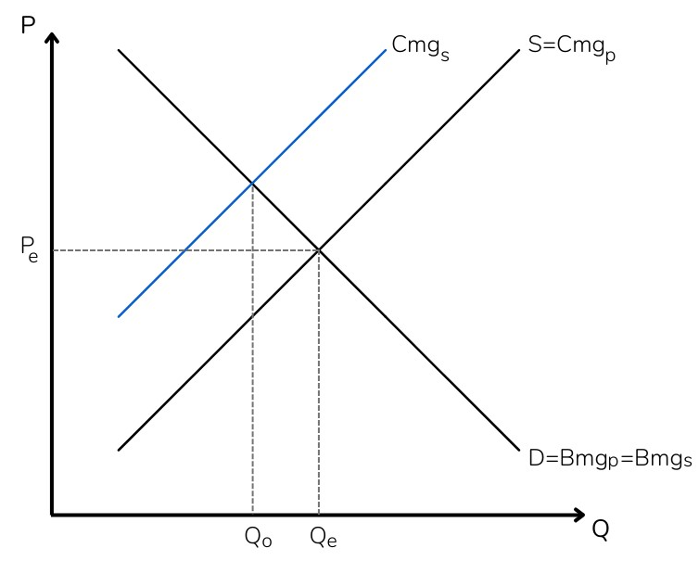
Elaboración propia
En este contexto, el costo marginal social (“Cmg_{s}” en el Grafico N°1), definido como el costo en que incurre la sociedad por la producción de una unidad adicional del bien, es mayor que el costo marginal privado (“Cmg_{p}”), definido como el costo que tiene para los productores fabricar una unidad adicional del bien (oferta agregada del mercado en cuestión).
Esta diferencia entre el costo marginal social y privado se debe a que los productores no internalizan el impacto negativo que tiene su producción sobre el resto de la población. En cambio, si estos efectos fueran considerados, los costos aumentarían, generando que la cantidad producida disminuya y alcance el nivel socialmente óptimo (“Q_{o}”), que es menor que la cantidad del equilibrio competitivo (donde solo se consideran los costos privados de la empresa), “Q_{e}”. Esta lógica es análoga en los casos en que se producen externalidades negativas en el consumo (se consume más de lo socialmente óptimo).
Las externalidades positivas, a diferencia del caso anterior, se producen cuando la elaboración o comercialización de un bien o servicio aumenta el bienestar de terceros, sin que estos deban pagar por tal beneficio. Nuevamente, estas pueden derivarse tanto de la producción como del consumo de un producto.
Supongamos, por ejemplo, que una firma destina recursos económicos para la investigación y desarrollo de nuevos productos. Cuando eso ocurre, la empresa tiene el potencial de fomentar una mayor competencia y elevar la calidad de vida de las personas, al proporcionar soluciones más efectivas y cómodas. Es decir, los beneficios pueden extenderse más allá de la empresa. Bajo los mismos términos, cuando una persona se educa, aumenta su productividad y puede optar a salarios más altos. Además de estos beneficios privados, el resto de la sociedad también se ve favorecida por contar con un ciudadano más informado y productivo.
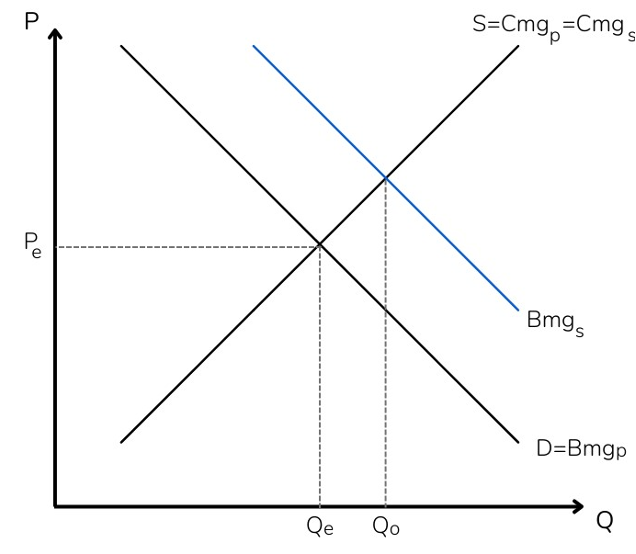
Gráficamente, el equilibrio de un mercado con externalidades positivas en el consumo asume la siguiente forma:
Gráfico N°2: Equilibrio de mercado con externalidades positivas
Elaboración propia
En este caso, el beneficio marginal social (“Bmg_{s}” en el Grafico N°2), entendido como el beneficio que obtiene la sociedad por una unidad adicional del bien, es mayor que el beneficio marginal privado (“Bmg_{p}”), correspondiente al beneficio que obtiene el consumidor por este concepto (demanda agregada del mercado en cuestión).
La diferencia entre el beneficio marginal social y privado se produce porque los consumidores no internalizan el beneficio que genera su consumo en las demás personas (solo toman en cuenta el beneficio privado que les reporta este consumo). De no ser ese el caso, la cantidad consumida aumentaría, alcanzando el nivel socialmente óptimo (“Q_{o}”), que es mayor que la cantidad del equilibrio competitivo, “Q_{e}”. Los resultados son análogos para los casos en que se generan externalidades positivas en la producción (se produce menos que lo socialmente óptimo).
Como vimos, en ausencia de regulaciones o políticas públicas que permitan que los agentes internalicen los efectos de sus acciones sobre terceros, las externalidades conducen a asignaciones de mercado ineficientes, ya sea porque se produce o consume más de lo socialmente óptimo (externalidad negativa), o menos (externalidad positiva).
A grandes rasgos, existen dos tipos de soluciones para abordar estas problemáticas y reestablecer una mayor eficiencia económica: soluciones públicas y soluciones privadas.
Las soluciones públicas son aquellas medidas implementadas por gobiernos u otras instituciones reguladoras. Siguiendo a Samuelson (2009), este tipo de soluciones puede clasificarse en dos dimensiones: directas o indirectas.
Los controles directos se refieren a aquellas intervenciones explícitas del gobierno o las instituciones públicas, con el fin de regular un mercado y así corregir una externalidad determinada. Un ejemplo de esto es una ley que establece niveles máximos de emisión de contaminantes para una industria, buscando ajustarse a los índices socialmente óptimos de producción.
Los controles indirectos, en cambio, tienen un enfoque basado en soluciones de mercado. Así, por ejemplo, la autoridad puede establecer impuestos o subsidios correctivos, con el fin de alinear los incentivos privados con los niveles socialmente óptimos. En otras palabras, un impuesto correctivo impone un costo monetario a la generación de una externalidad negativa, forzando al agente a incorporarlo en su actividad; en cambio, el subsidio correctivo premia la generación de externalidades positivas, impulsando a los agentes a producirlas en mayor medida.
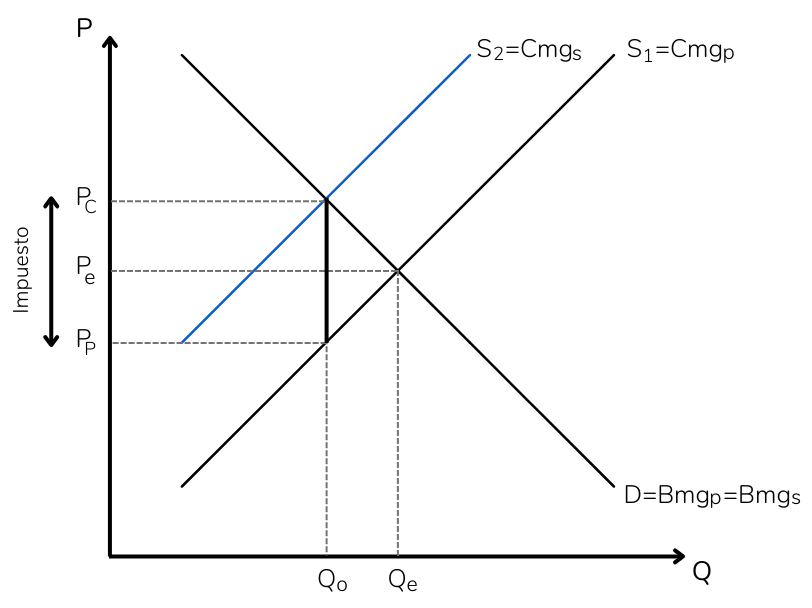
En concreto, en un equilibrio de mercado con externalidades negativas en la producción, como el ilustrado en el Gráfico N°1, se puede aplicar un impuesto correctivo de la siguiente manera:
Gráfico N°3: Aplicación de un impuesto correctivo
Elaboración propia
Este impuesto implementa un cobro monetario proporcional a la cantidad producida, con la finalidad de que el productor internalice el costo social que genera su producción. Como resultado, para todos los niveles de producción (valores del eje horizontal), los costos productivos que enfrenta la empresa aumentan. Con esto, la oferta relevante que enfrenta el productor ya no es “Cmg_{p}”, sino “Cmg_{s}” (Gráfico N°3).
Bajo esta nueva estructura de costos, el productor optimiza su producción igualando su nueva curva de oferta (“S_{2}”) con la demanda (“D”), alcanzando un nuevo equilibrio de mercado. Justamente, la idea es que el monto del impuesto correctivo haga que, bajo la nueva curva de oferta, el productor maximice su utilidad en el mismo nivel donde se maximiza el bienestar social (“Q_{o}”). Esto es lo que se conoce como “impuesto correctivo óptimo”.
En el Grafico N°3, el valor de este impuesto (bajo los cuales se produce la cantidad socialmente óptima) corresponde a la diferencia entre dos precios: el precio que cobra el productor cuando internaliza la externalidad (“P_{C}”), y el precio que cobraría por producir la cantidad socialmente óptima (“Q_{o}”) en ausencia del impuesto (“P_{P}”). Este tipo de impuestos son conocidos como impuestos pigouvianos, en honor al economista británico Arthur Pigou, quien desarrolló por primera vez este método para el control de externalidades en la década de 1920 (Parkin, 2009).
La lógica para un subsidio correctivo en un mercado con externalidades positivas es análoga al impuesto correctivo, con la diferencia de que, en este caso, el monto subsidiado es aquel que reduce los costos productivos de la empresa en un monto tal que haga que esta aumente su producción hasta alcanzar el nivel socialmente óptimo. En ambos casos, los incentivos económicos de los mismos agentes son los que permiten que el equilibrio competitivo “privado” se iguale al equilibrio socialmente óptimo.
Otras medidas económicas, como la implementación de permisos de contaminación negociables, pueden entregar resultados similares.
Aun sin intervención gubernamental o regulatoria, los efectos de algunas externalidades pueden ser contrarrestados mediante las acciones tomadas por individuos y empresas. Estas medidas son las que se conocen como soluciones privadas.
Por un lado, las sanciones sociales y códigos morales pueden acercar el comportamiento privado al óptimo social (Mankiw, 2012). Las personas evitan realizar ciertas prácticas nocivas, como arrojar basura en espacios públicos, por empatía hacia las demás personas o debido a la mala reputación que generan dichas acciones. Similarmente, algunas empresas pueden comprometerse con causas sociales, como el cuidado del medio ambiente, para generar una buena imagen y evitar las críticas de la comunidad.
De forma similar, las normas de responsabilidad legal hacen que los agentes sean más conscientes de los efectos secundarios asociados a sus patrones de consumo o producción. Por ejemplo, en la mayoría de las legislaciones, cuando una persona resulta herida o enferma por el uso de un producto defectuoso, la empresa fabricante debe responder legalmente por los daños causados. Esto provoca que la firma internalice la externalidad y tome en cuenta algunos de los costos sociales de su producción.
Una generalización de este tipo de soluciones es el Teorema de Coase, propuesto por el economista británico Ronald Coase en 1960, que postula que las partes involucradas en una externalidad pueden llegar a una solución eficiente sin necesidad de intervención gubernamental, bajo ciertas condiciones. En particular, que los derechos de propiedad estén bien definidos, los costos de transacción sean bajos y las partes afectadas sean pocas. A pesar de la base conceptual valiosa que provee, el Teorema de Coase es difícil de aplicar en la práctica, debido a los múltiples supuestos que involucra.
Para entender los conceptos de bienes públicos y recursos comunes, es necesario comprender dos conceptos esenciales: rivalidad y exclusión.
Siguiendo a Parkin (2009), un bien es rival si el uso que una persona hace de este disminuye la cantidad disponible para alguien más. A su vez, un bien es excluyente cuando solo pueden disfrutar de sus beneficios quienes pagan por él; es decir, cuando se puede impedir que una persona use el bien.
Estas dos propiedades (rivalidad y exclusión) dan lugar a cuatro tipos de bienes: bienes privados, bienes club, recursos comunes y bienes públicos.
Tabla N°1: Tipos de bienes
Rival No rival
Excluyente Bienes Privados Bienes Club
No excluyente Recursos Comunes Bienes Públicos
Fuente: Elaboración propia
Los bienes privados son aquellos que se caracterizan por ser tanto excluyentes como rivales. Estos son los típicos bienes y servicios de los mercados tradicionales, como los alimentos, automóviles y artículos de vestuario. Así, por ejemplo, cuando una persona compra un helado, reduce el número de helados disponibles para la venta. Al mismo tiempo, solo la persona que compra un helado se beneficia de su consumo.
También existen bienes que son excluyentes, pero no rivales, denominados bienes club o reservados. Los suministros de agua y electricidad, los parques privados y la televisión por cable son ejemplos de este tipo de bienes (consumir electricidad no impide que otras personas puedan consumirla, pero cada agente debe pagar para beneficiarse de esta).
Típicamente, este tipo de bienes es provisto por monopolios naturales. En este tipo de industrias, la forma más eficiente de producir un producto —la que minimiza los costos de producción— es cuando una única empresa se encarga de dicho proceso.
En cambio, el mercado presenta problemas para abastecer los mercados de bienes no excluyentes, como bienes públicos y recursos comunes.
Un bien público se caracteriza por ser no excluyente y no rival. Esto implica que todos pueden consumirlo de manera simultánea, y a nadie se le puede impedir que disfrute de sus beneficios. Ejemplos de este tipo de bienes son el alumbrado público, la defensa nacional y los espacios públicos.
Desde el punto de vista de la demanda de estos bienes, los consumidores tienen incentivos para actuar como “parásitos” o “polizones” (en inglés, “free riders”). Un free rider es una persona que puede obtener los beneficios de un bien público sin tener que pagar por él. Esta situación reduce los incentivos de los agentes económicos privados para participar en la provisión de estos bienes (no pueden cobrar por el servicio que prestan). Como resultado, la oferta privada de los bienes públicos es escasa y el equilibrio competitivo es incapaz de entregar la cantidad socialmente óptima de estos bienes, generando una subproducción.
En la práctica, los gobiernos y otras instituciones públicas asumen la labor de suministrar la mayoría de los bienes públicos, a partir del financiamiento que obtienen de impuestos y otras fuentes de ingresos públicos.
Un recurso común es un bien rival y no excluyente: si bien el consumo de una persona reduce la cantidad disponible para otros, a nadie se le puede impedir que use lo que está disponible. Los peces en el océano, las áreas verdes y las calles congestionadas son algunos ejemplos de recursos comunes.
Dado que no se cobra por su consumo, las personas tienden a usar excesivamente este tipo de bienes. La ausencia de incentivos para impedir la sobreexplotación y el agotamiento de los recursos comunes se conoce como la “tragedia de los comunes”. Por estos motivos, como el equilibrio competitivo no asigna los recursos comunes de manera eficiente, se produce una sobreproducción o sobrexplotación.
La corrección de esta falla de mercado requiere la implementación de regulaciones, como el establecimiento de derechos de propiedad o cuotas de producción.
Uno de los principales supuestos del equilibrio competitivo es que existe competencia perfecta entre los productores de un mercado. Como consecuencia, el precio de equilibrio se fija al nivel del costo marginal de las firmas (precio = costo marginal).
Sin embargo, en la práctica, deberíamos esperar que todas las empresas tengan algún grado de poder de mercado, definido como la capacidad de las compañías para subir los precios por encima de sus costos marginales de manera rentable (Comisión Europea, 2002).
El ejercicio de poder de mercado constituye una falla de mercado porque conlleva una pérdida de eficiencia, lo que implica a su vez una pérdida de bienestar social. Cuanto mayor sea el precio fijado, mayor será la pérdida de bienestar causada por el poder de mercado.
La institucionalidad de libre competencia es la encargada de prevenir y controlar el ejercicio del poder de mercado abusivo, así como de garantizar que los mercados sean competitivos.
La información perfecta es otro supuesto recurrente en los modelos económicos clásicos. Este principio asume que todos los participantes del mercado tienen acceso a toda la información relevante sobre los precios, calidad y cantidades de los bienes y servicios transados.
En la vida real, es común que algunos actores dispongan de más información que otros. Esta situación, denominada información asimétrica, puede conducir a resultados de mercado ineficientes, como la subproducción o reducción de la calidad de los productos.
Algunas de las fallas de mercado generadas por la asimetría de información más conocidas son el riesgo moral y la selección adversa.
El riesgo moral es la tendencia de una persona, a quien están monitoreando en forma imperfecta, a comportarse de manera deshonesta o indeseable (Mankiw, 2012). Por otro lado, la selección adversa es la tendencia de una persona a “establecer acuerdos en los que usa su información privada en beneficio propio y en desventaja de la parte menos informada” (Parkin, 2009).
Para ejemplificar estos fenómenos, pensemos en el mercado de seguros automotrices. Un seguro automotriz es un contrato entre una compañía de seguros y el propietario de un vehículo. En caso de que el automóvil sufra un choque, daños o robo, la compañía se compromete a cubrir la totalidad o una parte de las pérdidas financieras asociadas a estos imprevistos.
La asimetría de información en este mercado reside en el hecho de que las personas tienen información más detallada y precisa sobre su propio riesgo de sufrir un accidente automovilístico, en comparación con las compañías de seguros. Estas últimas solo pueden evaluar, imperfectamente, el riesgo de sus potenciales clientes, a través de la revisión de sus historiales de conducción y otros tipos de registros.
Por un lado, el riesgo moral predice que las personas se comportarán de forma más arriesgada tras contratar un seguro, pues saben que no tendrán que asumir todos los costos en caso de un accidente. Esta conducta es indeseable para las compañías de seguros, que esperan un comportamiento razonable por parte de sus clientes.
Por otro lado, la selección adversa indica que las personas con mayor riesgo de sufrir accidentes tienen más incentivos para contratar seguros, en relación con los conductores menos riesgosos. Esto puede conducir a un desequilibrio en la población asegurada, con una mayor proporción de conductores de alto riesgo en el pool de asegurados —lo cual va en clara desventaja de las compañías de seguros, que cuentan con menos información que sus clientes—.
La conjunción de estos fenómenos —una conducta más temeraria y una mayor proporción de clientes riesgosos— puede ocasionar un aumento de los accidentes reportados y, por tanto, un aumento de los costos para las compañías de seguros en el largo plazo. Como resultado, los precios de equilibrio serán más altos que los que existirían en un mercado con información perfecta.
En conclusión, el equilibrio competitivo difiere del óptimo social en un mercado con información asimétrica. Para mitigar estos efectos, se deben adoptar medidas que promuevan una mayor transparencia y monitoreo, así como otras acciones específicas para cada mercado —por ejemplo, la incorporación de deducibles y cláusulas en los contratos de seguros—.
Mankiw, N. G. (2012). Principles of Economics (6th ed.). Harcourt College Publishers.
Parkin, M. (2009). Economics (8th ed.). Addison-Wesley Inc., Reading, Massachusetts.
Samuelson, P. & Nordhaus, W. (2009). Economics (19th ed.).
*Este glosario fue editado el 6 de junio de 2024.