Newsletter
Suscríbete a nuestro Newsletter y entérate de las últimas novedades.
https://centrocompetencia.com/wp-content/themes/Ceco
volver
El término eficiencia tiene varios usos. En el contexto de la organización industrial, el derecho y la política de la competencia, se relaciona con la forma más eficaz de utilizar recursos escasos.
Generalmente se distinguen dos tipos de eficiencia: tecnológica (o técnica) y económica (o asignativa). Una empresa puede ser más eficiente tecnológicamente que otra si logra el mismo nivel de producción con menos insumos físicos. La eficiencia económica surge cuando los insumos se utilizan de tal manera que un determinado nivel de producción se consigue al menor costo posible. Un aumento en la eficiencia ocurre cuando se logra una producción existente o en una escala mayor a un costo menor (OCDE, 1993).
Los economistas generalmente consideran que la competencia estimula a las empresas individuales o los agentes económicos en la búsqueda de la eficiencia. La eficiencia aumenta la probabilidad de supervivencia y éxito empresarial y la probabilidad de que los escasos recursos económicos se utilicen al máximo. A nivel de empresa, la eficiencia surge principalmente a través de economías de escala y alcance y, durante un período más largo, a través del cambio tecnológico y la innovación.
Las fuentes de eficiencia examinadas en el análisis del bienestar económico son estáticas (asignativas y productivas) o dinámicas. Típicamente, la tensión subyacente a la política de competencia es, por un lado, entre eficiencia asignativa versus eficiencia productiva y, por otro lado, entre eficiencia estática versus eficiencia dinámica.
La razón fundamental de las fusiones puede ser la posibilidad de lograr ganancias de eficiencia. Por lo tanto, en ocasiones el análisis de fusiones tendrá que abordar las eficiencias productivas y/o dinámicas de una transacción. Por su parte, las prácticas examinadas como abuso de una posición dominante, aunque potencialmente exclusorias, también pueden tener beneficios de eficiencia (por ejemplo, prácticas de ventas atadas o empaquetamiento).
La competencia es un proceso que fuerza a las empresas a volverse eficientes y ofrecer una mayor variedad de productos y servicios a precios más bajos. La teoría económica enseña que cuando existe suficiente rivalidad y presión competitiva en los mercados, el resultado será que los precios sean estrechamente cercanos a los costos subyacentes, beneficio que está asociado a la eficiencia asignativa y que va en directo beneficio del consumidor.
Por otro lado, el poder de mercado, además de provocar una pérdida de bienestar por permitir que los precios sean demasiado altos, genera otras ineficiencias que tienen que ver con la reducción de costos, impactando la dimensión de la eficiencia productiva. Como veremos a continuación, el poder de mercado provoca una pérdida de eficiencia (y, por lo tanto, de bienestar) asociado a la eficiencia asignativa (precios altos) y a la eficiencia productiva (actividades improductivas).
Analicemos primero por qué el poder de mercado reduce la eficiencia de asignación. Supondremos un escenario en el que el nivel de tecnología (costos) está dado, y que se utiliza la tecnología más eficiente disponible (estos supuestos luego se relajarán al considerar la eficiencia dinámica).
Considérese entonces el caso extremo en el que el poder de mercado es máximo, esto es, la industria está monopolizada por una sola empresa, que cobra el precio de monopolio. En este escenario, el monopolista tiene costos marginales constantes c y se enfrenta a una demanda lineal ( OO’ ). Nos interesa conocer la relación entre precio y cantidad ofrecida. El siguiente gráfico ilustra esa relación para un mercado monopólico:
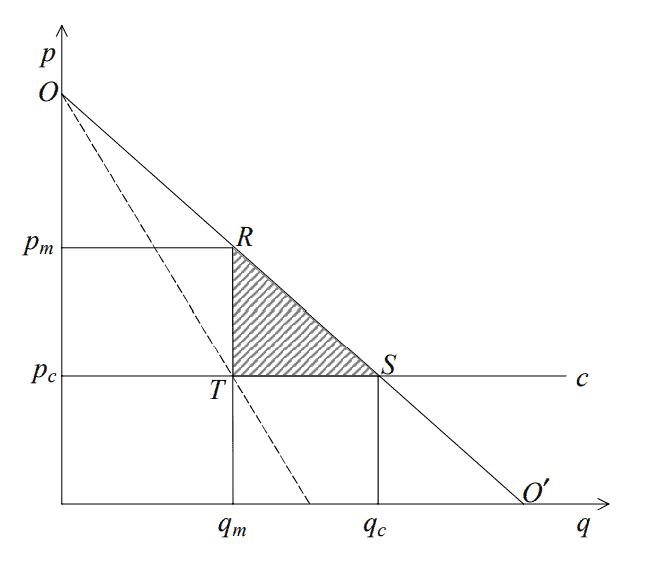
Sabemos que la demanda de mercado ( OO’ ) tiene pendiente negativa (a mayor precio, menor cantidad) y que el bienestar se define como la suma del excedente del consumidor (que es la diferencia entre la disposición a pagar y el precio finalmente pagado) y del productor (la diferencia entre el precio final y los costos incurridos). El gráfico muestra dos escenarios de comparación: (i) el caso de competencia perfecta, donde se ofrece a precio pc y (ii) el caso monopolista, donde se ofrece a precio pm.
En el equilibrio más competitivo, el bienestar viene dado por el triángulo Op_{c}S , correspondiente al excedente del consumidor (las empresas no tienen excedente, ya que los beneficios son iguales a cero). Bajo monopolio, el bienestar viene dado por el área descrita por los puntos Op_{c}TR , siendo la suma del excedente del productor p_{m}p_{c}TR (que esta vez es positivo) y del excedente del consumidor Op_{m}R .
La idea principal detrás de la ineficiencia asignativa provocada por el poder de mercado es la siguiente: cuando los precios están por encima de los costos marginales, esto genera un mayor excedente del productor, pero no lo suficiente como para compensar el menor excedente del consumidor causado por los precios más altos (Motta, 2004).
Hemos visto que un monopolista -o más generalmente, una empresa que disfruta de un gran poder de mercado- cobra un precio demasiado alto tal que conduce a una pérdida de bienestar, lo que se denomina ineficiencia asignativa. Sin embargo, podría haber una pérdida adicional de bienestar, denominada ineficiencia productiva, si una empresa que opera bajo monopolio tiene un costo más alto que si operara en entornos más competitivos.
Bajo monopolio, la empresa tiene poco incentivos para ser más eficiente y escoger las tecnologías que le permitan producir a menores costos. Retomando el gráfico anterior, tenemos que un aumento en los costos del monopolista (la línea recta c ) lleva a una mayor pérdida en el bienestar social que el caso donde sólo ocurría ineficiencia asignativa (Motta, 2004). ¿Por qué sucede esto? Hay dos argumentos principales que sugieren que es probable que un monopolio implique ineficiencia productiva. Primero, los gerentes de una empresa monopolística tienen menos incentivos para hacer un esfuerzo. En segundo lugar, cuando existe competencia, las empresas más eficientes tienden a sobrevivir y prosperar, mientras que las menos eficientes terminan cerrando. Si la industria es de estructura monopólica, el mercado no operará ninguna “selección de los mejores” y es tan probable que una empresa ineficiente sobreviva como una eficiente.
La idea de que la presión competitiva lleva a una empresa a buscar la forma más eficiente de organizar su producción y reducir su costo es muy antigua. Leibenstein (1966) introdujo el concepto de «X-ineficiencia» para reafirmar la idea de que el poder monopolístico -y la «vida tranquila» que lo acompaña- genera ineficiencia gerencial. Como veremos, esta “pereza gerencial” es un argumento que se aplica no solo a la ineficiencia productiva, sino también a la ineficiencia dinámica: la vida tranquila tampoco empuja a los gerentes a innovar.
Hasta ahora se han considerado propiedades estáticas, más que dinámicas, del poder de mercado. Por un lado, el poder de mercado implica una ineficiencia en la asignación, ya que una empresa (para cualquier tecnología dada) cobra un precio demasiado alto. Por otro lado, el poder de mercado implica también una ineficiencia productiva, ya que un monopolista podría no adoptar la tecnología más eficiente disponible.
Es necesario considerar la eficiencia dinámica, que se refiere a la medida en que una empresa introduce nuevos productos o procesos de producción. Si la eficiencia estática estudia si la competencia empuja a las empresas a operar en o más cerca de la actual frontera eficiente de producción, la eficiencia dinámica considera si la competencia las empuja a mover la frontera eficiente de producción más rápido o más lejos.
Un monopolista -o más generalmente, una firma con poder de mercado- podría tener menos incentivos para innovar, agregando así ineficiencia dinámica a la lista de pérdidas de bienestar creadas por firmas con poder de mercado (Motta, 2004). En simple, la intuición es la siguiente: la competencia empuja a las empresas a invertir para mejorar su posición competitiva frente a sus rivales. La ausencia de competencia reduce este incentivo para innovar, y esto a su vez significa que un monopolista será menos eficiente (menos innovador) que las empresas que operan bajo competencia.
Con todo, este ejemplo no puede generalizarse para concluir que, a mayor competencia en un mercado, más probabilidades habrá de que las empresas innoven. Existe un viejo debate en la literatura económica sobre el vínculo entre el poder monopolista y las innovaciones. Este debate se remonta a Schumpeter, quien sugirió que el poder del monopolio fomenta los esfuerzos de investigación y desarrollo. En efecto, los incentivos de las empresas para innovar están determinados no solo por la existencia de competencia sino también por la posibilidad de apropiarse de los resultados de su inversión. Si la competencia es demasiado fuerte, se reduce la apropiabilidad y también el incentivo para invertir e innovar.
Como es poco probable que las empresas realicen inversiones a menos que puedan esperar apropiarse de ellas, entonces la expectativa de poder de mercado tiene un papel importante, ya que ofrece a las empresas incentivos para la innovación y desarrollo.
El equilibrio entre la eficiencia ex ante (se quiere preservar los incentivos de las empresas para innovar) y la eficiencia ex post (una vez que las empresas hayan innovado sería mejor si todas las empresas de la economía tuvieran acceso a esa innovación) está en el centro de políticas públicas de inversión e innovación. Las patentes y otros derechos de propiedad intelectual son una forma permitir la apropiabilidad. Así, una empresa sabe que, durante un cierto período de tiempo, podrá explotar plenamente los resultados de sus innovaciones.
De estas conclusiones se desprende que, si bien el poder de mercado reduce la eficiencia de asignación, es más difícil establecer una relación clara entre el poder de mercado y la eficiencia productiva y dinámica. En muchos casos, la mera existencia de cierto grado de poder de mercado ayuda a la competencia. Es precisamente la perspectiva de disfrutar de cierto poder de mercado (es decir, de obtener beneficios) lo que empuja a las empresas a utilizar tecnologías más eficientes, mejorar la calidad de sus productos o introducir nuevas variedades de productos. Si las agencias antimonopolio tuviesen como objetivo eliminar o reducir el poder de mercado cada vez que aparezca, esto podría tener el efecto perjudicial de eliminar los incentivos de las empresas para innovar.
La capacidad de fijar precios por encima de los costos marginales genera pérdidas en el bienestar social o en la eficiencia económica. Sin embargo, existen razones o fuentes que explican por qué algunas industrias tienen esta capacidad y otras no. Entre ellas, tenemos la existencia de economías de escala, que consisten en aquellos casos donde los costos promedios de largo plazo de una firma o industria alcanzan su punto mínimo -y, por tanto, óptimo- a un alto nivel de output relativo a la demanda de mercado (Viscusi et al., 2018). Esta situación manifiesta la idea de que a veces es más eficiente que la producción la lleve a cabo un menor número de firmas, incluso muchas veces por una sola firma.
Por otra parte, existen economías de alcance cuando es más barato producir dos productos juntos (producción conjunta) por una sola empresa que producirlos por separado por más de una empresa (OCDE, 1993). Por ejemplo, puede ser menos costoso proporcionar un servicio aéreo desde el punto A a los puntos B y C con una única aeronave que tener dos vuelos separados, uno al punto B y otro al punto C.
Si bien muchos factores pueden explicar las economías de alcance, es de particular importancia la presencia de insumos comunes o complementariedades en la producción. Las empresas a menudo pueden esforzarse por aprovechar las economías de alcance para producir y ofrecer múltiples productos a costos más bajos.
La presencia de economías de escala y alcance genera una implicancia no menor para la política de competencia. Y es que si se ha dicho que el poder de mercado disminuye con el número de empresas en la industria, uno podría tener la tentación de concluir que cuanto mayor sea el número de empresas, mayor será la eficiencia alcanzada.
Sin embargo, en presencia de economías de escala, nos encontramos con una disyuntiva o trade-off. Por un lado, un mayor número de empresas implica más competencia en el mercado y precios más bajos, lo que sin duda aumenta el excedente del consumidor (eficiencia asignativa). Por otro lado, también conlleva una duplicación de costos fijos, lo que representa una pérdida en términos de eficiencia productiva. El efecto neto sobre el bienestar es a priori ambiguo (Motta, 2004).
Este trade-off entre eficiencia asignativa y productiva (un mayor número de empresas aumenta la competencia e impulsa los precios a la baja, pero al mismo tiempo implica una pérdida en las economías de escala) implica que una política de competencia dirigida a maximizar el número de empresas es un enfoque inadecuado.
Estas consideraciones deben actuar como una advertencia de que la política de competencia debe tratar de defender la competencia y no de defender a los competidores menos eficientes.
Especial consideración tienen las posibles eficiencias derivadas de operaciones de concentración, toda vez que éstas pueden representar un contrapeso a los riesgos aparejados a la misma. Cuando son analizadas, la evaluación de fusiones debe tomar en cuenta, por un lado, las posibles eficiencias productivas que se obtendrían por posibles economías de escala, economías de ámbito, economías de densidad y sinergias.
Por otro lado, las eficiencias dinámicas -relacionadas con el desarrollo de nuevos o mejores productos- constituyen sinergias que permiten a las empresas mejorar su desempeño de manera continua, en términos de calidad, servicio o variedad. Este tipo de eficiencias suele ser más propia de operaciones de concentración de carácter vertical o de conglomerado que de operaciones de carácter horizontal, debido a la potencial complementariedad entre empresas.
El 10 de mayo de 2018, la Fiscalía Nacional Económica (“FNE”) prohibió la adquisición de Alimentos Nutrabien S.A. (“Nutrabien”) por parte de Ideal S.A. (“Ideal”), tras concluir que dicha operación tendría la aptitud para reducir sustancialmente la competencia en los mercados nacionales de fabricación y comercialización de bizcochos individuales y alfajores.
Según la FNE, las condiciones de entrada y expansión de competidores, así como los remedios y las eficiencias argumentadas por las partes, no podrían mitigar suficientemente los riesgos encontrados.
En particular, las partes afirmaron que la operación generaría reducciones de costos en términos de: (i) recursos humanos, (ii) materias primas y (iii) logística y distribución, configurando así eficiencias estáticas de tipo productivo. Respecto a los dos primeros ítems, la FNE concluyó que las eficiencias alegadas no cumplían con los requisitos de verificabilidad e inherencia. En cuanto a los procesos de distribución, si bien la FNE reconoció parcialmente la existencia de eficiencias, consideró que su impacto sería insuficiente para compensar el mayor poder de mercado que obtendría la entidad fusionada.
Adicionalmente, las partes señalaron que la operación generaría eficiencias dinámicas derivadas del aumento de cobertura geográfica y complementariedad de sus canales de distribución. Sin embargo, la FNE estimó que no existían antecedentes suficientes para acreditar estas eficiencias.
En consecuencia, con fecha 25 mayo de 2018, las partes interpusieron un recurso de revisión especial ante el Tribunal de Defensa para la Libre Competencia (“TDLC”), solicitando la revocación de la resolución dictada y la aprobación pura y simple de la operación. Entre otros reparos, las partes criticaron a la FNE por haber aplicado un estándar de verificabilidad excesivo, desestimando eficiencias reales bajo supuestos infundados.
Al respecto, el TDLC sostuvo que la información entregada por las empresas sí permitía verificar eficiencias en los distintos segmentos de distribución, así como reducciones de costos —inherentes a la operación— en remuneraciones y compras de materias primas. Asimismo, cuestionó que la FNE no hubiese considerado las potenciales eficiencias asociadas a los productos de los cuales no se identificaron riesgos de alzas de precio. A juicio del TDLC, ello implicó que las eficiencias atribuibles a la operación fueran subestimadas en el análisis efectuado por la FNE (C. 106).
En base a estos razonamientos, el TDLC dictó sentencia el 27 de noviembre de 2018, revocando la Resolución de Prohibición y aprobando la operación sujeta a medidas de mitigación.
Khemani, R. S. (1993). Glossary of industrial organisation economics and competition law. Organisation for Economic Co-operation and Development; Washington, DC: OECD Publications and Information Centre.
Leibenstein, H. (1966). Allocative efficiency vs.» X-efficiency». The American Economic Review, 56(3), 392-415.
Motta, M. (2004). “Market Power and Welfare: Introduction”, en Competition policy: theory and practice. Cambridge University Press.
Nicholas, T. (2003). Why Schumpeter was right: innovation, market power, and creative destruction in 1920s America. Journal of Economic History, 1023-1058.
Viscusi, W. K., Harrington Jr, J. E., & Sappington, D. E. (2018). Economics of regulation and antitrust. MIT press.