Newsletter
Suscríbete a nuestro Newsletter y entérate de las últimas novedades.
https://centrocompetencia.com/wp-content/themes/Ceco
volver
Price discrimination consists of charging different prices for the same product or service when this differentiation is explained by characteristics of consumers themselves —or by market conditions— but not by cost-related reasons (OECD, 1993).
This practice can be highly advantageous for firms, enabling them to maximize profits by aligning prices with each consumer’s specific willingness to pay. However, at the same time, price discrimination can also have negative effects on consumer welfare, since it tends to extract consumer surplus and, moreover, may reduce the competitive intensity of the market.
In a perfectly competitive market, producers can only charge a uniform price to their customers (equivalent to the marginal cost). Thus, in this scenario, producers would be “price takers” (that is, they do not ‘set’ the price, but simply “take” it from the market equilibrium). Accordingly, if a producer can discriminate prices (that is, set different price levels for the same product), this is usually evidence of market power (Marco Colino, 2019).
In general, price discrimination is not illegal per se, so its legality or illegality must be assessed based on the effects of this conduct on the market (e.g., exploitative or exclusionary effects). In this regard, caselaw from different jurisdictions has indicated that this discrimination can be punished as abuse of a dominant position. As will be seen later, in the Chilean case, the Tribunal de Defensa de la Libre Competencia and the Supreme Court have adopted different criteria to analyze this conduct.
From a theoretical perspective, price discrimination can be understood through the perspective of monopoly optimization, more specifically, through the comparison of a scenario of uniform monopoly pricing versus differentiated monopoly pricing.
In the first scenario, it is assumed that the monopoly firm produces a good and sells it at a monopoly price (that is, higher than the competitive price) that is nonetheless uniform (that is, P_U = P_M > P_C). This means that it charges each customer the same amount for each unit sold (e.g., $100). Under this scenario, the monopoly extracts higher rents from its customers than in a competitive scenario, in which the price would tend to be equal to the marginal cost (e.g., P_C = Cmg = $70). However, if the monopolist has the ability to discriminate prices between consumers, charging a uniform price is not the best alternative.
In fact, consumers usually have different valuations (v_i) for the same good. When charging a uniform price, there will be three types of consumers: (i) those whose value the good more relative to the charged price (v_i > P_U); (ii) those who value the good equally to the charged price (v_i = P_U); and (iii) those who value the good less vis a vis the price charged (v_i < P_U).
So, in a scenario of uniform monopoly pricing: (i) there will be a group of consumers who managed to access the good at a lower price than they were willing to pay (for example, if the price was $100 and their valuation was $120, then they retain a surplus of $20), and (ii) there will be another group of consumers who did not manage to access the good, since the uniform price ($100) charged by the monopoly was higher than their willingness to pay, but that in a competitive scenario (for example, with a price of $70) would have accessed the good (P_C < v_i < P_U).
Thus, if the company has the ability to discriminate prices, depending on the degree of discrimination it can apply, it would be able to capture a larger number of customers, charging a higher price to those who are willing to pay more, and a lower price (but one that nonetheless isn’t below its marginal cost) to those who are less willing to pay or value the good less.
Hereinafter —and to simplify the theoretical reasoning— it is assumed that there is a single (monopolistic) company that provides a good or service. However, the economic intuition of these models can be extrapolated to markets with more than one player, provided they meet a series of conditions.
From an economic perspective, following what is mentioned by Gonzalez (2016), three conditions must be met for price discrimination to occur: (i) no arbitrage, (ii) market power, and (iii) consumer information.
One of the conditions refers to the imposition of mechanisms that prevent customers who pay different prices from trading with each other. This condition can be referred to as the no arbitrage condition. This condition is important, because if arbitrage existed, customers who are charged less could resell the product to those who value it more, at a price just below that set by the monopolist. Low-value consumers could earn income (since they would be selling the product at a higher price than they bought it for), while high-value consumers, who were willing to pay the price set by the monopolist, could buy the product at a lower price (Gonzalez, 2016). Therefore, for price discrimination to be effective —from the producer’s point of view— it is necessary for customers to be unable to trade the goods they acquire.
It is easier to avoid arbitrage in personalized services (e.g., consulting), since the goods are not interchangeable between consumers. On the other hand, it is more difficult to avoid arbitrage in commodities or highly homogeneous goods (e.g., raw materials).
If a company does not have market power, it will be unable to raise its prices above marginal cost. In the extreme case of perfect competition, price depends only on cost and not on the customer’s valuation of the product. In contrast, in a scenario of imperfect competition, price will depend both on the cost of production and on individuals’ valuation of the good (Gonzalez, 2016).
If there is no market power, consumers who are being discriminated against will switch to a supplier offering lower prices. Thus, according to theory, in a competitive scenario, this exercise is repeated indefinitely until a competitive equilibrium price is reached. Therefore, for companies to be able to discriminate in prices, it is necessary that they have some capacity to control the market.
The company must have information about consumers so that it can segment them according to their willingness to pay. This information can be extracted from observable customer characteristics (e.g., age, place of residence, income) or from how they behave in response to different offers (Gonzalez, 2016).
The more information the company has —and the better its quality— the better the segmentation it can perform and, therefore, the more personalized prices it can offer. This occurs, for example, with some digital platforms that collect and process large volumes of data from their consumers.
Pigou (1920) was the first to classify price discrimination. Although his definition is not very informative (since second-degree discrimination cannot be considered an intermediate case between first- and third-degree discrimination), it is still used today. There are three types of price discrimination: first-degree, second-degree, and third-degree price discrimination.
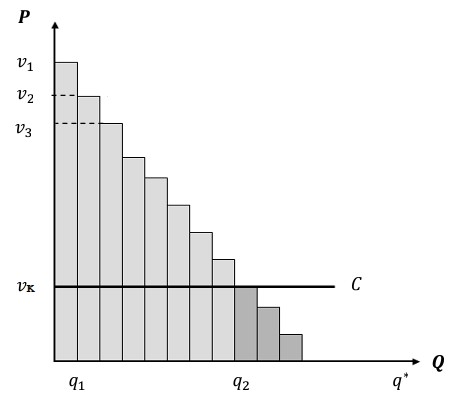
First-degree price discrimination, also known as perfect discrimination, refers to the practice of charging each customer the maximum price he or she would be willing to pay for a product or service. In this case, the company can extract all consumer surplus, resulting in optimal economic profit for the company. For this to happen, the price set by the company is completely personalized and equivalent to each consumer’s maximum willingness to pay.
Figure 1: First-degree price discrimination.
Source: González (2016).
Suppose there is a finite number (“N”) of individuals (“i”) willing to consume one unit of a good. The willingness to pay to consume that unit is v_i, such that v_1 > v_2 > v_3 > ... > v_n. There is a single supplier that absorbs all demand and knows the valuations of all consumers. In addition, it produces at a marginal cost “C”. If the company manages to avoid arbitrage, then each consumer “i”, whose valuation is greater than or equal to the marginal cost “c”, will be charged a price P_i = v_i. With this, the company will capture all consumer surplus, charging each consumer the maximum they are willing to pay. The price of the last unit traded will be equal to the marginal cost, that is: p_k = v_k = C.
From a welfare perspective, first-degree discrimination is an efficient scenario, since the last unit traded is sold at its marginal cost. However, unlike in a competitive scenario, in this situation all the allocative efficiency gains are appropriated by the producer.
Although this scenario may be rather theoretical (given the difficulty companies have in knowing exactly the willingness to pay of all their customers), first-degree discrimination can be observed in auctions. In this scenario, consumers who are interested in purchasing a good bid iteratively to acquire it, so that the monetary amount offered by each customer represents their willingness to pay. The product will ultimately be allocated to the person who offers the highest price (that is, the one who has the highest willingness to pay for it).
Second-degree price discrimination refers to the practice of offering different prices based on the quantity or volume purchased. For example, a company may offer discounts to consumers who buy large quantities of a product, such as “loyalty rebates”.
So, even though the monopolist does not have information about consumers’ willingness to pay, it can still discriminate by offering a set (or “menu”) of products at different prices. In this way, the company expects consumers to self-assign themselves into a market segment based on their own willingness to pay (which only they themselves know).
Second-degree discrimination occurs in the telecommunications market. Mobile phone companies, instead of charging a single (uniform) tariff to all customers for each minute used, offer different plans or package alternatives with different prices. Thus, people who use more minutes will be willing to pay for a more expensive plan (offering, for example, unlimited minutes). On the other hand, those who are less willing to pay for this service will choose a cheaper plan, but with more restrictions.
Many times, these telephone plans may include a fixed component (representing the minimum charge for accessing the service) and a variable component (which depends proportionally on consumption). This is known as a two-part tariff (for a deeper treatment of the mathematics, see Varian 2016 or Viscusi 2018).
Similarly, airlines offer different travel categories (e.g., first class, business class, economy class), and each of these alternatives varies in price and quality of service. Consumers who value these services most will be willing to pay a higher price for them, but since the company does not have the information necessary to segment them correctly, it offers different packages so that consumers can do so themselves.
Although this alternative form of discrimination may be convenient for the company in cases where it does not have information about its customers, its practical application requires that there be optimal differentiation among the different “menus”. Otherwise, if these menus are not attractive enough for, for example, the market segment that should consume the service with a high willingness to pay, they will choose the other menu (that is, the one aimed at consumers with a lower willingness to pay).
Thus, returning to the example of telephone plans, if each minute spoken on an unlimited plan cost the same as those on a restricted plan, and there were no penalty or additional charge for exceeding the limit, consumers would have no incentive to purchase the more expensive plan (unlimited minutes). Similarly, if traveling first class were only slightly more comfortable than traveling on economy, no customer would be willing to pay more for such a similar service.
There is also the possibility of intertemporal price discrimination. The launch of a new product (e.g., a new book or cell phone) motivates agents to differentiate their temporal valuation; that is, consumers who want to access the product sooner are willing to pay a higher price, while those who do not value it as much —but still want to purchase it— can wait for the price to decrease.
A uniform pricing policy over time would prevent the firm from extracting the higher consumer surplus of customers who are willing to pay a premium for earlier access. That is why companies can apply a price that decreases over time. This type of discrimination (despite being second-degree, as it requires customer self-selection) is different from the others in that it segments the same demand, but across different time periods.
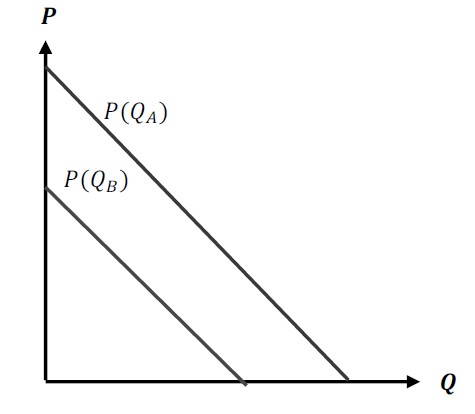
Third-degree price discrimination refers to a monopolist’s ability to segment a market (e.g., by age, geographic location, occupation). In this case, the company segments the market into different consumer groups and charges different prices to each group. Within the same market, the company does not have the ability to differentiate between customers, so it only applies a uniform price to each of the market segments.
It is possible to apply segmentation strategies by observing certain characteristics of customers. Given the possibility of segmentation, and that the price within on segment is the same for all customers, the possibilities for arbitrage are reduced, since the price between customers with “similar” characteristics (that is, who value the product in the same way) does not change (they paid the same).
Figure 2: Third-degree price discrimination.
Source: González (2016).
Let us consider the case where a monopolist sells in two segments of a market. The segment that groups consumers with a high willingness to pay has a demand represented by the function P(Q_A). On the other hand, the demand function of consumers with a low willingness to pay is represented by P(Q_B).
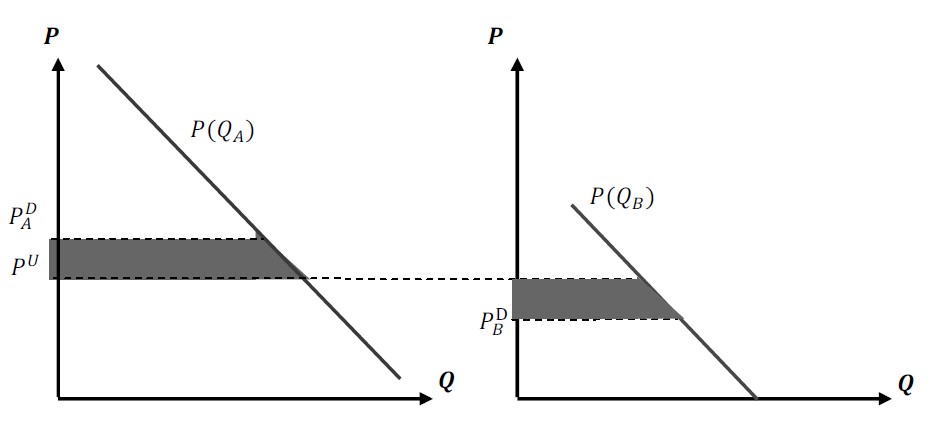
Therefore, if the company decides to set different prices in each of these two market segments, it will choose the prices (P_A and P_B) that maximize the sum of the profits obtained in each market. On the other hand, in a scenario where the monopolist cannot group consumers into different market segments, it will charge a uniform monopoly price (P_U), where P_A > P_U > P_B.
Given the segmentation into two different markets, the overall effect on consumers is ambiguous. Consumers in segment A (high willingness to pay) would benefit from the uniform price, as they would pay less and consume more. Conversely, consumers in segment B would be disadvantaged by the uniform price because they would pay more and consume less. Figure 3 shows the changes in consumer and firm welfare when moving from a discriminatory price to a uniform price.
Figure 3: Benefits of uniform pricing vs. third-degree discrimination
Source: González (2016).
Therefore, the net effect on consumer welfare will depend on the losses of the group in segment B and the gains of the group in segment A. In general, this balance will depend on the elasticities of demand and the relative size of each market segment. The effect on welfare may be negative if the low-demand market segment is very small compared to the high-demand segment.
Now, let us consider regulation that does not allow price discrimination between market segments A and B, such that the monopolist is forced to charge a uniform price for both segments. Given that the monopolist already knows the market segmentation, it will decide to charge a single price P_A = P_U. Therefore, it will exclude customers in segment B from the market, preventing them from consuming.
One advantage of price discrimination is that it can increase market efficiency by allowing companies to capture more revenue. Price discrimination can also encourage innovation, since companies that use this strategy have a greater incentive to develop new products and services, and thus better differentiate their customers.
On the other hand, price discrimination can improve the allocation of resources in the economy. By charging different prices for the same product or service, discrimination allows consumers who are willing to pay more for a product to gain access to it, while those who cannot afford the full price can obtain the product at a lower price. This can help increase consumer satisfaction and contribute to maximizing social welfare.
Price discrimination can also have economic disadvantages. First, it can have exclusionary effects. This can occur, for example, with loyalty rebates offered by a dominant firm to its customers (e.g., retroactive volume discounts), which prevent its competitors from improving or challenging that offer.
On the other hand, price discrimination can also have exploitative effects when used to extract consumer surplus. This practice, which is related to the concept of “excessive pricing”, has been sanctioned in the European Union through Article 102 of the TFEU.
Additionally, when a company is vertically integrated and uses different strategies to discriminate prices, it may have competitive advantages that negatively affect other market participants. For example, a vertically integrated company may favor its distribution channels and harm its competitors by offering lower prices to that channel, making it harder for other distribution channels to compete. Similarly, a company could apply margin squeeze strategies through price discrimination in order to eliminate a competing company from the market and thus increase its market share.
It is not easy for companies to demonstrate that the price discrimination they apply is justified on grounds of efficiency. For this reason, companies are careful when applying different types of price discrimination.
In the United States, the Robinson-Patman Act (1913) specifically prohibits certain unjustified forms of price discrimination that harm competition. Although this prohibition was enforced in the past (FTC v. Morton Salt Co. (1948)), said provision has gone through periods of disuse. Currently, price discrimination is reviewed under Sections 1 and 2 of the Sherman Act.
In cases of incremental rebates, U.S. case law has indicated that these should be evaluated using the price-cost test adopted in predatory pricing cases (Brooke Group Ltd. v. Brown & Williamson Tobacco Corp. (1993)). On the other hand, in cases of loyalty rebates, lower courts have applied the rule of reason (Lepage’s Inc. v. 3M (2003)) and have focused on price-cost comparisons (Cascade Health v. Peacehealth (2007)).
Article 102 TFEU prohibits abusive conduct by companies that occupy a dominant position in a relevant market. Point (c) of this provision explicitly prohibits companies from applying different conditions to equivalent transactions with commercial parties if the latter are at a competitive disadvantage.
This rule acquires particular importance in the European Union (EU), given the objective of economic integration that underpins the Union. Thus, the prohibition of discrimination partly seeks to prevent the “compartmentalization” of the markets of each EU Member State through the charging of different price levels without justification in costs (Marco Colino, 2019).
The case that set the precedent was United Brands v. Commission (1978), in which the Court of Justice of the European Union stated that a price may be excessive if it bears no reasonable relation to its “economic value” (differing from the cost approach).
Although price discrimination can be exploitative, the wording of Article 102(c) suggests that the focus should be on cases of secondary harm (that is, where the anti-competitive effect is observed in the competitors —downstream— of the company favored by price discrimination).
Companies generally have no incentive to distort competition with their trading partners. However, this may change when a dominant company is vertically integrated and therefore competes with its own trading partners (downstream). Although there is case law in this regard (GT-Link v De Danske Statsbaner (1997)), it is still debated whether Article 102(c) TFEU provides a solid legal basis for this type of case.
Most cases of price discrimination under Article 102 TFEU target front-line harm, where the dominant company inflicts exclusionary effects on its competitors.
Finally, in Post Danmark II (2013), it was demonstrated that retroactive rebates, linked solely to purchase volume, may be legal under certain conditions. On the other hand, in Hoffmann-La Roche & Co. AG v Commission of the European Communities (1976), it was indicated that fidelity rebates, which are conditional on the customer buying (almost) all of the dominant company’s products or services, are illegal when they prevent buyers from dealing with competitors of the dominant company.
The Tribunal de Defensa de la Libre Competencia (TDLC) does not consider price discrimination to be, a priori, illegal under DL 211. In response to a complaint filed by the FNE against Transbank for abuse of a dominant position, the TDLC stated that “price differentiation per se is not anti-competitive, and may even be necessary for the efficient functioning of a market” (considering 46°, Judgment 29/2005).
For his part, Tomás Menchaca (former president of the TDLC) has pointed out that for price discrimination to be sanctioned under competition law, “it must be abusive, that is, arbitrary, lacking reasonable economic justification (…) and exercised by those who hold market power”.
In this regard, the TDLC, in its Report No. 2, in the context of a request from the Ministry of Transport for the Tribunal to rule on the level of competition in fixed telephone services, stated that companies with market power cannot unjustifiably discriminate in their prices and, if they do so, they would be unjustifiably appropriating consumer surplus (that is, engaging in exploitative practices).
For its part, the FNE has indicated to the TDLC that price discrimination is abusive when it leads to excessive prices for certain consumers, or is implemented to eliminate competition to the detriment of competitors and consumers (see Case No. NC-246-08). Furthermore, there have been cases in which the TDLC has required the formulation of tariff self-regulation plans to prevent, among other things, price discrimination with anti-competitive effects. One such case was the Transbank S.A. tariff self-regulation plan, which is reviewed below. In 2016, Cruz Verde requested —through a non-contentious procedure— that the TDLC rule on the criteria applied by Transbank to establish merchant discounts. According to Cruz Verde, pharmacies must pay significantly higher commissions than other sectors (e.g., supermarkets), something that lacked economic justification. This is because the operations on the acquiring side (i.e., on Transbank’s side) would be the same for the different sectors.
The TDLC ruled, in its Resolution 53/2018, that Transbank’s self-regulation plan did not meet public, objective, and non-discriminatory criteria. Therefore, the Tribunal imposed on Transbank the obligation to propose a new self-regulating tariff plan with certain conditions, including non-discrimination by sector. However, the TDLC indicated that discounts that depend on the average value of sales or the number of transactions generated by each merchant may exist (that is, the greater the sales and transactions, the greater the discount).
Resolution 53/2018 was challenged (by various parties) before the Supreme Court. In its ruling, the Court further restricted Transbank’s margin to engage in price discrimination (based on the constitutional guarantee of “equality before the law”). Thus, contrary to the TDLC’s ruling, the Court affirmed that Transbank’s plan “may not differentiate by transaction volumes, total amounts in predetermined periods, categories, or items for merchants that receive payments by credit or debit cards” (see C° 32º, Rol 24.828-2018).
Likewise, the Court —also contrary to the TDLC’s ruling— decided that Transbank could not be authorized to offer public entities (e.g., SII, Treasury) free membership in its system (i.e., commission-free). This is because, in the Court’s opinion, this circumstance could perpetuate Transbank’s privileged position, as it would hinder the entry of new competitors who may not have the financial conditions to support a similar exemption (see C. 22°-23°, Rol 24.828-2018).
In another case, in 2017, several banks (Bice, BBVA, Scotiabank, Banco Security) filed lawsuits against Banco Estado for arbitrary price discrimination (in particular, interbank fees). According to the plaintiffs, they paid a higher price for the service of receiving electronic bank transfers with Banco Estado, compared to the prices it charged other banks. According to the plaintiffs, these differences were not economically justified.
The TDLC decided to dismiss the lawsuit (Ruling 174/2020). In this regard, the Tribunal affirmed that the reported conduct did not constitute an anti-competitive practice under the analysis of abuse of dominant position.
The TDLC’s decision was challenged by the plaintiffs before the Supreme Court. The Court upheld the appeals, affirming that Banco Estado had abused its dominant position and had arbitrarily discriminated against smaller banks. Thus, the Court forced Banco Estado to set a single tariff (equal and non-discriminatory) for interbank transfers.
These differences between the TDLC and the Supreme Court show that there is some uncertainty regarding the legality and illegality of price discrimination. Finally, Agüero and Montt (2010) have pointed out that Chilean case law has affirmed that it is possible to establish different prices, but these must be impartial and generally applicable to all consumers and/or customers.
Agüero, F., Montt S. (2010). Derecho de paso y libre competencia. informe en derecho.
Marco Colino, Sandra (2019). Competition Law of the EU and UK, 8º edición.
Motta, M. (2004). Competition policy: theory and practice. Cambridge university press.
Gonzalez, A. (2016). Apuntes de Organización Industrial.
OCDE. (1993). Glossary of Industrial Organisation Economics and Competition Law
Pigou, A.C. (1920). The economics of welfare. London: Macmillan.
Richard Steppe, Friso Bostoen, Price Discrimination, Global Dictionary of Competition Law, Concurrences, Art. N° 85413
Varian, H. R. (2016). Microeconomía intermedia: un enfoque actual. Alpha Editorial.
Viscusi, W. K., Harrington Jr, J. E., & Sappington, D. E. (2018). Economics of regulation and antitrust. MIT press.
*Section 2, «Economic conditions for price discrimination», underwent some modifications on May 29, 2023.