Newsletter
Suscríbete a nuestro Newsletter y entérate de las últimas novedades.
https://centrocompetencia.com/wp-content/themes/Ceco
volver
Classical economic theory predicts that a market economy should, on its own, allocate available resources efficiently, achieving what is known as «competitive equilibrium.» However, in practice, there are circumstances that prevent markets from allocating resources efficiently, circumstances referred to as market failures.
Externalities are one of the most analyzed market failures in economic literature. These occur when the market decisions of buyers and sellers affect the well-being of a third party, who is neither paid nor compensated for said effect (Mankiw, 2012). In these cases, market prices do not reflect the side effects associated with the production or consumption of these goods, such that the competitive equilibrium is not efficient for society as a whole.
Traditionally, externalities are categorized as negative or positive, depending on their effect on consumer well-being. The following sections review, we review both types of externalities, as well as possible solutions to restore economic efficiency in the markets affected by them. Finally, we review antitrust cases in which these concepts were applied.
A negative externality is a situation in which an economic activity reduces the well-being of individuals who are not part of the market, without them being compensated for the harm they receive. This type of externality can derive from both the production and consumption of a good or service.
For example, a factory that pollutes the air or water as part of its production process affects the health of the population living nearby. If the producer makes decisions based solely on the direct production costs it has (the company’s private cost) and the income opportunities it possesses —ignoring the social cost of pollution— the market equilibrium will be unable to maximize the total benefit for society. Similarly, but from the consumption side, when a person smokes a cigarette, she not only puts her own health at risk but also that of those around her who inhale the smoke released (passive smokers).
Graphically, the equilibrium of a market with negative externalities in production takes the following form:
Graph No. 1: Market equilibrium with negative externalities in production
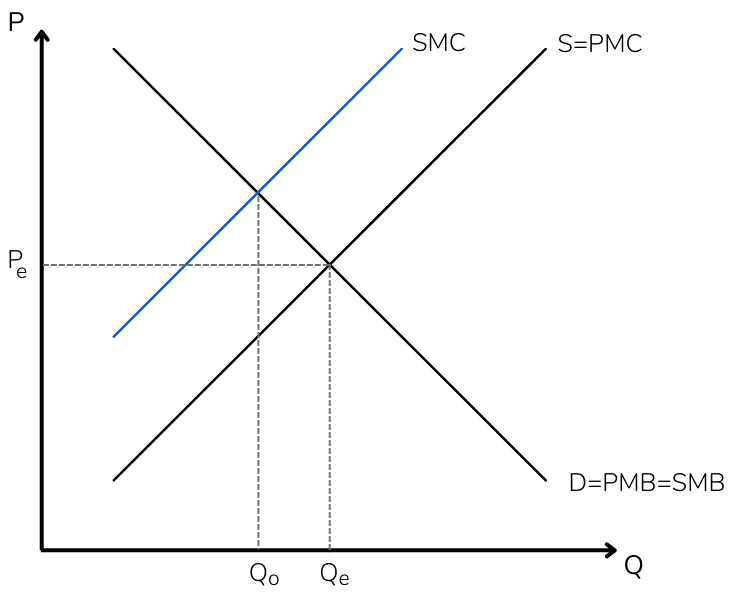
In this context, the Social Marginal Cost (SMC in Graph No. 1)—defined as the cost incurred by society for the production of one additional unit of a good—is higher than the Private Marginal Cost (PMC), which is the cost producers bear for manufacturing that additional unit (the aggregate supply of the market in question).
This gap between social and private marginal costs exists because producers do not internalize the negative impact their production has on the rest of the population. However, if these effects were taken into account, costs would increase, causing the quantity produced to decrease until it reaches the socially optimal level (Q_o), an output level beneath that reached in competitive equilibrium (Q_e), where only the firm’s private costs are considered.
In cases where negative externalities occur in consumption, the Private Marginal Benefit (PMB in Graph No. 2)—understood as the benefit a consumer receives from an additional unit of the good (the aggregate demand of the market)—is greater than the Social Marginal Benefit (SMB), which represents the benefit society receives.
In other words, consumers do not internalize the negative impact their consumption has on the rest of the population. Graphically:
Graph No. 2: Market Equilibrium with Negative Externalities in Consumption
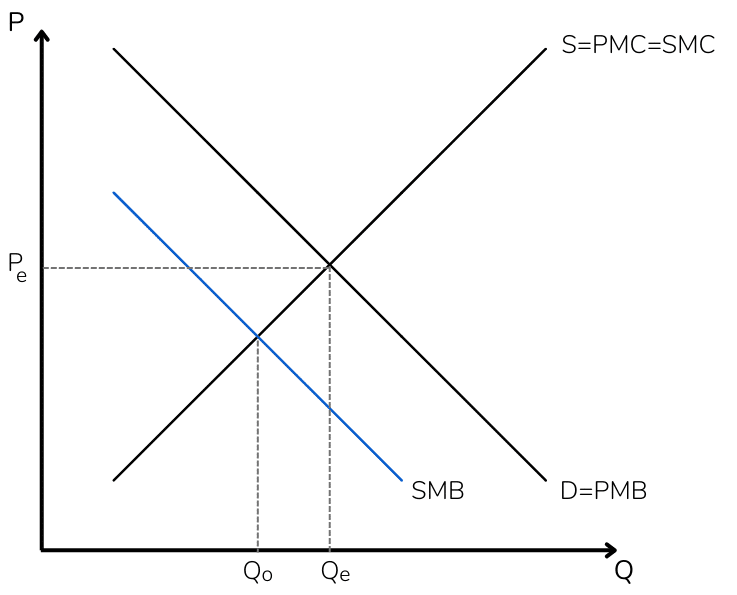
In both cases —negative externalities in production and consumption— the equilibrium quantity (“Q_e”) is greater than production in a socially optimal level (“Q_o”).
Positive externalities, unlike negative externalities, occur when the production or sale of a good or service increases the well-being of third parties, without them having to pay for such a benefit. Again, these can derive from both the production and the consumption of a product.
Suppose, for example, that a firm allocates economic resources to the research and development of new products. When this occurs, the company has the potential to foster greater competition and raise the quality of life of people by providing more effective and convenient solutions. That is, the benefits can extend beyond the firm (even to its competitors, through so-called “R&D spillovers”; Iglesias 2023, p. 21). Similarly, when a person is educated, their productivity increases and they can earn higher salaries. In addition to these private benefits, the rest of society also benefits from having a more informed and productive citizen. In a sense, caselaw constitutes another example of a positive externality. This is true to the extent that the costs of generating a ruling are borne only by the litigating parties, while any citizen can benefit from the legal predictability it provides.
Graphically, the equilibrium of a market with positive externalities in consumption takes the following form:
Graph No. 3: Market equilibrium with positive externalities in consumption
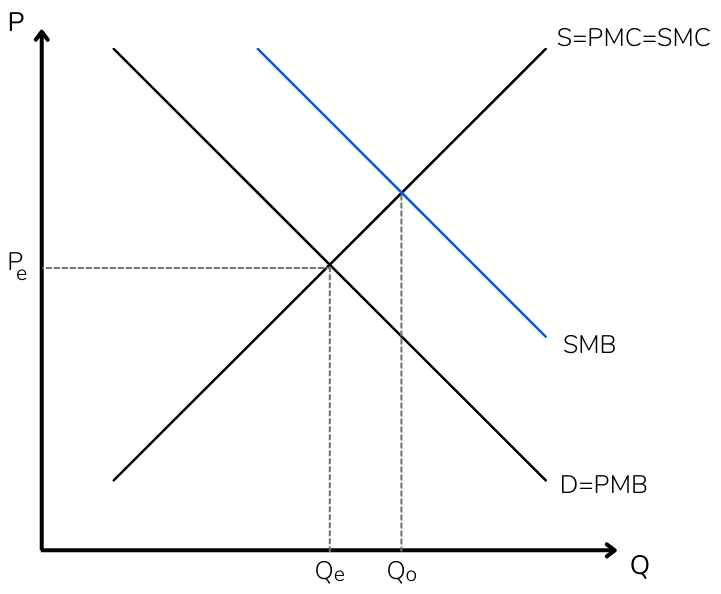
In this case, the social marginal benefit (“SMB” in Graph No. 3) is greater than the private marginal benefit (“PMB”) (aggregate demand of the market in question).
The difference between the social and private marginal benefit occurs because consumers do not internalize the benefit that their consumption generates for other people (they only consider the private benefit that this consumption brings them). Were it otherwise, the quantity consumed would increase, reaching the socially optimal level (“Q_o”), which is greater than the competitive equilibrium quantity, “Q_e”.
In cases where positive externalities are generated in production, the private marginal cost (“PMC” in Graph No. 4) is greater than the social marginal cost (“SMC”). In this way, producers do not internalize the benefit that their production generates for the rest of society. Graphically:
Graph No. 4: Market equilibrium with positive externalities in production
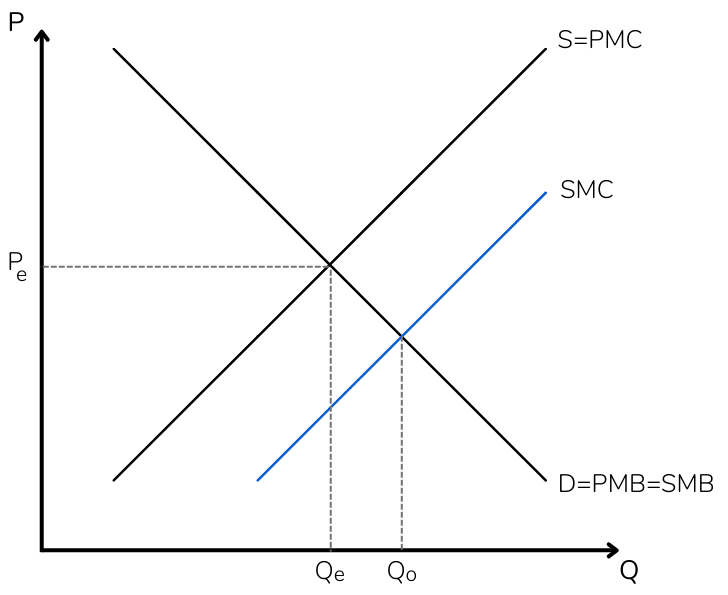
In both cases—positive externalities in production and consumption—, the quantity produced at equilibrium (“Q_e”) is less than the socially optimal production level absent externalities (“Q_o”).
As we have seen, in the absence of regulation or public policies that allow agents to internalize the effects of their actions on third parties, externalities lead to inefficient market allocations, either because more is produced or consumed than is socially optimal (negative externality), or less (positive externality).
Broadly speaking, there are two types of solutions to address these problems and restore greater economic efficiency: public solutions and private solutions.
Public solutions are those measures implemented by governments or other regulatory institutions. Following Samuelson (2009), these types of solutions can be classified into two dimensions: direct or indirect.
Direct controls refer to those explicit interventions by the government or public institutions with the aim of regulating a market and thus correcting a specific externality. An example of this is a law that establishes maximum pollutant emission levels for an industry, seeking to adjust to socially optimal production rates.
Indirect controls, on the other hand, rely on market solutions. Thus, for example, the authority can establish corrective taxes or subsidies to align private incentives with socially optimal levels. In more concrete terms, a corrective tax imposes a monetary cost on the generation of a negative externality, forcing the agent to incorporate it into his activity; in contrast, the corrective subsidy rewards the generation of positive externalities, encouraging agents to produce them to a greater extent.
Specifically, in a market equilibrium with negative externalities in production, such as the one illustrated in Graph No. 1, a corrective tax can be applied as follows:
Graph No. 5: Application of a corrective tax
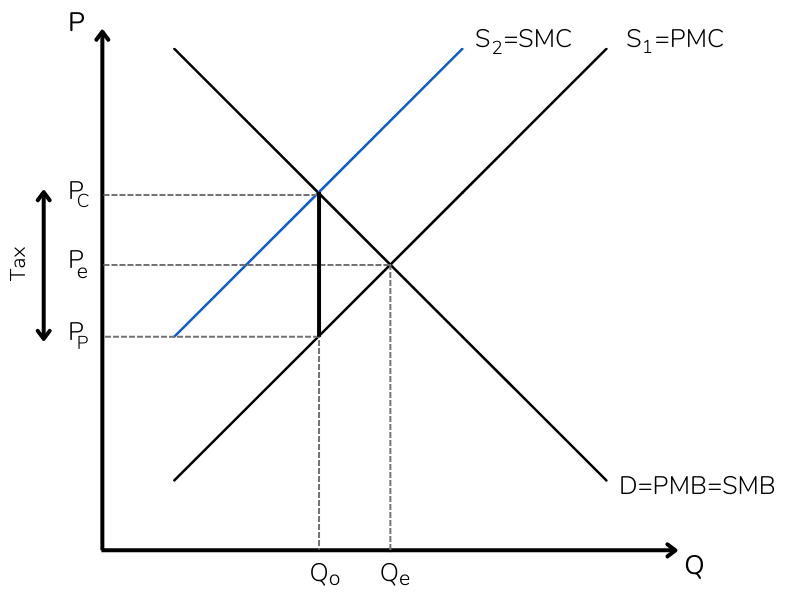
This tax implements a monetary burden proportional to the quantity produced, with the aim of having the producer internalize the social cost generated by its production. As a result, for all production levels (values on the horizontal axis), the production costs faced by the firm increase. With this, the relevant supply faced by the producer is no longer “PMC”, but rather “SMC” (Graph No. 5).
In this example, the tax is linear: although the amount to be paid by the firm is directly related to the quantity produced (if the firm produces more, then it pays more), the amount charged for each additional unit produced is always the same.
Under this new cost structure, the producer optimizes its production by matching its new supply curve (“S_2”) with demand (“D”), reaching a new market equilibrium. The idea is that the corrective tax makes the producer, under the new supply curve, maximize their utility at the same level where social welfare is maximized (“Q_o”). This is what is known as an “optimal corrective tax.”
In Graph No. 5, the value of this tax (under which the socially optimal quantity is produced) corresponds to the difference between two prices: the price the producer charges when internalizing the externality (“P_C”), and the price they would charge for producing the socially optimal quantity (“Q_o”) in absence of the tax (“P_P”). These types of taxes are known as Pigouvian taxes, in honor of the British economist Arthur Pigou, who first developed this method for controlling externalities in the 1920s (Parkin, 2009).
The logic for a corrective subsidy in a market with positive externalities is analogous to the corrective tax, with the difference being that, in this case, the subsidized amount is that which reduces the firm’s production costs by an amount that causes it to increase production until it reaches the socially optimal level. In both cases, the economic incentives of the agents themselves are what allow the “private” competitive equilibrium to equal the socially optimal equilibrium.
Other economic measures, such as the implementation of tradable pollution permits, can deliver similar results. Under this mechanism, the government or regulatory entity sets a maximum limit on the total amount of pollution tolerated in a market or industry. Subsequently, it assigns permits that set the allowed pollution limit for each firm (in accordance with the established cap). These firms can trade their permits in the market, buying additional permits if they need to increase their production and, therefore, their emissions, or selling permits if they manage to reduce their emissions below what is allowed. This generates economic incentives for firms to reduce their emissions, fostering innovation and the adoption of cleaner technologies.
Even without government or regulatory intervention, the effects of some externalities can be countered through actions taken by individuals and firms. These measures are known as private solutions.
On one hand, social sanctions and moral codes can bring private behavior closer to the social optimum (Mankiw, 2012). People avoid performing certain harmful practices, such as littering in public spaces, out of empathy toward others or due to the bad reputation such actions generate. Similarly, some firms may commit to social causes, such as environmental care, to generate a good image and avoid community criticism.
Similarly, legal liability rules make agents more aware of the secondary effects associated with their consumption or production patterns. For example, in most legislations, when a person is injured or becomes ill from the use of a defective product, the manufacturing firm must be legally responsible for the damages caused. This causes the firm to internalize the externality and take into account some of the social costs of its production.
A general outlook based on these types of solutions is the Coase Theorem, proposed by British economist Ronald Coase in 1960, which states that the parties involved in an externality can reach an efficient solution without the need for government intervention, under certain conditions. In particular, that property rights are well-defined, transaction costs are low—the expenses and efforts necessary to carry out a negotiation or reach an agreement—and the affected parties are few. Despite the valuable conceptual basis it provides, the Coase Theorem is difficult to apply in practice due to the multiple assumptions it involves.
Below, we review two competition law cases where the concept of externality was applied.
Starting in 2016, the global agrochemical sector experienced a wave of mergers that contributed to the consolidation of an industry that was already highly concentrated.
During its analysis of the Dow/DuPont and Bayer/Monsanto mergers, the Directorate-General for Competition of the European Commission («DG Comp») considered the impact these had on the levels of innovation and environmental pollution in the sector—classic examples of positive and negative externalities, respectively.
Indeed, various economic agents and civil organizations pointed to the potential impact of these operations on the sustainability of the agrochemical sector, noting a wide range of considerations that threatened to undermine food security, reduce biodiversity, and harm the environment (negative externality). At the same time, other actors maintained that innovation in the agrochemical sector can contribute to environmental protection, food security, and human health through the development of more effective active ingredients (positive externality). How can both effects be reconciled?
According to Deutscher & Makris (2023), DG Comp’s analysis for these cases was based on the premise that a high level of post-merger innovation would be sufficient to mitigate any relevant sustainability issues related to competition. Under this logic, the authority reportedly limited its analysis to the impact of these mergers on the innovation process in the agrochemical sector.
The resulting investigation concluded that the Dow/DuPont and Bayer/Monsanto concentrations would reduce total industry innovation, as well as competition in some product markets affected by the mergers. However, both operations were approved subject to structural and behavioral mitigation measures, arguing that the application of these remedies would be sufficient to preserve competition in the relevant markets involved, including competition in innovation.
On September 26, 2018, the National Economic Prosecutor’s Office (FNE) filed a claim before the Tribunal de Defensa de la Libre Competencia (TDLC) against 11 passenger transport companies from Temuco and Padre Las Casas for having entered into an agreement to limit the provision of transport services between 2003 and 2017. Specifically, the defendants allegedly agreed on the maximum number of buses in circulation for each company.
In their defense, the companies claimed that the agreement did not seek to limit production, but rather to correct the effects of two negative externalities associated with their economic activity: traffic congestion and environmental pollution.
Indeed, both phenomena can be understood as negative externalities in production. Given that the socially optimal quantity in an industry with negative externalities is lower than the quantity allocated by the market, limiting the maximum number of buses in circulation for each company constitutes a plausible measure to address these market failures. In fact, the defendant companies claimed that the agreement had been recognized by the Regional Ministerial Secretariat of Transportation and Telecommunications (SEREMITT) and the Regional Government of Araucanía as a collaborative act to fight congestion and pollution.
According to the TDLC, the fact that an anticompetitive agreement is endorsed by administrative authorities does not mean it ceases to be illegal in the eyes of free competition, unless such authorization is made through a regulation with the status of law (Article 4 of DL 211). In this case, SEREMITT and the Regional Government did not have a legal mandate to «authorize» an agreement of this type; therefore, DL 211 remained fully applicable. In this sense, it is worth noting the legal (and regulatory) initiatives that other countries have developed to establish a framework that legitimizes «sustainability agreements.»
Notwithstanding the arguments put forward by the defendants, the TDLC estimated that there were other ways to achieve a reduction in congestion and pollution without harming competition. Therefore, it ruled that the agreement in question should not be treated as a legitimate collaboration agreement between companies, but directly as a collusive agreement referred to the amount of production (punishable under the per se rule in accordance with Art. 3, letter ‘a’ of DL 211).
Consequently, the TDLC upheld the claim, convicting the 11 companies of collusion with fines ranging from 20 to 160 UTA. However, it is worth noting that the fines were reduced, among other reasons, due to the role regional authorities played in endorsing the agreement based on its capacity to counteract the aforementioned negative externalities (this decision was confirmed by the Supreme Court).
References:
Mankiw, N. G. (2012). Principles of Economics (6th ed.). Harcourt College Publishers.
Parkin, M. (2009). Economics (8th ed.). Addison-Wesley Inc., Reading, Massachusetts.
Samuelson, P. & Nordhaus, W. (2009). Economics (19th ed.).