Newsletter
Suscríbete a nuestro Newsletter y entérate de las últimas novedades.
https://centrocompetencia.com/wp-content/themes/Ceco
volver
In competition law, the per se rule and the rule of reason are two standards of judicial scrutiny used to determine the illegality of market conduct.
Based on the per se rule, to determine the lawfulness or unlawfulness of conduct it is sufficient to evaluate or qualify its nature. This is because the very nature of the conduct would be «in itself» —per se— illegal or legal (depending on how the rule is designed). In contrast, under the rule of reason, to determine the illegality of conduct it is not enough to evaluate its nature; its effects on the market must also be assessed (something which will depend on the market power held by the agent or agents engaging in the conduct).
In procedural terms, a per se rule that declares conduct illegal is more favorable to the plaintiff, as they only need to prove that the conduct was committed for the adjudicator to declare it illegal and thus obtain a conviction. Conversely, under the rule of reason, the plaintiff must also prove the anticompetitive effects of said conduct.
Now, in which cases should a judge apply the per se rule and in which cases the rule of reason? Generally, the criterion for determining which standard to apply stems from the experience accumulated through both competition law jurisprudence and economic analysis. Thus, if over time a conduct has been systematically declared anticompetitive or pro-competitive, it is reasonable that, based on that experience, the conduct be subjected to a per se rule, as it becomes unnecessary to stop and examine its effects. In this sense, the U.S. Supreme Court has noted that to determine whether it is appropriate to apply the per se rule to a particular case, one must determine if experience allows for the conclusion that examining effects would be irrelevant (White Motor Co. v. United States, 372 U.S. 253, 265, 1963).
There is a certain consensus that the accumulated experience of competition law enforcement indicates that so-called «hard-core cartels» should be subjected to the strict scrutiny of the per se rule of illegality. These types of cartels are formed between direct competitors with the aim of eliminating competition in its essential variables, such as price, production, and market share (Grunberg, 2020).
However, the very notion of a «hard-core cartel» has not been free of debate because, like most concepts in competition law, it has an «open texture.» In this regard, a paradox regarding the application of the per se rule has been pointed out: while the advantage sought by applying said rule is to «save» the discussion regarding the effects of a conduct, sometimes the very determination of whether or not the per se rule applies requires some degree of analysis of the effects of the conduct under examination (Vásquez and Zink, 2022). The U.S. Supreme Court has somewhat recognized this paradox by stating that: “there is often no bright line separating per se from rule of reason analysis, since ‘considerable inquiry into market conditions’ may be required before the application of any so-called «per se» condemnation is justified” (California Dental Association v. Federal Trade Commission, 526 U.S. 756, 1999).
On the other hand, regarding conduct other than hard-core cartels, there has generally been no sustained consensus for applying the per se rule. For example, the application of the per se rule to resale price maintenance (minimum price) has been a controversial matter. In the U.S., Robert Bork advocated for the per se legality of these types of vertical restrictions (Bork, 1966). For its part, the Supreme Court has varied its criteria: in 1911 it declared this conduct per se illegal (Dr. Miles Med. Co. v. John D. Park & Sons Co., 220 U.S. 373, 394, 408, 1911), only to reverse said precedent in 2007, subjecting it to the scrutiny of the rule of reason (Leegin Creative Leather Products, Inc. v. PSKS, Inc., 551 U.S. 877, 2007). In this regard, Hovenkamp has explained the litigation and administrative costs that the application of the per se rule of illegality to resale price maintenance generated for the competition law enforcement system (Hovenkamp, 2018).
All of the above demonstrates that setting per se rules carries the risk of producing undesired costs and effects. In this sense, Justice Marshall of the U.S. Supreme Court warned in 1969 that: “Per se rules always contain a degree of arbitrariness. They are justified on the assumption that the gains from imposition of the rule will far outweigh the losses and that significant administrative advantages will result” (United States v. Container Corp. of Am., 393 U.S. 333, 341, 1969). Along these lines, to review this balance between benefits and costs associated with the application of a per se rule, it is useful to turn to the differentiation theory of competition law rules and the analysis of error costs (Type I and Type II).
The decision to apply the per se rule to a particular category of market conduct or behavior is, in a sense, a public policy decision within competition law. Its purpose is to promote the efficiency of prosecuting specific anticompetitive behavior while simultaneously incentivizing procompetitive conduct.
One way to explain the rationale of this policy is found in the theory of differentiation of legal rules presented by Christiansen and Kerber. According to these authors, competition law rules can be categorized by their degree of differentiation —that is, the intensity of the investigation and fact-finding exercise that the rule requires to be applied to a specific case (Christiansen and Kerber, 2006).
Thus, the more differentiated a rule is, the more investigation will be required to determine whether it should be applied by the adjudicator. Conversely, the less differentiated a rule is, the less investigation and evidence will be required. Consequently, the administrative and procedural costs of applying a low-differentiation rule are lower than those of applying a high-differentiation rule.
Within this conceptual framework, the per se rule is a low-differentiation rule, while the rule of reason is a highly differentiated rule. Meanwhile, intermediate rules exist —such as the so-called «quick-look analysis»— which are more differentiated than a per se rule but less differentiated than the rule of reason.
The problem with low-differentiation rules, such as the per se rule, is that their application can lead to less accurate outcomes. This issue arises precisely because, by dispensing with a detailed study of the facts, the per se rule may incur in Type I errors (conviction of the innocent) or Type II errors (exoneration of the guilty).
Thus, a rule that treats conduct as «per se unlawful» could produce a Type I error—that is, it could convict an innocent agent (because the rule will treat procompetitive conduct as unlawful). Such a per se rule is applied to hard-core cartels or, as occurred at one point in U.S. jurisprudence, to resale price maintenance. On the other hand, a rule that treats conduct as «per se lawful» could produce a Type II error —that is, acquit a guilty agent (because the rule will treat anticompetitive conduct as lawful). An example of this type of per se rule is the bundle of «safe harbor» rules that exist in the competition law of some jurisdictions regarding certain conducts (e.g., European Commission Regulation (EU) No. 1217/2010, regarding certain types of research and development agreements).
In this way, the question regarding a rule’s degree of differentiation can be analyzed as a trade-off between two equally desirable elements: precision and predictability (Broulík, 2019). Thus, while the rule of reason will tend to generate more precision (reducing Type I or Type II errors), the per se rule will tend to generate greater predictability (even if it generates Type I or Type II errors). This is because the per se rule allows market agents to anticipate the authority’s decision regarding the lawfulness or unlawfulness of their conduct without having to review the facts and effects in detail.
According to Christiansen and Kerber, to design an optimal competition rule due account must be taken of the frequency of positive (procompetitive) and negative (anticompetitive) effects associated with the conduct covered by the rule. To illustrate this, the authors utilize a matrix of five types of market behavior, labeled as B_1, B_2, B_3, B_4, and B_5, as shown below. On one hand, the horizontal axis (w) shows the anticompetitive effects of each behavior to the left of the center and its procompetitive effects to the right of the center. On the other hand, the vertical axis (f) shows the frequency distribution of both types of effects for each kind of behavior:
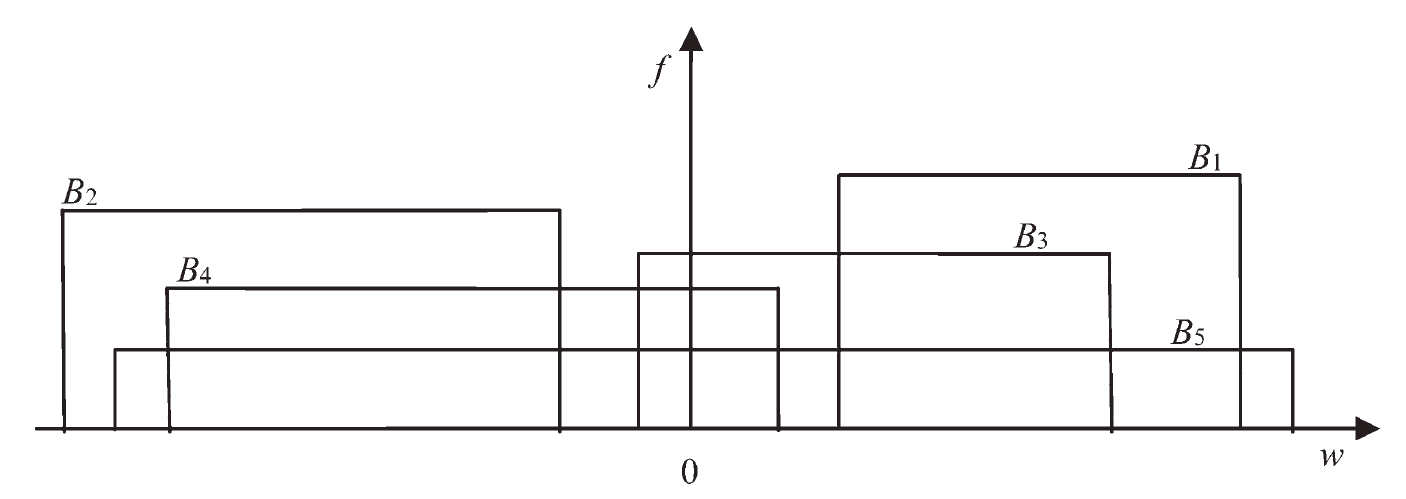
Source: Christiansen y Kerber, 2006 (figure N°3)
According to the information provided in the matrix, conduct B_1 always produces anticompetitive effects; consequently, the optimal competition rule would be a minimally differentiated one that prohibits that conduct without the need for further analysis, that is, the conduct should be considered as «per se unlawful». Conversely, conduct B_5 always produces procompetitive effects; therefore, the optimal rule would be a minimally differentiated one that always authorizes said conduct—that is, the conduct should be considered as «per se lawful».
On the other hand, conduct B_3 can produce both procompetitive and anticompetitive effects with equal frequency, so the optimal rule is a highly differentiated one that allows for the sanctioning or acquittal of the conduct after a detailed investigation and analysis of the facts —that is, a rule of reason approach is warranted. Finally, there are conducts B_2 and B_4, which normally produce one of the two effects but, on rare occasions, produce the opposite effect (in the case of B_4, procompetitive effects, and in the case of B_2, anticompetitive effects). For these kinds of conduct, it would be advisable to establish moderately differentiated rules, such as a «quick-look analysis» rule (the mechanics of which will be explained below).
At the legislative level, U.S. competition law does not expressly establish a per se rule. In fact, Section 1 of the Sherman Act states that every contract, combination in the form of trust or otherwise, or conspiracy, in restraint of trade or commerce among the several States, or with foreign nations, is illegal; however, it says nothing about how the courts should evaluate the conduct of market agents to determine whether or not they restrain trade.
Thus, the per se rule and the rule of reason are jurisprudential constructions emanating from U.S. courts since the end of the 19th century and, in particular, from the Supreme Court.
In this vein, the first case worth mentioning is Trans-Missouri (1897). In it, the U.S. government sued a railway association for a price-fixing agreement on transportation services. The association’s defense, based on general principles of Common Law, argued that the Sherman Act’s prohibition could only apply to «unreasonable» restraints of trade. The Court rejected this defense and stated that:
«the suit of the Government can be maintained without proof of the allegation that the agreement was entered into for the purpose of restraining trade or commerce, or for maintaining rates above what was reasonable» (United States v. Trans-Missouri Freight Ass’n, 166 U.S. 290, 1897).
Thus, in the words of Robert Bork, by deciding against the railway association without the need to conduct a judgment on the reasonableness of the prices, the Court formulated a rule of per se illegality for price cartels (Bork, 1993).
The Supreme Court’s analysis took a turn in the celebrated Standard Oil (1911) case, which culminated in the breakup of the trust of tycoon J.D. Rockefeller. In this case, the Supreme Court held that only restraints of trade that were «unreasonable» (unreasonableness) should be declared anticompetitive. To make this shift, the Court maintained that the rule of reason had also been applied in the previous Trans-Missouri case, later stating in general terms that:
«the criteria to be resorted to in any given case for the purpose of ascertaining whether violations of the section [Sherman Act] have been committed is the rule of reason» (Standard Oil Co. of New Jersey v. United States, 221 U.S. 1, 1910).
As Vásquez explains, although the Standard Oil precedent suggested that all conduct should be analyzed under the rule of reason, over time the Court identified cases in which the analysis of the effects of the conduct was not necessary, or in which anticompetitive effects were presumed —the burden falling on the defendant to prove the reasonableness of the conduct (Vásquez, 2020:4). Thus, in the Trenton Potteries (1927) case, the Court noted that while Standard Oil stated that only unreasonable restraints of trade should be declared illegal, it could not be inferred from this that price-fixing agreements were reasonable (even if the prices fixed under them were economically reasonable). According to the Court, price-fixing agreements can be declared, in themselves, unreasonable without needing to analyze their economic reasonableness or unreasonableness (United States v. Trenton Potteries Co., 273 U.S. 392, 1927).
The per se rule (of illegality) regarding price agreements was subsequently reaffirmed with clarity in Socony-Vacuum (1940). In its ruling, the Supreme Court declared:
«[…] for over forty years, this Court has consistently and without deviation adhered to the principle that price-fixing agreements are unlawful per se under the Sherman Act, and that no showing of so-called competitive abuses or evils which those agreements were designed to eliminate or alleviate may be interposed as a defense,» adding that: «price-fixing combinations which lack Congressional sanction are illegal per se; they are not evaluated in terms of their purpose, aim, or effect in the elimination of so-called competitive evils» (United States v. Socony-Vacuum Oil Co., Inc., 310 U.S. 150, 1940).
Another aspect to highlight in U.S. jurisprudence is the intermediate «quick-look analysis» rule mentioned previously. Indeed, the application of the per se rule to price agreements caused the Supreme Court to begin facing categorization problems. In this sense, occasionally the very concept of a «price agreement» did not operate as a «starting point» for analysis, but rather as a conclusion reached after examining the effects of the conduct.
As Vásquez points out, as a consequence of the sequence of cases in which the Court refused to apply the per se rule to alleged price agreements, talk began of a new rule of analysis for restraints on competition: the ‘quick look analysis’ rule (Vásquez, 2020). This rule assumes that once the plaintiff proves the existence of a trade-restrictive conduct that, under a «quick look,» might merit the per se rule (of illegality), the defendant must prove a procompetitive justification (typically an efficiency) to avoid the application of that standard of scrutiny. If the defendant achieves this, the case continues to be analyzed under the rule of reason.
For example, in the California Dental (1998) case, the Court explained that:
«An abbreviated or «quick-look» analysis is appropriate when an observer with even a rudimentary understanding of economics could conclude that the arrangements in question have an anticompetitive effect on customers and markets» (California Dental Ass’n v. FTC, 526 U.S. 756, 1999).
In European Union (EU) competition law, there is no per se rule of illegality.
The first paragraph of Article 101 of the Treaty on the Functioning of the European Union (TFEU) prohibits agreements between undertakings «which have as their object or effect» the restriction of competition, particularly those that fix purchase or selling prices or limit production (among other types of agreements listed in the regulation).
Based on this rule, EU doctrine and case law distinguish between restrictions of competition «by object» and «by effect.» The former are those “regarded, by their very nature, as being harmful to the proper functioning of normal competition” (para. 22 of the Guidelines on the applicability of Article 101 of the Treaty on the Functioning of the European Union to horizontal co-operation agreements). On the other hand, restrictions of competition «by effect» require an analysis of the effects of the conduct in question to determine whether it falls under the normative premise of the first paragraph of Article 101.
However, regardless of whether the agreement is understood to imply a restriction of competition «by object» or «by effect,» the defendant will always have the possibility of triggering an effects analysis through the application of the third paragraph of Article 101 TFEU. Indeed, this latter provision establishes that the first paragraph of Article 101 shall be inapplicable to agreements which, along with benefiting consumers, fulfill the objective of «improving the production or distribution of goods» or «promoting technical or economic progress.» This applies insofar as the restrictions on competition are indispensable to attaining these objectives and do not allow the participating undertakings to eliminate competition.
In this way, since the third paragraph of Article 101 does not distinguish between restrictions «by object» and «by effect,» it applies to both. This implies that the practical effect of qualifying conduct as restrictive «by object» in the EU is strictly procedural in nature: the burden of proof is shifted from the plaintiff to the defendant, who must prove that the agreement in question meets the legality parameters of the third paragraph of Article 101 (Whish and Bailey, 2018). In other words, the classification of an agreement as a restriction «by object» is the basis for a rebuttable presumption of illegality.
For this reason, a per se rule of illegality like that in the U.S. does not exist in the EU (not even regarding hardcore cartels). This is because, even regarding agreements that establish restrictions «by object,» the defendant can always trigger a discussion of their effects by invoking the defense of the third paragraph of Article 101 (Whish and Bailey, 2018).
Thus, regarding «hardcore cartels» (such as price-fixing agreements), the high courts of the EU have indicated that a review of their effects is not necessary to apply the first paragraph of Article 101 TFEU, since experience shows that such conduct leads to falls in production and increases in prices (Cartes Bancaires, C-67-13, Maxima Latvija, C-345/14). Notwithstanding the foregoing, the effects of these agreements must still be reviewed under the third paragraph of Article 101, though it will be more difficult for the defendant to prove that the agreement in question does not restrict competition (Budapest Bank, C-228/18).
Furthermore, it can be noted that the very category of restriction of competition «by object» has not been without controversy, creating a paradox similar to the one already described regarding the operation of the per se rule. For example, the Court of Justice of the European Union has indicated that, for the purposes of determining whether a particular agreement constitutes a restriction «by object,» consideration must be given to its content, its objective purpose, and the economic context in which it is situated, warning that in this latter task, the functioning of the affected market must be considered (Cartes Bancaires, C-67-13). In this regard, Whish and Bailey suggest that this reasoning affects the very function the distinction between restriction «by object» and «by effect» serves, which is precisely to spare the plaintiff the need to perform an effects analysis to invoke the application of the first paragraph of Article 101 TFEU (Whish and Bailey, 2018).
Following the reforms introduced by Law 20,361 (2009) and Law 20,945 (2016) to Article 3, letter a) of Decree Law No. 211, which Establishes Rules for the Defense of Free Competition (DL 211), it is plausible to assert that a per se rule (of illegality) regarding hardcore cartels exists in Chile, provided one analyzes the text and history of said law. However, this interpretation has not been without controversy.
Article 3, letter a) of DL 211 penalizes what are colloquially known as «hardcore cartels,» such as agreements to fix sales prices, limit production, or allocate market zones or quotas (among others). Prior to the reform introduced by Law No. 20,361, the plaintiff had to prove the existence of the agreement and, additionally, that the participants had abused the market power granted by that agreement. Consequently, the aforementioned reform eliminated the requirement to prove the abuse of market power, making it sufficient for the plaintiff to prove that the agreement conferred market power.
Subsequently, with the second reform introduced (Law 20,945), the former Article 3, letter a) was replaced with a legal provision that banned: “Agreements or concerted practices involving competitors that consist of fixing sale or purchase prices, limiting production, allocating market zones or quotas, or affecting the outcome of bidding processes, as well as agreements or concerted practices that, by conferring market power upon competitors, consist of determining marketing conditions or excluding current or potential competitors.”
In this manner, this second reform introduced a distinction between agreements identified (in the bill) as “hardcore cartels” and the rest of the collusive agreements. Regarding the former, the final rule does not require the agreement to confer market power upon its participants, whereas it does require this for the latter.
Under the current regulatory scenario (post-2016), the Tribunal for the Defense of Free Competition (TDLC) has ruled that Article 3, letter a) of DL 211 stipulates that “agreements between competitors consisting of price fixing, limiting production, allocating market zones or quotas, or affecting bidding processes are unlawful, whether or not effects were produced and whether or not they conferred market power upon the participants,” adding that since Law No. 20,945 eliminated the requirement for the agreement to confer market power, “a per se rule for hardcore cartels” has been established (Judgment No. 175/2020, C. 66°, case FNE v. Transporte Av. Alemania et al.).
In a similar vein, the Supreme Court—in the case initiated by the FNE complaint against Compañía Marítima Chilena S.A., Compañía Sudamericana de Vapores S.A., and others—stated that: «[agreements] are grouped between those that have an anticompetitive object or are illegal per se, and those that have anticompetitive effects or are illegal under the rule of reason. The former are the so-called hardcore cartels, which are characterized by generating harmful effects on competition without generating offsetting efficiencies; for this reason, they are prohibited by their mere existence, as their anticompetitive effect is so probable that they are condemned ‘per se‘» (Case No. 15,005-2019, August 14, 2020, C. 27).
Likewise, in the ACHET consultation regarding the LATAM merger, faced with the dilemma of whether or not to apply the per se rule, the TDLC noted: «The issue lies in clearly establishing whether an agreement produces or facilitates collusive behavior, in order to determine if the per se rule established in letter a) of the second paragraph of Article 3 of D.L. 211 applies. This is, certainly, both a question of fact and of law» (Resolution 54/2018, C. 14). Thus, given the competition authorities’ lack of experience regarding this type of agreement (joint venture), it was not appropriate to apply the per se rule; consequently, the operation had to be subjected to «a substantive analysis that allows the Parties to show its effects on the market and prove that the agreements are, on balance, pro-competitive» (C. 18).
However, it is worth noting that some TDLC ministers have maintained a contrary view. For instance, in the aforementioned Judgment No. 175/2020, Ministers Ricardo Paredes and María de la Luz Domper stated that the amendments made by Law 20,945 to literal a) of Article 3 «do not establish the so-called per se rule» for hardcore cartels and, consequently, the TDLC should always «conduct some analysis of the potential pro- and anticompetitive effects of said agreements.» The basis for this position is that literal a) of Article 3 remains under the umbrella of the first paragraph of said article, which penalizes any fact, act, or contract «that prevents, restricts, or hinders free competition, or tends to produce such effects» (see para. 4 of the minority vote).