Newsletter
Suscríbete a nuestro Newsletter y entérate de las últimas novedades.
https://centrocompetencia.com/wp-content/themes/Ceco

Review the discussion panel jointly held by CeCo and ASCOLA Latam on Competition Law and Sustainability
Access the spanish version of this documents here.

"At the time of writing this article, the Draft Merger Guidelines have only just been published, they are subject to consultation, and they will be amended in the light of this before being finalised. It is therefore premature to draw too many conclusions, but some initial comments can be made"
We are experiencing wildfires, floods and record temperatures; experts like the IPCC say we have pretty well no chance of meeting the Paris 2°C warming target (let alone the 1.5°C target) and we are likely to exceed a catastrophic 3°C without deep cuts in emissions[1]. Top economists have estimated climate change damage has already cost us around 2 trillion euros between 2014 and 2023[2] with actuaries warning that climate change and nature loss threaten 50% of global GDP.[3] (and remember most estimates of climate change in the past have proved to be serious underestimates rather than alarmist overestimates).
So, what’s all this got to do with competition law? Well, quite a lot really. When faced with an existential crisis, we need to use all policies and tools available. It’s no good competition academics, lawyers and economists retreating into some sort of technocratic “antitrust bubble” saying “it’s not our problem” and, if it is, then it’s someone else’s job to sort it out” We all have a moral duty to do what we can. Of course, competition law is not the answer to climate change, but it can and must play its part.
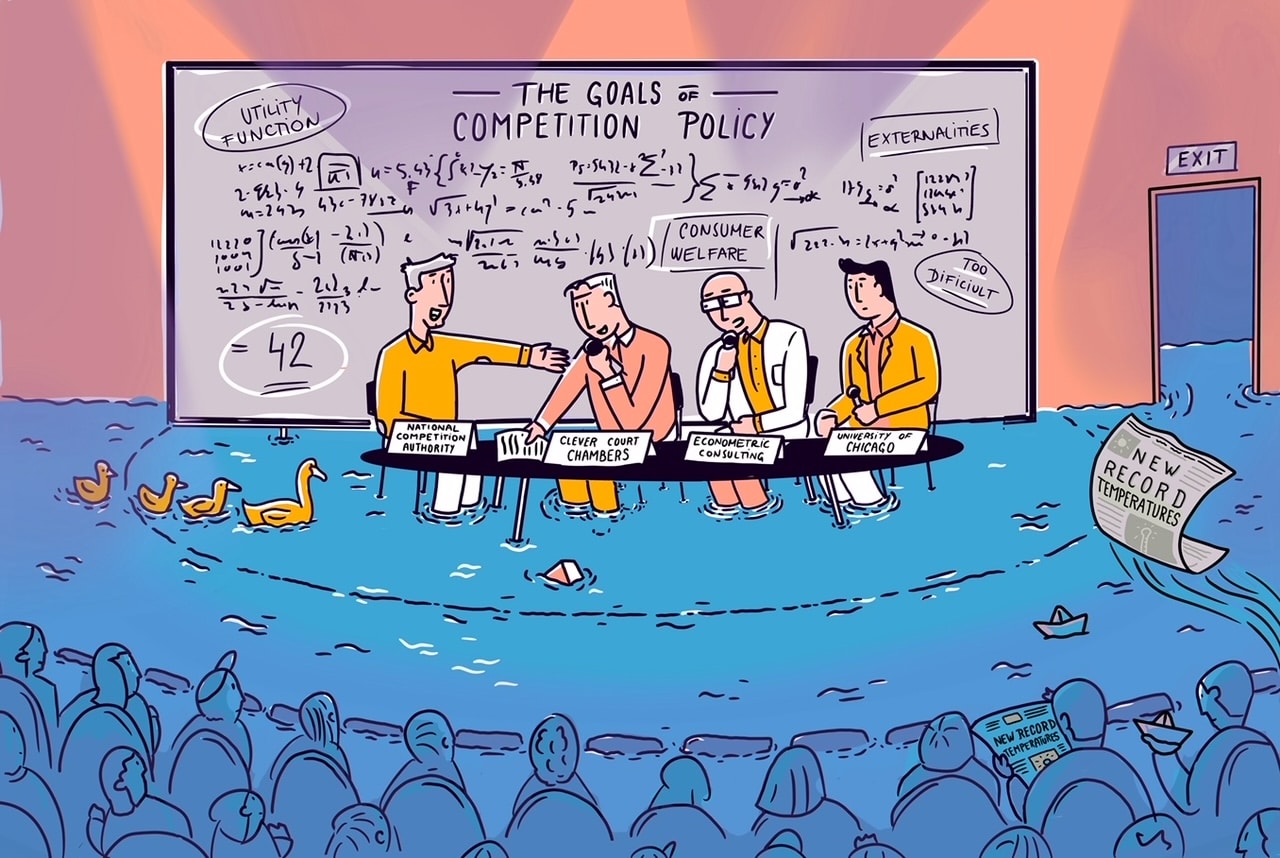
Climate change and sustainability are relevant to all aspects of competition policy, particularly the prohibition on anticompetitive agreements; the sanctioning of abuses of a dominant position; and merger control[4]. In each case, sustainability can be a positive or a negative factor or, put another way, competition policy can be used as a “sword” to sanction anti-competitive agreements and unsustainable conduct, or sustainability can help shield positive action to fight climate change from potential misuse of competition law.
That makes six aspects to consider: three areas of competition policy and the “sword” and the “shield”.
Regulation is often the first-choice policy instrument, but it is limited in jurisdictional scope, slow in coming or simply missing completely due to a lack of political will or agreement – just think of the failures at recent COPs. For example, if we had a proper global carbon price or carbon tax, then there would probably not be much role for competition policy to play. In the real world there is.
Similarly, companies can often compete to produce more sustainable products – and where they can, they should. However, at least in the short term, first movers may suffer a competitive disadvantage and either not produce a more sustainable product at all – or it remains a niche product[6].
Market Failure
This is a classic market failure and, as the British economist, Lord Stern put it: “climate change is the result of the biggest market failure the world has seen”.[7] This is as a result of several factors including:
(1) a corporate collective action problem (each company may want to produce a more sustainable product but dares not do so in case it is undercut by rivals);
(2) so-called negative externalities (i.e., costs imposed on society but not included in the company’s accounts);
(3) information asymmetries (i.e., even consumers who are willing to pay a price for more sustainability may either not know that one product is more sustainable than its competitors, and/or they do not believe the claims of more sustainability because of the fear of greenwashing);
(4) a consumer collective action problem (why should I pay more for a more sustainable product if others do not?);
(5) hyperbolic discounting (we tend to underestimate future harms and benefits and focus on immediate costs and benefits; and
(6) as consumers we say/think one thing but when we pick a product off the shelf in a shop we buy the cheapest-not the most sustainable product.
As we need to make whole sectors of our economy more sustainable at scale and at pace, this market failure means businesses often need to work together if (in the real world) this is to have any chance of being achieved. In most cases this can be done within existing competition law – at least in Europe[8].
To facilitate this, many competition authorities have produced guidelines explaining this – notably the European Commission[9] and the UK’s CMA[10] in 2023, but also various authorities around the world including several European states, Australia, New Zealand, Singapore and Japan with others under consideration (including Brazil -and potentially, Mexico).
They have also made it clear that they have an “open door” / “porte ouverte” policy and they are open to help companies with individual projects. Many have issued informal guidance on these (including the European Commission and the national competition authorities in Germany, the Netherlands, France, the UK and Belgium)[11].
The big worry, however, is the US, which has not produced guidelines and court action has been taken against so-called ESG agreements in a number of Republican states (eg Texas v Blackrock[12]). This has had 2 adverse effects:
On the positive side the US (and possibly Brazil) are outliers, and a growing portion of the world seems to be following the more progressive European lead. Let’s hope more South American countries do so.
In conclusion, there is a lot businesses can do to work together to fight climate change and make their industries more sustainable without infringing competition law. In cases of doubt, they should respond to the competition authorities’ invitation to seek guidance. That said, care needs to be taken if there are implications in the US (and probably Brazil).
On the other hand, it is clear that agreements to limit competition on sustainability issues (where it is a parameter of competition) is just as much an infringement of competition law as a price fixing or a market sharing agreement. The European Commission has fined companies hundreds of millions of euros for such infringements – as have various national competition authorities. [1] For example, in the AdBlue case the Commission imposed a fine of 875 million euros on five German car manufacturers for restricting competition in emission cleaning technology for new diesel passenger cars.[14]
The abuse of dominance provisions can also be used as a “sword” to attack unsustainable conduct by dominant companies – notably where there has been a serious market failure and regulation has failed to tackle it. Where this is possible, it makes sense from a time and resources perspective given that it has been estimated that just 100 companies have been responsible for over 70% of global emissions since 1988[15].
One example might be where a dominant company avoids the costs of disposing of its waste products by dumping them in a river or on land whereas its smaller competitors incur the costs of disposing of such waste responsibly. In the language of EU law this might be an exclusionary and/or an exploitative abuse[16].
The law in this area is under-developed but dominant companies have a “special responsibility” to behave well, and courts have made it clear that the abuse of dominance provisions are very flexible and that the categories of abuse are not fixed [17].
An abuse is where a dominant company deviates from “normal competition” or “competition on the merits”[18]. What is normal may change over time and should reflect society’s values at any given time. There is therefore no reason in principle why categories of abuse around unsustainable conduct could not be developed.
Although there are limited cases in this area, national competition authorities are showing increasing willingness to recognise sustainability considerations in the assessment of abuse.
For example, in the Google/Enel X case, harming the environment was an aggravating factor when fines of £100 million were imposed on Google by the Italian Competition Authority (‘ICA’). The ICA took into account the “possible negative effects [ which] could occur to the diffusion of electric vehicles, to the use of “clean” energy and to the transition towards a more environmentally sustainable mobility”.[19]
Other cases brought by national competition authorities include Corepla by the Italian authority[20] and Engie II by the French authority[21].
Moreover, the Commission and various national authorities and courts are considering a number of pending cases in this area.
For example, in the Greek Lignite case, in alleging that the dominant Greek electricity provider PPC has abused its dominant position by selling its electricity in the Greek wholesale electricity market below cost, the Commission’s statement of objections alleges that, not only were independent power providers marginalised, but also investment into more environmentally friendly energy sources was deterred. In outlining the harm, the Commission explains how the conduct may have led, not only to higher prices for Greek consumers, but also to “higher emission levels and local pollution” for consumers.[22]
That said, many of the cases so far can also be seen to fall within established categories of abuse. We should only “re-invent the wheel” if we really have to.
For example:
Using the abuse of dominance provisions as a “sword” to help tackle unsustainable conduct by dominant companies would complement environmental (and potentially social sustainability) regulations – either because regulation is absent, or because it is not being properly enforced or not enforced at all.[23]
Big companies have the greatest potential to help with the transition to a more sustainable economy, and we need to make sure that steps taken by such companies are not mis-characterised as an abuse. For example, a dominant company’s decision to phase out, withdraw or replace non-sustainable products or processes with sustainable ones should not (assuming it is genuine) be seen as some sort of constructive refusal to supply. Similarly, if a dominant company decides not to supply products and services (such as finance or insurance) which its customer would use for objectively unsustainable purposes, either this is not an abuse at all, or it may be “objectively justified”.
It will be interesting to see what the European Commission’s anticipated final guidelines on exclusionary abuses will say on this[25]. My current understanding is that they will include more on sustainability in the context of the section dealing with “objective justification”. [26]
First some words of caution:
However, in the context of the climate crisis we can’t just hide in our “antitrust bubble” when assessing a proposed merger. It is now well accepted that sustainability considerations can be very relevant in merger control. As the European Commission put it when announcing its Draft Merger Guidelines on 30th April this year[28]: “sustainability and resilience have become relevant parameters for competition” and the guidelines seek to “recognise sustainability and resilience as important competitive realities, providing guidance on how their positive contributions to the economy and society as a whole may be considered in merger control reviews”.
The Commission’s Competition Merger Brief of September 2023[29] had already anticipated this, showing that sustainability issues were relevant in merger control in various ways:
It also illustrates how sustainability issues have been taken into account in its decisional practice.
Sustainability considerations can also be considered in varying degrees under the national merger control rules of a number of countries.[31]
It is clear from the above that sustainability considerations can be positive factors making it more likely that a deal will be cleared: for example, where a large company acquires a smaller company with green technology and roles this technology out across the larger platform of the merged entity.
Conversely, mergers can be harmful for sustainability; for example, the opposite of the above: “green killer acquisitions” where a big company buys a more sustainable rival and kills off its green technology or products. Mergers can also reduce incentives to invest and innovate in green products and technologies.
At the time of writing this article, the Draft Merger Guidelines have only just been published, they are subject to consultation, and they will be amended in the light of this before being finalised. It is therefore premature to draw too many conclusions, but some initial comments can be made.
First, they are helpful from a sustainability point of view in several respects. For example:
Secondly, there are a number of areas where I have reservations about the Draft Merger Guidelines (but we need to see the final text before drawing too many conclusions). For example:
Climate change is a potentially existential threat for humanity-or at least for life as we know it. In these circumstances we need to use all policies and tools available. Competition policy is no exception and is a powerful tool which can and must be used wherever appropriate.
This is discussed in more detail in other papers (by me and other authors) [45] but this paper has outlined 6 ways in which competition law can play a part in the fight against climate change and putting our economy on a more sustainable basis.
I conclude with a brief summary of how the competition authorities (at least in Europe) are doing in each of these areas:
Interim Progress Report
(i) Competition authorities are generally doing a good job using the prohibition on anti-competitive agreements as a “sword” to condemn agreements which restrict competition on sustainability.
(ii) They have also done reasonably well in showing how sustainability cooperation agreements can be consistent with competition law – although there are various ways in which the Horizontal Guidelines could be improved.
(iii) and (iv) On mergers I am optimistic that the competition authorities have a pretty good understanding of how sustainability can be either a positive or a negative factor when assessing a merger under competition law. That said, I would like to see the Draft Merger Guidelines set out more clearly the potential harms of a merger from a sustainability perspective in line with the more extensive treatment of the potential sustainability benefits of a merger.
(v) I am also optimistic that the European Commission’s anticipated guidelines on abuse of dominance, will help demonstrate that action by dominant companies to be more sustainable may be objectively justifiable and not amount to an abuse-the shield aspect.
(vi) Unfortunately, I am less confident that these guidelines will show how the abuse provisions can be used as a sword to attack unsustainable conduct by dominant companies. However, there are more and more cases emerging from the competition authorities which illustrate how this can be done.
So, I give a punctuation of 69/100: a very good pass and a fantastic improvement on a few years ago with potential to gain a distinction in the near future.
Footnotes:
[1] For example: IPPC “Climate Change 2022: impacts, Adaptation and Vulnerability” (27 February 2022).
[2] Robert Catherall, “The economic cost of extreme weather events” (2024) Oxera.
[3] Sandy Trust et al “The Emperor’s New Climate Scenarios” (2023), UK Institute and Faculty of Actuaries.
[4] It is also very relevant to subsidy control (state aid in EU parlance) and public procurement, but these aspects of competition policy are outside the scope of this short paper.
[5] This paper focuses on EU law but many countries (not only in Europe but around the world) are modelled on EU law-with many containing identical wording. Furthermore, even laws which use different wording (such as Sections 1 and 2 of the US Sherman Act) are generally trying to tackle the same fundamental problems-the prevention of anti-competitive harms to the economy and society (and I would add the planet).
[6] It is no answer to this “collective action” problem that some firms have managed to produce a sustainable product profitably if such products remain niche (and often expensive).
[7] “The Economics of Climate Change” (Cambridge University Press 2008).
[8] The legal case as to why most sustainability cooperation agreements should not infringe competition law (at least not in Europe) is set out more fully in S. Holmes, ‘Climate Change, Sustainability, and Competition Law’ (2020) 8 Journal of Antitrust Enforcement 354; and in M.Dolmans , ‘Sustainable Competition Policy’ (2020) 6 Competition Law & Policy Debate 4.
[9] European Commission Horizontal Guidelines, June 2023. Chapter 9 is devoted entirely to “Sustainability Cooperation Agreements”. These guidelines have been widely welcomed and represent considerable progress. Nevertheless, they have been rightly criticised in various respects (see footnote 45 and citations therein)
[10] “Green Agreements Guidance”, 12 October. 2023 [CMA 185].
[11] For a summary of some of these opinions see Simon Holmes “Sustainability and Competition Policy in Europe: Recent Developments” [Journal of European Competition Law and Practice. Volume 15, Issue 8, December 2024].
[12] Texas v Blackrock Inc [Case6:24-CV-00437] and “Shareholder Engagement Considerations in light of Texas v Blackrock”, Cleary Gottlieb, August 6, 2025. On this transatlantic divide see further Dolmans/Lin/Hollis, 8(2) Competition Law &Policy Debate (2023), 63-80 and Angerbauer/Sachs, WuW 2026,62-67.
[13] One of the key “tipping points for global warming is the risk that the Amazon rain forest tips from being a carbon sink into a savannah emitting CO2. See, for example, Professor Tim Lenton, “Global Tipping Points” (2023), and “Global Tipping Points Report 2025” (2025). Tragically, on 6 May this year a report came out showing model projections finding that the Amazon tipping point is already being crossed {6 May 2026, “Deforestation induced drying lowers Amazon climate threshold”, Nico Wunderling et al.]
[14] Commission Decision of 8 July 2021 relating to a proceeding under Article 101 of the Treaty on the Functioning of the European Union and Article 53 of the EEA Agreement (Case AT.40178 – Car Emissions) C(2021) 5037 final. Another example is the E20 million fine imposed by the French competition authority in the Bisphenol A Case [Press release of the French Autorite de la Concurrence of 11 January 2024].
[15] See P Griffin, “The Carbon Majors Database: CDP Carbon Majors Report 2017” [CDP, July 2017].
[16] In the case of an “exploitative” abuse the dominant company’s conduct directly harms consumers whereas in the case of an “exclusionary” abuse the effect is indirect as a result of the exclusionary effect on competitors of the dominant company.
[17] Case T-321/05 Astra Zeneca v Commission [2010 ECR II-2805].
[18] See, for example, C-85/76 Hoffman-La Roche & Co v Commission [1979 ECR 1979-00461]. There is also a substantial discussion of “Competition On The Merits” in the European Commission’s Draft 102 Guidelines” (see footnote 25 below).
[19] Italian Autorità Garante della Concorrenza e del Mercato (‘AGCM’), ‘ICA: Google fined over 100 million for abuse of dominance’ (13 May 2021) Press Release; This was upheld by the European Court of Justice [ C-233/23 Alphabet Inc. and Others v Autorità Garante della Concorreza e del Mercato and Enel X Italia [2025] ECLI:EU:C:2025:110 (‘Google Android Auto’)].
[20] AGCM Press release of 10 November 2020.
[21] French Autorite de la concurrence, Engie vs Direct Energie, 7 September 2017, no 17-D-16.
[22] European Commission, ‘Commission Sends Statement of Objections to PPC over Predatory Pricing in the Greek Wholesale Electricity Market’ Press Release IP/24/672, 07.02.2024.
[23] This is discussed more extensively in S Holmes, “Using the abuse of dominance provisions to help fight climate change and unsustainable conduct” [La Revue Des Juristes de Science Po, Mars 2026-No 29]. See also S Holmes “Climate Change, Sustainability and Competition Law”, Note [13] above; S Holmes and M Meagher “A sustainable Future: how can control of monopoly power play a part?” [(2023) ECLR 61, Part II]; and M. Iacovides and C. Vrettos, ‘Radical for Whom? Unsustainable Business Practices as Abuses of Dominance’ in S. Holmes, D. Middelschulte and M. Snoep (eds.), Competition Law, Climate Change & Environmental Sustainability (Concurrences, 2021.
[24] On 31 July 2024 the European Commission published draft “Guidelines on the application of Article 102 TFEU to abusive exclusionary conduct by dominant companies” (“The Draft 102 Guidelines”). These are not generally discussed in this short article as the Commission aims to finalise these later in 2026 after taking into account a number of anticipated judgments of the European Court of Justice-for example that in the Google Android case [Case T-604/18 Google LLC v Commission].The draft is discussed to a certain extent in my Science Po article cited in footnote 23 above and in V.G Garcia , T. Klein and D Moore, “Sustainability and exclusionary abuse under Article 102: navigating a developing EU framework” [(2025) 2 Competition Law Journal 84].
[25] See footnote 24 above.
[26] For a discussion of sustainability as a “shield” (and further examples) see the S Holmes article in footnote 9 and M. Iacovides and V. Mauboussin, ‘Unilateral Conduct and Sustainability under EU Competition Law’ (Edward Elgar Publishing 2024).
[27] The relevance of climate change and sustainability considerations in merger control is considered more extensively in several of my papers including “Climate Change, Sustainability and Competition Law and” (Part VII) and in Part III of “A sustainable future: how can control of monopoly power play a part?” (see footnotes 9 and 24 above). Two excellent articles on environmental sustainability and merger control are included in Simon Holmes, Dirk Middelschulte and Martijn Snoep (eds), Competition Law, Climate Change & Environmental Sustainability (Concurrences, Institute of Competition Law, 2021): Nicole Kar, Emma Cochrane and Bella Spring, “Environmental Sustainability and EU Merger Control: EU Competition Policy’s Dark Horse to support Green Investment”; and Alec Burnside, Marjolein De Backer and Delphine Strohl, “Can Environmental Interests Trump an EUMR Decision.”See also 2 papers by Elias Deutscher and Stavros Makris: “Sustainability concerns in EU merger control: from output -maximising to polycentric innovation competition” [JAE 2023, 11, 350-399] and “Making sustainability visible: a new framework and operationalization tests for merger control;” [Research Handbook on sustainability and competition law, Elgar Publishing,2024][. Suzanne Kingston discusses EU Merger policy and sustainability in Chapter 10 of her book “Greening EU Competition Law (Cambridge: Cambridge University Press, 2011).
[28] Commission Press Release IP/26/918 and draft “Guidelines on the assessment of mergers under Council Regulation (EC) No 139/2004 on the control of concentrations between undertakings”. (The Draft Merger Guidelines).
[29] Competition Merger Brief, Issue 2/2023-September.
[30] Or when considering whether there is a “Substantial Lessening of Competition” (“SLC”) under the laws of other countries such as the UK (and one would like to add the US).
[31] A notable example is the Miba Zollern case in Germany where the German government allowed a deal that had previously been blocked by the German Bundeskartellampt ruling that the positive effects of the deal for the environment and climate protection outweighed the competitive disadvantages (citing noise reduction, reduced fuel consumption, and, more generally, climate protection and sustainable environment policy”). Sustainability issues are clearly relevant under national merger control in Europe but also in other parts of the world -a good example being Australia with its “public interest” test (eg in the Brookfield/MidOcean/Origin decision of the ACCC of 10 October 2023.]
For a consideration of sustainability issues under UK competition law see Simon Holmes, “Climate Change, sustainability and competition law in the UK” [ECLR (2020)42 ECLR Issue 8}.
[32] See, for example paras 20, 23, 34, 133, 297-300, 315, 319-322, 339-342 and 348 of the Draft Merger Guidelines.
[33] Para 20 ibid.
[34] Para 23 ibid.
[35] Paras 297 to 300 ibid.
[36] These include: “(i) a combination of complementary assets; (ii) improved access to sustainable inputs; or (iii) the creation of new or improved products that are more sustainable. (para 299 ibid).
[37] Para 315 ibid.
[38] Paras 321, 322, and 336/337). For a fuller discussion of these concepts see the Commission’s Horizontal Guidelines (see para 10 above).
[39] See footnote 14 above.
[40] Paras 341 and 348 ibid.
[41] Para 55 ibid.
[42] Given the significant increase in concentration and corporate market power in recent decades, this is of potential concern. See the discussion and papers cited in Parts 1 and III of “A sustainable future: how can control of monopoly power play a part?” -see footnote 24 above.
[43] Para 306 ibid.
[44] See, in particular paras 569 and 583 of the Horizontal Guidelines cited in footnote 10 and criticism of this approach-for example in “A consistent policy for all three areas of EU competition law”, M. Dolmans and Sylvie DeTar. [https:// papers.ssrn.com].
[45] There is a growing literature on sustainability and competition policy. In addition to the various papers cited in this article there are a number of interesting books on the topic including:
(1) Holmes/Middelschulte/ Snoep, Competition Law, Climate Change and Environmental Sustainability, Concurrences, 2021; (2) Julian Nowag(ed.), Research Handbook on Sustainability and Competition Law, Edward Elgar, 2024. (3) Haucap/Podszun/Rohner/Rösner, Competition and Sustainability: economic policy and options for reform in antitrust and competition law, Edward Elgar, 2024; (4) Suzanne Kingstone, The Greening of EU Competition Law.

"The Brazilian experience reveals a competition authority increasingly aware of the sustainability debate, yet still reluctant to move beyond traditional antitrust orthodoxy. Although Cade has repeatedly acknowledged the growing importance of environmental cooperation and engaged with comparative international experiences, it has so far avoided articulating any clear framework capable of accommodating sustainability concerns within competition analysis"
On 18 August 2025, Brazil’s competition authority (Cade, in its Portuguese acronym) suspended the Soy Moratorium, one of the world’s most prominent voluntary environmental agreements. Under the arrangement, major grain traders operating in the world’s largest soybean exporter collectively committed not to purchase soy grown on recently deforested areas of the Amazon. In force for nearly two decades, the initiative has been credited with significantly reducing deforestation in monitored areas.
The interim measure issued by the authority’s investigative arm, the General Superintendence (SG), which treated the arrangement as a potential buyers’ cartel, triggered an immediate institutional dispute. The decision was promptly challenged before the judiciary, which suspended its effects pending review by Cade’s Administrative Tribunal. Although the Tribunal ultimately upheld the SG’s decision, it also suspended its practical effects in light of a subsequent ruling by the Brazilian Supreme Court. Beyond the institutional turmoil, however, the episode crystallises a question that Brazilian competition law has long avoided: when competitors coordinate to pursue environmental objectives, how should antitrust law respond?
The answer is far from obvious. After all, antitrust law was built to combat cartels. Yet a growing body of scholarship and regulatory practice argues that competition authorities should also be able to weigh the environmental benefits of cooperative initiatives, provided those benefits are genuine, verifiable, and cannot be achieved through less restrictive means. Getting that balance right, however, requires caution. Environmental rhetoric can be instrumentalised, and sophisticated sustainability narratives may serve as cover for output restrictions, exclusionary practices, coordinated conduct, or exchanges of commercially sensitive information. The risk of “green-labelled” cartels is real, and competition authorities are right to take it seriously.
This tension has not gone unnoticed abroad. Several jurisdictions have moved toward a conciliatory approach, carving out specific exemptions for sustainability agreements but conditioning them upon strict regulatory requirements. The European Commission’s revised Horizontal Guidelines, for instance, introduced a framework under which sustainability agreements may qualify for an exemption under Article 101(3) TFEU, but only where they generate clear efficiency gains, remain indispensable to achieving the environmental goal, preserve residual competition, and pass a fair share of the benefits on to consumers.
Brazil, however, has not adopted any equivalent framework. This omission is particularly consequential given that the country hosts a significant portion of the Amazon rainforest while simultaneously ranking among the world’s largest agricultural commodity exporters. Moreover, its Federal Constitution explicitly places environmental protection alongside free competition as co-equal principles of the economic order under Article 170, which may be read as providing a legal foundation for a more integrated approach to sustainability within antitrust analysis — notwithstanding the counterargument that Brazil’s Competition Law (Law No. 12,529/2011) neither recognises sustainability agreements as a distinct category nor establishes specific criteria for assessing environmentally motivated cooperation between competitors.
Therefore, how such agreements are treated appears, to a significant extent, to remain an institutional choice on Cade’s part. Yet the authority has historically built an orthodox enforcement reputation anchored in price effects, output restrictions, and market efficiency, with sustainability still occupying only a marginal position in its practical deliberations. Indeed, before the Soy Moratorium controversy, Cade’s Administrative Tribunal had substantively engaged with the intersection between competition law and sustainability in only two proceedings involving sustainability agreements. In both cases, the authority recognised the growing relevance of environmental cooperation between competitors, yet stopped short of articulating any clear analytical framework capable of accommodating sustainability concerns within antitrust analysis, — a stance later described by former Commissioner Victor Fernandes (2024), in an award-winning commentary, as reflecting an “agnostic” approach toward environmental objectives.
The first case in which the authority engaged explicitly with sustainability concerns was the SustainIt joint venture (Merger Case No. 08700.009905/2022-83, 2023), which involved a platform designed to standardise sustainability metrics across the agri-food supply chain, created by Cargill, Louis Dreyfus, ADM, and SustainIt. Cade’s Tribunal approved the transaction unanimously and without restrictions. The rapporteur, Commissioner Sérgio Ravagnani, acknowledged that sharing sustainability-related information throughout supply chains has become an increasing requirement nationally and internationally, but emphasised that commitment to sustainability objectives does not exempt firms from antitrust rules. Information-sharing risks were addressed through an «Antitrust Protocol» committing the parties to open, non-discriminatory platform access, a solution that preserved the environmental function while containing competitive risk.
The case exposed a sharp divide within the Tribunal. Commissioner Victor Fernandes argued that Cade should clarify which sustainability agreements can benefit from a form of antitrust safe harbour. He also noted that most collaborations rarely raise significant competition concerns a priori, particularly those that comply with mandatory international standards, adopt voluntary sustainable best practices, develop open databases, or coordinate sectoral awareness initiatives. By contrast, Commissioner Gustavo Freitas de Lima stated unequivocally that environmental objectives are extraneous to antitrust analysis, insisting that objectives such as environmental protection «must be pursued within the boundaries of the normative framework of Law No. 12.529/2011.» Then-President Alexandre Cordeiro similarly warned against opening a «Pandora’s box» by expanding Cade’s mandate to weigh sustainability considerations against competitive effects.
The second case, Consultation No. 08700.004130/2024-11 filed by Lara Central in 2024, involved a proposed joint venture to transform landfill biogas into biomethane, a renewable energy source. Cade admitted the consultation and Commissioner Gomes recognised that the lack of concrete guidance in Brazil may create legal uncertainty and discourage companies from pursuing environmentally beneficial collaborations. Commissioner Fernandes again advocated for a safe harbour framework. Lima again restated his orthodox position.
The pattern across both cases is consistent. Cade acknowledges the international debate, engages with it comparatively, and then retreats to a strict consumer welfare standard, without ever explaining why that standard, as applied in Brazil, must exclude environmental gains from its scope.
As discussed above, the Soy Moratorium case (Investigation 08700.005853/2024-38) became one of the most high-profile antitrust disputes in recent Brazilian history. The environmental and economic significance of the agreement, combined with the political controversy surrounding the complaint, made it a case watched well beyond Brazil’s borders. The challenge was brought primarily by agribusiness associations alleging economic harm to local producers, and subsequently by the Supply and Rural Development Committee of Brazil’s Chamber of Deputies, which filed a formal complaint before Cade against the multinational companies participating in the agreement. The General Superintendence issued a preliminary injunction suspending the Moratorium, treating it as a harmful purchasing cartel, with no meaningful engagement with the environmental dimensions of the arrangement.
For a moment, it appeared that Cade would finally be forced to confront, in a concrete manner, the unresolved tension between cartel enforcement and environmental coordination. That confrontation, however, never materialised. Following the Brazilian Supreme Court’s decision, the Administrative Tribunal, operating under a partly renewed composition, limited itself to upholding the Superintendence’s decision while suspending its practical effects. Nevertheless, the commissioners’ remarks during the judgment session revealed considerable uncertainty as to whether the Moratorium could properly be classified as a buyers’ cartel, as well as recognition that a more detailed and technically grounded assessment would be necessary. Whether such an assessment will eventually take place, however, remains uncertain pending further developments. In the meantime, the agreement was substantially hollowed out: several signatory companies withdrew following the enactment of state laws that made participation fiscally disadvantageous, effectively dismantling the agreement before any ruling on the merits was issued.
What remained, once again, was silence — and silence, in this context, is not neutral. By failing to articulate a framework for assessing environmentally motivated agreements, Cade effectively reinforced an orthodox stance that leaves no room for sustainability considerations in antitrust analysis. The Soy Moratorium controversy makes the cost of that stance visible. Environmental rhetoric can of course be instrumentalised, and the risk of green-labelled cartels is real. But a competition law framework with no meaningful space for sustainability agreements does not remain neutral. It inevitably takes sides. Brazil, given its position at the intersection of global trade and global environmental governance, is a particularly consequential place to get that balance wrong.
Once again, what ultimately prevailed was silence. Yet silence, in this context, is not neutral. By avoiding the articulation of any clear analytical framework for sustainability agreements, Cade indirectly reinforces a more orthodox approach in which environmental cooperation remains peripheral (if not entirely external) to antitrust analysis.
The Brazilian experience reveals a competition authority increasingly aware of the sustainability debate, yet still reluctant to move beyond traditional antitrust orthodoxy. Although Cade has repeatedly acknowledged the growing importance of environmental cooperation and engaged with comparative international experiences, it has so far avoided articulating any clear framework capable of accommodating sustainability concerns within competition analysis.
The result is a landscape marked by uncertainty. Companies pursuing environmentally motivated cooperation remain unable to predict whether their initiatives will be treated as legitimate forms of collective action or as potential cartel conduct. In practice, the absence of guidance has itself become a regulatory choice.
The Soy Moratorium controversy illustrates the consequences of that silence. Rather than producing a substantive institutional discussion on how competition law should assess sustainability agreements, the case became trapped in procedural disputes, judicial interventions, and political conflict. Meanwhile, the agreement itself was progressively weakened before any final assessment on the merits could even take place.
None of this means that environmental cooperation should receive blanket antitrust immunity. Sustainability rhetoric can undoubtedly be instrumentalised, and competition authorities are right to remain cautious toward arrangements capable of restricting rivalry under the guise of environmental protection. But the opposite risk deserves equal attention. A competition law framework that offers no meaningful analytical space for sustainability agreements does not remain neutral. Particularly in a country like Brazil — whose economy, environmental responsibilities, and constitutional order are deeply intertwined — refusing to confront the issue may ultimately amount to taking a position of its own.
The central challenge, therefore, is not whether sustainability should matter within antitrust analysis, but how to develop sufficiently rigorous criteria capable of distinguishing legitimate environmental cooperation from disguised anticompetitive coordination. So far, Brazilian competition law has postponed that conversation. The Soy Moratorium case suggests it may not be able to avoid it for much longer.

"we cannot only be concerned with environmental sustainability, but should include social sustainability, justice, equality, fairness, democracy, and security – all necessary ingredients of prosperity and the EU’s vision of a “good society” – in our understanding of sustainability as a goal of EU competition law"
Should the European Union (EU) pursue sustainability as a goal through its competition policy, and if so, how and to what extent? To provide an answer to this question, we must first dispel the myth that the alternative to a competition policy that pursues (among other values) sustainability is a pure, neutral competition policy that is devoid of ideology and politics and that solely pursues rational, economic objectives, econometrically verifiable, and objective. Far from that, the alternative is a competition policy that will be instrumentalized by whichever policy framework and political ideology neoliberalism will mutate into, most likely, as Slobodian convincingly demonstrates, what is already inherent in it (Slobodian, 2021), namely the far right (Slobodian, 2025).
If we were to recount the story of real, applied neoliberalism, one starting point among several possibilities would be the 1973 coup in Chile that ushered in the dictatorship of Augusto Pinochet. Narrating the history of neoliberalism with Pinochet’s rise as its starting point has the added advantage of revealing the unequivocal fact that the Global South is consistently the first to be affected by any destructive and detrimental concept, method, weapon, or tool conceived, designed, and concocted in the Global North (Slobodian, 2025, at 131-132). With Pinochet’s dictatorship, the era of the Chicago Boys (Bevins, 2023; Roff, 2025), the técnicos, and el modelo of rampant Chilean neoliberalism (Bruey, 2020) was ushered in, cheered on enthusiastically by Friedrich von Hayek and Milton Friedman (Whyte, 2019).
It took only about a decade for the ideas initially tested in the authoritarian laboratories of Latin America to reach Europe, in a typical imperial boomerang fashion (Césaire, 1950 at 20; Arendt, 1951; Weil, 1952). Margaret Thatcher’s handling of the miners’ strike is a clear example of this.
Those ideas slowly became official policy in the EU, too, when neoliberalism seemed to have won the argument over socialism, and history – supposedly – came to an end (Fukuyama, 1989). The Single European Act transposed the United Kingdom’s version of “authoritarian populism” to the Union, through a market liberalisation agenda (Wilkinson, 2023, at 294). The collapse of the USSR offered an opportunity for the expansion of capitalism and markets in the emergent new republics at the Union’s periphery. The Maastricht Treaty made a Union out of the European Economic Communities, constructed the edifice of a (would-be) federation and raised a European flag, but offered little democratic legitimacy to projects such as the European Monetary Union (Agamben, 2025). Europe created a common currency devoid of solidarity, and introduced no common borrowing or taxation, hoping that rules, market discipline, and competition between the Member States would lead to neoliberal outcomes such as deregulation, privatization, labour market flexibilization, and, hence, keep the Member States on track. The Eurozone crisis demonstrated how this failed, but instead of abandoning the model, the Union doubled down on austerity and engaged in authoritarian and coercive exercise of public power, which it deemed necessary to achieve those neoliberal outcomes (Lokdam, 2023, at 310).
Thus, overall, the Union’s economic constitution, far from being neutral as is often argued (e.g., Maduro, 1998; Kaupa, 2016) was in fact applied with a neoliberal agenda in mind (Bugarič, 2023; Grégoire, 2024). What about competition policy?
For the Community, a primary concern with competition policy initially was not so much economic efficiency as it was constructing the single market. Competition law was there, predominantly, to guarantee that the removal of Member States’ tariff and other trade barriers brought about by European integration would not be negated by anti-competitive agreements amongst undertakings, compartmentalizing anew the single market along national lines (Case 56/64 Consten and Grundig v Commission). This meant that the Commission prioritized vertical agreements (e.g., those that offered absolute territorial protection to distributors) and was preoccupied with the structure of markets in its enforcement, often focusing on form rather than economic impact.
During the 90’s, however, neoliberalism – in its Chicago school iteration – did start to make its way from the United States into EU competition policy, too, through what came to be known as the “more economic approach” that focused on consumer welfare, an artfully invented term by Bork (1978), considering that it really was about total surplus (i.e. including both consumer and producer surplus) and that it had nothing to do with welfare as any ordinary citizen would actually understand it, focusing essentially on low prices, increased output, or efficiency.
Despite the persistence of other goals (Stylianou & Iacovides, 2022), slowly but surely, consumer welfare and efficiency became increasingly prominent goals, first through the Commission’s enforcement (and several soft law instruments, such as the Relevant Market Notice, guidelines on horizontal and vertical agreements, guidelines on horizontal and vertical mergers, and the Guidance on Enforcement Priorities on Article 102 TFEU), and eventually, also in the Court’s case law. There was an effort to present the policy as neutral and to keep it shielded from the rest of the corpus of EU law (see, e.g., Peeperkorn, 2021 at 418-418). A generation of competition lawyers, academics, policymakers, practitioners, and judges, was conditioned to focus narrowly on Articles 101 and 102 TFEU as well as the EU Merger Regulation, to be in a competition law bubble of sorts (see, e.g., Loozen, 2019). Economists and econometric tests were brought in (Bishop, 1997). Chief economist departments were created at the Commission’s Directorate-General for Competition and at National Competition Authorities (NCAs) in the EU. Technocracy would henceforth rule and competition policy would be a rational legal field, removed from the whims of politicians (see, e.g., Commission Decision in Case M.8677 Siemens/Alstom) and from the sentimental rollercoasters of citizens who could not always be trusted to understand that globalisation and competition amongst nations and corporations might well result in job losses, severe deindustrialisation, withering away of local communities, and environmental harm, but that this was necessary to bring about an expansion of markets that would (hopefully) fix those problems and other externalities at some time in the future. There was no alternative, we were told (Séville, 2016).
Inevitably, there would be winners and losers in this world of cutthroat competition, but it was not competition law’s job to protect competitors that were seen as less efficient in terms of price, or quality, in the eyes of consumers (Case C-413/14 P Intel v Commission, § 134). Let alone to care about citizens, local communities, the environment, pollution, workers, and so on, so long as that “caring” could not be translated into choices in a free market and if it could not be monetised through market participants’ willingness to pay.
The transition was a profound shift in regulatory philosophy for the EU and, therefore, the implementation was gradual, although competition policy in Europe was already quite influenced by ordoliberalism, a homegrown ideology with close affinity to neoliberalism (Cole & Ηartmann, 2023). The irony of the slow adoption of neoliberalism’s prescriptions by EU competition law is that by the time the Court of Justice fully and explicitly endorsed its philosophy (e.g., in Case C-209/10 Post Danmark; and in Intel, ibid), neoliberalism was already crumpling under the weight of its own failures. The collapse of Lehman Brothers in 2008 commenced the long process of replacing that policy framework and political ideology with something else. Several crises since then, we are now in permacrisis mode, looking for a way out of the mess.
For the EU, according to Bartl, there are three possible ways forward, based on different social imaginaries of prosperity contenting to reconstitute our societies after neoliberalism. The first one is, basically, a business-as-usual scenario, with certain incremental adaptations that take into account current challenges, such as climate change, but that leave unaltered the current system’s foundational fixation with individualism, privatisation, private initiative, market-driven technological innovation, and financialization. The second is a nativist, tribal, conservative imaginary that focuses on identity and relies on nationalist, chauvinist, anti-immigrant, and racist discourses, while being hostile towards democratic institutions, the rule of law, and even scientific knowledge. The third, finally, is a new social imaginary of shared prosperity, where democratic and public bodies will be the driving force behind prosperity, rather than markets, businesses, or profit (Bartl, 2024, summarised at 3-4). For Bartl – perhaps a bit optimistically – the imaginary of shared prosperity is present in the European Green Deal (2019) and legislation that emanates from it.
Indeed, the Green Deal spurred a lot of activity related to sustainability in EU competition law, starting with a recognition that competition law can be applied in ways that support the Green Deal goals (e.g., Commission, 2021a; Commission, 2021b; European Parliament, 2020). Since then, we have had a new specific chapter on sustainability agreements in the revised Horizontal Guidelines (Commission, 2023), an exception for sustainability agreements in the agricultural sector (Regulation1308/2013, new article 210a; Commission, Agricultural Exclusion Guidelines, 2023) sustainability-related adaptations to the Relevant Market Notice (Commission, 2024, §§ 15 and 72) and merger control (Draft Merger Guidelines, 2026), as well as a slight acknowledgment of sustainability’s relevance for Article 102 TFEU as a quality parameter (Draft Guidelines on Article 102 TFEU, 2024, fn. 4). On the enforcement side, we have had the Car Emissions case, showing how antitrust prohibitions can operate synergistically with sustainability goals (Commission Decision in Case AT.40178, 2021).
Nevertheless, these developments do not really show any significant departure from the neoliberal, consumer-welfare focused competition policy. Sustainability is only partially recognised as a goal of EU competition law, if we look at the decisional practice of the Commission and the case law of the Court of Justice of the European Union (Iacovides & Stylianou, 2024). The Commission’s approach, thus, remains one in which sustainability is accepted, so long as it can be read into a consumer welfare approach, as recently pointed out by Nowag and Cheng (2026, at 371). This is evident, for instance, in the Commission’s new Guidelines on Horizontal Agreements (Commission, 2023) where sustainability agreements giving rise to collective benefits can only be considered for an Article 101(3) exception under the “fair share to consumers” criterion if the buyers of the product would be willing to pay for the more sustainable product (§ 585).
This limited incorporation of sustainability considerations in contemporary EU competition law is no surprise, as largely the EU has not shaken off its neoliberal economic constitution yet (Grégoire, 2026). Instead, as we see clearly during the second von der Leyen Commission, the incremental changes brought about in a business-as-usual scenario of trying to improve neoliberalism will always be considered optional, reversible, subject to horse-trading and negotiable to appease business interests, or the far right, or to achieve other goals, such as the now preeminent goal of European competitiveness (Draghi, 2024; Competitiveness Compass, 2025), or security through militarisation (see, in general, the Omnibus Proposals, 2025). In other words, as during the Eurozone crisis, instead of a departure from a failed model, the EU is doubling down on neoliberalism.
There are at least two problems with insisting on that failed model. The first is that we will – inevitably – keep failing in our efforts to find solutions to the pressing issues facing our societies and our planet. The scientific evidence is indisputable. Planetary boundaries are still being transgressed at an increasing rate and that will cause irreversible harm to people and planet (Stockholm Resilience Centre, 2025). Our carbon allowance for staying within 1.5 degrees Celsius temperature increase as mandated by the Paris Agreement (2015) is almost used up (Global Carbon Budget, 2025). We are probably already overshooting that level of warming (Guterres, 2025). The consequences are not abstract, they manifest in intensifying heatwaves, collapsing ecosystems, mass extinction, displacement, and cascading food insecurity that disproportionately affects those least responsible for the crisis. We have sluggish growth, disgruntled populations, the rise and rise of the far right, authoritarian regimes, backsliding on democracy, endless wars and conflict, near-collapse of public international law, and discredited or disregarded international institutions.
The second problem is that while we will be betting our future on the failed model finally working (it won’t!), putting our eggs in the basket of decoupling economic growth from energy and material throughput (never proven at scale, European Environmental Bureau, 2019) and techno-optimistically (Andreessen, 2023) hoping that some miraculous solution will be found by a billionaire to our current predicaments (as if!), the authoritarian, nativist, conservative, anti-immigrant, anti-science imaginary (Bartl’s second imaginary, above) will be consolidating its grip on the world. Every day we delay meaningful transformation, these forces gain ground, embedding themselves in electoral systems, media ecosystems, and cultural norms. Meanwhile, the window for democratic, equitable solutions narrows. We are not just running out of carbon budget; we are running out of time.
So, the question we ought to be asking is not whether competition policy should pursue sustainability or not. That dilemma is false, premised as it is on the erroneous view that an approach that does not pursue sustainability is more neutral or legitimate. As I hope the discussion above has demonstrated, it is not. The more economic approach to EU competition law is not inevitable; it is an ideologically driven application of neoliberalism on the economic constitution. Choosing not to pursue sustainability through competition rules would be an expression of that chosen ideology.
Importantly, it would be contrary to EU law, especially Article 11 TFEU (Holmes, 2020; Iacovides & Vrettos, 2022; see also Nowag, 2016 in general on Article 11 TFEU). The EU itself, and therefore its economic constitution too, has always been a political project. As any constitution, the Treaties give expression to the aspiration of its constituent powers (the Member States and, indirectly, their peoples) to achieve certain goals. We may agree or disagree with the Union’s method for achieving those goals, for instance, the inclusion of economic rules, such as competition rules, in the economic constitution (Grimm, 2017; Spieker, 2025). But this is what we got, for now. We cannot simply separate competition policy from the rest of the corpus of EU law and pretend that the former’s application is simply a matter of blind arithmetic.
Since sustainability must be a competition law goal, then, the question to ask is rather what content that sustainability should have and how to go about achieving it.
Regarding the content, Article 2 of the Treaty on the European Union (TEU) provides that “the Union is founded on the values of respect for human dignity, freedom, democracy, equality, the rule of law and respect for human rights, including the rights of persons belonging to minorities. These values are common to the Member States in a society in which pluralism, non-discrimination, tolerance, justice, solidarity and equality between women and men prevail.” In the pivotal recent judgment of Commission v Hungary (Valeurs de l’Union), the EU Court of Justice, sitting as a full court, found that the values enshrined in Article 2 TEU are “per se, legally binding, as a result of which there is an obligation, for the Member States and institutions of the Union, to respect, maintain and promote those values” (Case C-769/22, § 536). The Court interpreted Article 2 TEU as being justiciable on its own, meaning that in cases of manifest and particularly serious breaches of one or more values (ibid, § 551), infringement actions can be brought against Member States that do not respect them on the basis of this article, without needing to show that the violations of Article 2 TEU values are linked to violations of other, more specific provisions of EU law.
As the quote above makes clear, the obligation to respect, maintain and promote the values enshrined in Article 2 TEU rests not only on the Member States, but also on the Union itself. The content of sustainability must, thus, be compatible with those values. From that we can infer that we cannot only be concerned with environmental sustainability, but should include social sustainability, justice, equality, fairness, democracy, and security – all necessary ingredients of prosperity and the EU’s vision of a “good society” (Advocate General Ćapeta Opinion in Case C-769/22 Hungary v Commission (Valeurs de l’Union), § 157) – in our understanding of sustainability as a goal of EU competition law. This is also supported by the text of Article 3 TEU, which contains the EU’s core aims and objectives as well as other provisions of horizontal application, including the aforementioned Article 11 TFEU.
Regarding the method, there are already several suggestions in the relevant literature, among others Monti (2020), Holmes (2020), Iacovides & Vrettos (2021), Crona & Iacovides (2023), Deutscher & Makris (2023), Holmes and Meagher (2023), Haucap et al (2024); Iacovides & Mauboussin (2024), McLean (2024); Mäihäniemi (2024), Nowag (2024); Marco Colino (2025) Deutscher (2025), Iacovides (2025), and Bernatt & Darr (2026). Summarising, in these works we find, inter alia, suggestions for using competition law as a sword against unsustainable conduct, a broader acceptance of out-of-market efficiencies, expanding our understanding of market power, using precedents such as Albany (Case C-67/96) or Wouters (Case C-309/99) to exclude sustainability-enhancing conduct from the scope of the antitrust rules, developing theories of harm that are suited to protect democracy, sustainability, or workers, seeing unsustainable business conduct as abuse of dominance, and changing our current understanding of innovation (see also Iacovides & Stylianou, 2024, at section 3 for a summary of the relevant literature).
In conclusion, the permacrisis is also a crisis of the European constitutional imagination (Wilkinson, 2023). That lack of imagination is, in my opinion, unnecessarily hindering our capacity to radically redesign the economic constitution to align it with what European citizens truly value and with the Union’s vision of a good society, with competition policy as one of its building blocks and (broad) sustainability as one of its goals. By insisting on a neoliberal understanding of competition policy and by obscuring the economic domination effects that understanding has had over the past decades, we would not be defending a neutral policy. We would be enabling the instrumentalization of the policy against the weakest in society (see, e.g., “retaliatory” action by the FTC against undertakings providing healthcare to trans persons, Memorandum Opinion by District Court of Columbia Judge Boasberg, 2026) and for the support of regressive forces (see, e.g., Ferguson speech, 2026). We would be failing to protect our democracy, our security, and our digital independence.
Instead, we should move beyond the current business-as-usual superficial incorporation of sustainability in competition policy to truly defend people and planet. In the EU, we have a relatively strong democracy, rule of law, independent institutions and a good track record of protection of rights. We should trust in our capacity to implement a competition policy that respects, maintains and actively promotes sustainability.

"the relationship between sustainability and other areas of innovation is highly context-dependent and not linear. Unfortunately, that means that agencies cannot adopt simple, straightforward approaches"
These days, competition authorities are often in an awkward position. They have to deal with sustainability matters even though many of these agencies claim that this is not their area of expertise. Competition law’s starting point is that rivalry is good for us: it lowers prices, increases quality and drives innovation.[1] At the same time, in the sustainability competition debate, the opposite is frequently brought to the fore: the argument goes that the transition firms require firms to cooperate and thereby reduce competition. In other words, action to, for example, decarbonise would require cooperation to prevent a race to the bottom. This leaves people wondering: so which is it? Does competition drive sustainability innovation, or does competition and competition law stand in the way of it?
Unsurprisingly, the lawyers’ – but also the economists’- answer is: it depends.
But what does it depend on? It depends on a number of economic variables that authorities need to assess on a case-by-case basis. Thus, the relationship between competition and sustainability innovation is not linear and instead context-dependent.
This post first covers the nature of sustainability improvements and explains that they are not an external policy objective but rather form part of quality and therefore should be treated as innovation. The second part examines the mechanisms by which competition drives sustainability innovation. Third, the conditions under which less competition is required to achieve such sustainability innovation. Finally, how does this affect the practical work of competition law enforcement?
Before exploring whether more or less competition drives sustainability, a clear economic framework needs to be established. Such a framework tempers the urge to treat sustainability as a non-economic value outside of competition and markets, as a public-policy objective that competition law should not or should accommodate as an exception.[2] Such external framing is misleading when sustainability is part of the economic framework, translated into the language of competition law and economics.
To achieve this, it is worth looking at products not only from the perspective of price. Products present themselves as a bundle of attributes to the consumers. Products have characteristics and are not, in most cases, ‘undifferentiated goods’. Thus, sustainability is simply a non-price, quality parameter that delivers value to the consumer. How much consumers value these non-price quality parameters can be expressed in monetary terms.[3] In other words, quality improvements have a price. Sustainability is most often a quality parameter that can be measured more easily than other quality measures. For example, it is harder to measure whether organic food tastes better. Other matters are more amenable to objective measurement. For example, the extent to which organic food reduces exposure of the consumer to toxic substances such as pesticides can be measured. Thus, sustainability is a dimension of product quality.
This suggestion is also supported by observations on the demand side. Consumers are willing to pay for improved sustainability[4] characteristics even when the good’s physical utility remains unchanged.[5] Think, for example, of the higher prices that products commanded because they are, for example, organic or fair-trade products. This increased willingness to pay shows that sustainability is not a public policy objective separate from competition and consumer welfare, but rather a factor that makes a product better in the eyes of the (informed) buyer.
As sustainability is a quality parameter, any improvement of it is innovation. In this sense, the two concepts, sustainability and innovation, become one, where sustainability merely describes the form of innovation. Looking more closely at the term innovation, it can be understood as the successful exploitation of new ideas. In this sense, it can be distinguished from mere invention, which is the generation of ideas without (commercial) application.[6] The idea of sustainability improvements as innovation is also supported by Schumpeter’s view that innovation includes introducing qualitatively better versions of existing products and is not limited to entirely new ones.[7] Achieving sustainability improvements seems unthinkable without new methods, materials, or organisational models of operation, which make such sustainability improvements innovative by definition.
The connection between sustainability and innovation also becomes clear when considering the sustainability transition. This concept captures a fundamental shift in how society and markets operate. A move that requires innovation to reduce the harms and move towards ecologically sound and socially equitable outcomes.
This insight into the relationship between sustainability, quality, and innovation helps dispel the myth that sustainability has nothing to do with competition and competition law. Sustainability innovation is a process that involves dynamic efficiency and competition. In other words, the pursuit of sustainability and the pursuit of innovation are, for these purposes, the same pursuit.
So, what about the famous prior held by nearly all competition lawyers and economists: competition drives innovation, and thus competition leads to sustainability innovation and thereby sustainability?
There is indeed reason to hold onto that intuition. Competition can, indeed, act as a powerful driver of sustainability innovation. We can identify three distinct mechanisms through which such innovation happens. First, competition drives firms to innovate as a way of escaping purely price competition. In this way, it creates incentives for firms to invest in sustainability improvements in order to seize an advantage. It also aligns with consumer preferences, as they increasingly value sustainability characteristics. In the following, we look at these more closely and highlight how sustainability fits with Schumpeter’s insights.
The most important driver of sustainability innovation is the incentive of firms to differentiate their products and thereby escape static price competition. Such innovation allows firms to escape the race to the bottom in terms of price, where they offer the same product as their competitors and a loop of price cutting leads to ever lower prices for the product. This price pressure also starves investment in sustainability and possibly puts pressure on the firm to further externalise costs by, for example, increasing negative externalities such as pollution. In other words, pure price wars mean reduced investment in sustainability improvements and a greater likelihood that firms will cut corners, increase pollution, or engage in other unsustainable business practices.
Sustainability innovation offers firms a way out: by introducing a product that has a higher sustainability quality, for example, an organic version, the firm is able to differentiate itself and thereby move away from a competitive cycle that is purely based on price. This idea is what Aghion and others[8] modelled as ‘escape competition’ with regard to sustainability. They suggest that it is not monopolists or firms with market power that innovate the most. Instead, the incentives to innovate are highest for firms in neck-to-neck competition with similar innovation capabilities. In these cases, each firm has an incentive to invest in sustainability improvements, or sustainability R&D if you want, because it allows the firm to seize a lead and the rents that come with it. To put it more pointedly, it is moderate to rigorous competition rather than monopoly that provides firms with an incentive to invest in more sustainable production methods and technologies.
While the just discussed point relates to firms, we can also look at this from the perspective of consumers. Consumers value sustainability characteristics and are willing to pay for higher sustainability levels – although whether that willingness is high enough is a different question.[9] This willingness to pay will shape firms’ incentives. When firms compete on sustainability, competition can drive higher levels of investment in sustainability than a monopolist would.[10] For this form competition to appear and deliver beyond the theoretical realm, the sustainability levels of the competing products must be observable and verifiable.[11] Otherwise, the incentive to improve sustainability quality weakens.
Finally, you can also see Schumpeter’s famous ‘creative destruction’ in the light of sustainability. Schumpeter’s idea describes how the introduction of new commodities, technologies, and organisational forms is reshaping markets and society. The sustainability transition can be seen in just that light: firms that fail to innovate toward sustainability face obsolescence as cleaner, more efficient technologies take over. We can see that with regard to renewable energy. Many technologies are already cheaper than fossil fuels, and the creative destruction idea is also reflected in the whole debate about stranded assets. The firms develop more sustainable technologies and act as destroyers of the current equilibrium that creates substantial amounts of certain externalities. The firms’ drive for continuous innovation in their use of scarce resources reduces marginal costs and improves resource efficiency while driving competitors to either adapt or exit.
Now the harder, and often more contested situation. There are well-known market failures in which unrestrained rivalry produces too little sustainability investment, and in which a measure of coordination among competitors, or a higher level of concentration (or even a monopoly), yields superior sustainability outcomes. However, looking at this case through the lens of (sustainability) innovation provides a framework to better appreciate the relationship between reduced competition and sustainability. It is worth looking at four mechanisms in more detail, particularly as they relate to questions about the incentives to innovate.
Going back to the already mentioned idea of Schumpeter, creative destruction requires firms to have both the resources and the incentive to fund risky, long-horizon projects.[12] Sustainability innovation may, in certain sectors such as renewable energy or circular materials, require high fixed costs and a high risk of failure. This situation falls within the realm of the appropriability problem described by Kenneth Arrow: a perfectly competitive market leads to systematic underinvestment in research because firms cannot capture the value of their inventions. If rivals can immediately copy a sustainability innovation, such as a new production technology, without bearing the full cost of the original R&D, the innovator will never recoup its investment. Thus, there is no incentive to invest in the first place: underinvestment is the rational choice. However, a degree of market power can temporarily protect rents and therefore be a necessity for developing higher-quality products.
The second well-known and related problem is that of the first-mover disadvantage.[13] The first-mover disadvantage in the innovation field is generally described as a free-riding problem.[14] The firm that moves first bears higher costs and regulatory uncertainty, while latecomers free-ride on the market it has built. In the context of sustainability, this is described by a prisoner’s dilemma equilibrium. In this equilibrium, every firm sticks with cheaper ‘dirty’ production to stay price-competitive, even though all would prefer a greener outcome. Coordination is then the tool that allows the solution of the deadlock of the prisoner’s dilemma. Where firms can agree on sustainability standards or pool sustainability R&D, they can internalise the positive externalities of green investment. While a production cartel typically harms consumers by reducing output, a coordination on sustainability can be beneficial where the agreement expands the market for sustainable products or creates a market that would otherwise not exist.
From the innovation literature, we also know that the relationship between market structure and innovation is not fixed. Aghion and others[15] have introduced the famous inverted-U shape: innovation peaks neither under perfect competition nor under monopoly. Instead, moderate oligopolistic cases see peak innovation. This result is explained as follows: Competition drives firms to escape rivalry through innovation, but excessive rivalry erodes post-innovation rents so severely that the incentive to innovate collapses in the first place. For sustainability, this means cut-throat competition can be actively harmful, forcing firms to prioritise short-term survival and cost-cutting over long-term sustainability innovation, even triggering a race to the bottom. It also means that, in particular cases, reduced competition, even to a moderate oligopoly, may promote dynamic efficiency by providing stable margins. These margins, in turn, will then be used by the firms to invest in sustainability innovation.
The final point that warrants attention is the reduction in competition stemming from standards, coopetition, and qualitative floors. Practically, the most relevant and possibly important form of reduced competition are sustainability standards. Such standards set the floor for sustainability and prevent participating firms from engaging in practices that undercut this standard. Such a standard leaves competition on other parameters, such as price and other quality parameters, intact. The literature on ‘coopetition’, firms competing and cooperating simultaneously, has shown that such a relationship between firms leads to positive spillover effects on innovation, including sustainability innovation. While standards have competitive risks,[16] a properly designed competition law framework[17] for such standards allows competition to be redirected. Competition in the form of even higher sustainability standards is possible, but beyond that, competition focuses on price and other parameters. Firms must find their competitive edge through other innovations and resource efficiency.
The discussion above shows that the relationship between sustainability and other areas of innovation is highly context-dependent and not linear. Unfortunately, that means that agencies cannot adopt simple, straightforward approaches. As in other innovation situations, the relevance of any economic model used in the specific case depends on how closely its assumptions align with the reality, in other words, the facts of the case. It also means that the tried-and-tested (possibly even trite) demand rejects a one-size-fits-all approach and calls for a systematic, case-by-case approach. Three sets of variables may be worth considering.[18]
First, as a competition agency, it is a very reasonable approach to be sceptical if firms claim that they will do something good for humanity or the world. There are reasons why the standard assumption is that firms are rational profit maximisers. However, the governance structure of the relevant arrangement under investigation matters. How close is the assumption to reality in the specific case? The aim of firms to improve sustainability outcomes can be taken with a grain of salt. However, where, for example, charities drive an initiative, they might even be legally required to prioritise such aims, so the rational profit-maximiser framework would not apply. Similarly, other governance structures might also influence the level of scepticism. Public benefit corporations, or even cooperatives, might deserve a closer look, as they may have legal or other intrinsic preferences for sustainability that alter their calculus regarding long-term sustainability outcomes and immediate returns. In other words, the governance structures that are put in place to drive for sustainability innovation help in determining the probability whether or not it is greenwashing or even a hidden cartel.
Second, with regard to consumer behaviour, one should be mindful that the demand-side mechanism driving incentives for sustainability innovation is not a given. It requires consumers not only to value sustainability but also to observe it accurately while acting rationally. This condition leads to several points. Firstly, behavioural biases routinely distort these signals. Status quo bias keeps consumers in unsustainable choices even when they prefer more sustainable alternatives. Where complexity exists, heuristics push them to focus on price alone. Hyperbolic discounting leads them to seize immediate cost savings while discounting long-term sustainability improvements. These matters will create a gap between the stated willingness to pay and actual purchasing behaviour. Moreover, this gap can lead to a systematic dampening of the firms’ incentive to invest in sustainability innovation. Thus, agencies should not rely on revealed preferences (prices) alone. Instead, stated-preference techniques, such as contingent valuation, are used to capture consumers’ valuations of sustainability innovation. Secondly, agencies should keep an eye on market realities regarding the observability of sustainability parameters. Any improvement or deterioration in this regard will directly affect firms’ incentives to invest in sustainability innovation.
The third parameter relevant in practice is the resource type that will benefit from the improvement. The kinds of resources at stake often have implications for the model applied. Competition incentives sustainability differentiation in private goods, but competition can also accelerate the depletion of, for example, common-pool resources such as fisheries or forests.[19] In such cases, competition can incentivise overuse[20] of the resource, whereas a monopolist or a cooperative might be essential to preserve it and protect long-term consumer welfare. Similarly, it will also matter whether the sustainability parameter is continuous or binary.[21] Many parameters allow incremental improvement, but some, such as the absence of forced labour, are threshold conditions that are fulfilled or not. For binary parameters, competition cannot be expected to drive further gains once they are met. Thus, a qualitative floor for a binary set of sustainability parameters in coordination is often the most efficient design, as this coordination does not lead to a potential loss of competition on that parameter.
It is too simplistic to ask whether competition is ‘good’ or ‘bad’ for sustainability. Sustainability is a quality parameter. Improving it is (sustainability) innovation. Competition can either drive that innovation or strangle it, depending on firms’ incentives, market structure, consumer behaviour, and the nature of the resource at stake.
Rivalry can be exactly what drives firms to differentiate, to offer better goods to the sustainability-minded consumer. The path can be one of either out-innovating or being creatively destroyed. In other cases, rivalry produces a prisoner’s dilemma, an appropriability failure, or a race to the bottom that coordination can solve and bring about sustainability innovation. While it may be mentally challenging in a world that seeks black-and-white truth, the mature position is to hold both truths at once. The challenge is to build an enforcement practice capable of distinguishing between them. That means, just as in nearly all competition cases, the analytical tools must match economic realities, and that the right answer to competition and sustainability questions will usually be: it depends.
Footnotes:
[1] For a critical account of this starting point see Ariel Ezrachi and Maurice E Stucke, Competition Overdose (Harper 2020).
[2] For details, see also Julian Nowag, Global Antitrust and Sustainability: Law, Economics, Enforcement (OUP 2025) 168ff.
[3] For a competition case where this has been implemented, see ACM, Chicken of Tomorrow (2015) available at https://www.acm.nl/sites/default/files/old_publication/publicaties/13789_analysis-chicken-of-tomorrow-acm-2015-01-26.pdf.pdf accessed 9 June 2026. One may criticise individual methodological choices of those calculations, but it seems to be the first case that has implemented such an approach and is as such laudable.
[4] For an overview of such studies on this matter, see Julian Nowag, Global Antitrust and Sustainability: Law, Economics, Enforcement (OUP 2025) 62-63.
[5] For the argument here we can leave aside whether and to what extent the willingness to pay is high enough to justify the price increase.
[6] On this see G.M. Peter Swann, The Economics of Innovation: An Introduction (Edward Elgar 2009) 23.
[7] Joseph A Schumpeter, Capitalism, Socialism and Democracy (4th edn, Unwin University Books 1954) 83; see also Marzena Lemanowicz, ‘Innovation in Economic Theory and the Development of Economic Thought’ (2015) 14(4) Oeconomia 66.
[8] Philippe Aghion and others, ‘Environmental Preferences and Technological Choices: Is Market Competition Clean or Dirty?’ (2023) 5 American Economic Review: Insights 1. See also Philippe Aghion and others, ‘Competition and Innovation: An Inverted-U Relationship’ (2005) 120 Quarterly Journal of Economics 701 (for the general escape-competition model).
[9] See also the discussion below.
[10] This is a central insight of Kenneth J Arrow, ‘Economic Welfare and the Allocation of Resources for Invention’ in National Bureau of Economic Research (ed), The Rate and Direction of Inventive Activity: Economic and Social Factors (Princeton UP 1962) 619. See also Aghion and others, ‘Environmental Preferences’ (n 8).
[11] See also the discussion below.
[12] See Joseph A Schumpeter, Capitalism, Socialism and Democracy (Harper & Row 1962) ch VIII; Kenneth J Arrow, ‘Economic Welfare and the Allocation of Resources for Invention’ in National Bureau Committee for Economic Research (ed), The Rate and Direction of Inventive Activity: Economic and Social Factors (Princeton UP 1962) 619. For an overview see also Jonathan B Baker, ‘Beyond Schumpeter vs Arrow: How Antitrust Fosters Innovation’ (2007) 74(3) Antitrust Law Journal 575.
[13] William Boulding and Markus Christen, ‘First-Mover Disadvantage’ (2001) 79(9) Harvard Business Review 20.
[14] See Julian Nowag, Global Antitrust and Sustainability: Law, Economics, Enforcement (OUP 2025) 54–56.
[15] Philippe Aghion and others, ‘Competition and Innovation: An Inverted-U Relationship’ (2005) 120 Quarterly Journal of Economics 701.
[16] Think of standards that have been used to coordinate price or to exclude certain competitors.
[17] See e.g. the framework adopted in EU Commission Communication from the Commission, ‘Guidelines on the applicability of Article 101 of the Treaty on the Functioning of the European Union to horizontal co-operation agreements’ [2023] OJ C 259/1, and for an overview of the different approaches Julian Nowag, Global Antitrust and Sustainability: Law, Economics, Enforcement (OUP 2025) 142-155 and on the situation before the guidelines see Julian Nowag and Alexandra Teorell, ‘Beyond Balancing: Sustainability and Competition
Law’ (2020) 4 Concurrences – On-Topic, 56-60 available at <https://www.dechert.com/content/dam/dechert%20files/knowledge/publication/2020/7/Antitrust-Chronicle-July-II.pdf> accessed 9 June 2023.
[18] For more details Julian Nowag, ‘Chapter 2: The Economics of Sustainability and Competition’ in Wolf Sauter and Julian Nowag, Competition Law and Sustainability: Principles of Competition Law (forthcoming Edward Elgar 2026) Section 4.
[19] See Julian Nowag, ‘Chapter 2: The Economics of Sustainability and Competition’ in Wolf Sauter and Julian Nowag, Competition Law and Sustainability: Principles of Competition Law (forthcoming EE 2026) Section 3. a) and b), see the details on common-pool resources.
[20] In other words, overexploitation, i.e. fishing at levels that will deplete the stock over time.
[21] See Julian Nowag, Global Antitrust and Sustainability: Law, Economics, Enforcement (OUP 2025) 50-52.

"Competition policy, as a top-down, centralised institution, is likely to lack the effective power to deter undesired behaviour by clandestine agents. This raises a question that transcends Latin America: to what extent should global debates about competition and sustainability account for the institutional realities of the Global South?"
The intersection between competition law and environmental sustainability is receiving growing attention from scholars, practitioners, and policymakers worldwide. In the European Union and the United States, the debate has advanced significantly, producing new guidelines, exemptions, and enforcement practices that attempt to reconcile market competition with environmental objectives (Kingston, 2012; Nowag, 2020; Holmes, 2020). Yet the discussion has largely overlooked the Global South, where the socio-ecological, institutional, and economic circumstances under which competition law operates differ substantially from those in industrialised economies.
This article synthesises the main findings of three studies we have conducted on competition law and environmental sustainability in Latin America. The first, published in the Competition Law Review (Gutiérrez & Solarte-Caicedo, 2023), examined the complex relationship between competition law and initiatives for halting deforestation in the Amazon, focusing on Bolivia, Brazil, Colombia, Ecuador, and Peru. The second, a chapter in the Research Handbook on Sustainability and Competition Law (Gutiérrez & Solarte-Caicedo, 2024), expanded the scope to document the full range of enforcement and non-enforcement processes across Latin American jurisdictions in which competition and environmental sustainability intersect. The third, published in the Law and Development Review (Gutiérrez & Suárez, 2023), investigated whether and how antitrust agencies in Argentina, Colombia, and El Salvador use competition advocacy—specifically, competition assessments of regulatory projects—to link regulation and development, including environmental sustainability.
Taken together, these three studies allow us to present a panoramic view of how competition law interacts with environmental objectives in Latin America, a region where approximately 40% of its territory is covered by the Amazon basin, where constitutional frameworks enshrine robust environmental protections, and where informal and illegal economies permeate the supply chains of commodities linked to deforestation. The present text is organised as follows. Section 1 discusses the constitutional and legal foundations. Section 2 examines competition law as a “sword”—a tool that can advance environmental objectives. Section 3 analyses competition law as an obstacle or risk to environmental initiatives. Section 4 addresses the competition advocacy function and its relationship with development and sustainability. Section 5 concludes with open questions and avenues for future research.
A key contribution of our research has been to identify the constitutional dimension of the relationship between competition law and environmental policy in Latin America. The question of whether competition policy should include sustainability considerations is fundamentally normative (Nowag, 2020). We therefore examined how the Constitutions of Bolivia, Brazil, Colombia, Ecuador, and Peru establish environmental and economic objectives, and how these “Ecological” and “Economic” Constitutions interact (Gutiérrez & Solarte-Caicedo, 2024).
We found that the Constitutions of these five countries set up comprehensive systems for environmental protection. Brazil consecrates the right to an ecologically balanced environment as a public good essential for a healthy life (article 225 of the 1988 Constitution). Colombia’s Constitution contains over 30 articles referring directly or indirectly to the environment, including a collective right to a healthy environment (article 79) and a civic duty to protect natural resources (article 95). Peru enshrines the right to a balanced and appropriate environment (article 7) and mandates the State to promote sustainable use of natural resources (articles 67–69). Ecuador stands as a pioneer: nature itself—the “Pacha Mama”—is recognised as having rights under its Constitution. Bolivia’s Law 71 of 2010, complementing its 2009 Constitution, recognises the rights of Mother Earth and establishes that individual rights are limited by collective rights in Mother Earth’s life systems (Gutiérrez & Solarte-Caicedo, 2024).
These environmental protections coexist with constitutional mandates for market economies. Colombia, Peru, and Ecuador operate under “social-market economy” models in which free markets are subject to social principles. Crucially, the Colombian Constitutional Court has stated that environmental protection is one of the superior goals that justifies limiting economic activity. In Brazil, Article 170 of the Constitution places competition and environmental protection side by side as principles of the economic order (Gutiérrez & Solarte-Caicedo, 2024; OECD, 2021).
This constitutional architecture has a practical implication: authorities and practitioners may have recourse to these legal frameworks to justify a nuanced approach to competition cases grounded in environmental considerations. Even if direct environmental arguments are deemed insufficient for competition analysis, the effects of the environmental crisis on human life, dignity, health, and equality—all of which are superior constitutional goals—could also justify incorporating environmental considerations into competition discussions (Gutiérrez & Solarte-Caicedo, 2023; 2024).
Our research examined whether competition law enforcement has been used, or could be used, as a “sword” to advance environmental objectives in Latin America. Following the analytical framework proposed by Holmes (2020) and Nowag (2020), we documented instances across different types of enforcement activity: anticompetitive practices, merger control, and competition advocacy (Gutiérrez & Solarte-Caicedo, 2023; 2024).
The clearest example comes from Colombia. In 2022, the Superintendencia de Industria y Comercio (SIC) sanctioned 51 undertakings and 19 individuals for colluding in 259 public procurement processes associated with the cleaning and maintenance of hydrographic basins in the department of Bolívar. The SIC explicitly stated that these anticompetitive practices had negatively affected water supply, water quality, protection against natural hazards such as floods and landslides, and biodiversity conservation (Gutiérrez & Solarte-Caicedo, 2024). This case illustrates how traditional antitrust enforcement against bid-rigging can serve environmental objectives, even when the primary motivation is protecting competition in public procurement markets.
In Mexico, the Comisión Federal de Competencia Económica (COFECE) published a detailed report on the market for Clean Energy Certificates (CEE), identifying them as instruments that foster both economic competition and environmental sustainability. The agency found regulatory barriers that discouraged new clean energy projects and proposed 51 specific recommendations to three different regulatory bodies (Gutiérrez & Solarte-Caicedo, 2024). Additionally, the Andean Tribunal ruled that health and environmental protection take precedence over economic rights associated with freedom of competition when they conflict, concluding that protecting life, health, and the environment is superior to competitive agricultural development (Gutiérrez & Solarte-Caicedo, 2024).
However, when we examined whether competition enforcement had been actively used to fight deforestation in the Amazon, our findings were less encouraging. We did not find significant competition enforcement activities that explicitly and meaningfully promoted environmental initiatives in Bolivia, Brazil, Colombia, Ecuador, or Peru (Gutiérrez & Solarte-Caicedo, 2023). We identified two main reasons for this gap. First, the markets driving deforestation—livestock, agriculture, timber, mining—do not appear to suffer from low levels of competition in the early stages of the supply chain; rather, growing domestic and global demand incentivises the enlargement of incumbent producers and the entry of new agents. Second, these markets are dominated by informal undertakings and criminal organisations. The threat of administrative fines would not be able to directly influence the incentives of undertakings that are deforesting the Amazon (Gutiérrez & Solarte-Caicedo, 2023).
A central finding across our studies is that competition law can undermine environmental initiatives in Latin America, particularly private-sector efforts to tackle deforestation. We identified three factors that generate these tensions, as explained below through specific examples (Gutiérrez & Solarte-Caicedo, 2023; 2024).
The competition laws of Bolivia, Brazil, Colombia, Ecuador, and Peru do not include explicit clauses that exempt conducts due to environmental concerns. There is no “green exemption” analogous to the Austrian competition law reform (Robertson, 2022), nor is there explicit inclusion of environmental protection as an element for claiming an exemption from anticompetitive agreement prohibitions, as in Hungary. Colombia and Ecuador have general antitrust exceptions, but these have barely been operative in practice (Gutiérrez & Solarte-Caicedo, 2023). Chile stands as a notable exception: Law 20,920 on extended producer responsibility requires that collective waste management systems obtain a report from the competition tribunal confirming that their rules do not restrict free competition, thereby providing a legal framework that shields green cooperation (Facuse & Goecke, 2021; Gutiérrez & Solarte-Caicedo, 2024).
The Brazilian soy moratorium, signed in 2006 by the biggest soy traders, constituted the first voluntary zero-deforestation agreement implemented in the tropics. After the moratorium started, soy cultivation through deforestation in the Amazon fell from 30% to only 1% by 2014 (Gibbs et al., 2015). Yet in November 2019, Aprosoja—the main association representing soy growers in Brazil—publicly questioned the moratorium and announced it was considering filing a complaint before CADE. The federal government expressed support for this position (Gutiérrez & Solarte-Caicedo, 2023; 2024). Although no formal complaint has been filed, the threat elevates the legal risks—or at least the perception thereof—for companies participating in or contemplating similar agreements. A parallel case exists in Indonesia, where the competition agency challenged a standard for oil palm intended to reduce deforestation (Nowag, 2020). These precedents may create a chilling effect on private environmental initiatives.
In the Brazilian BBF–Biopalma merger, involving two companies operating in the Amazon palm oil market, a competitor raised environmental and land liabilities as grounds for opposing the transaction. CADE dismissed these arguments twice, concluding that such issues fell outside its competence (Gutiérrez & Solarte-Caicedo, 2023; 2024). In Colombia, the Water Case in Bogotá presented a state-owned company’s environmental justification for refusing to supply bulk water. The mayor of Bogotá publicly argued that the policy met the city’s climate change objectives. The SIC dismissed these arguments and fined the company, stating that local governments could not invoke public policy to circumvent competition law and that free economic competition is a constitutional right that prevails over corporate or local provisions (Gutiérrez & Solarte-Caicedo, 2023; 2024).
The Uruguayan Plastic Bags case further illustrates this tension. The competition agency sanctioned supermarket associations and individual supermarkets for agreeing to simultaneously charge for non-compostable plastic bags ahead of a regulatory deadline. Although the supermarkets argued that they acted on environmental grounds, the agency concluded that they could have made these decisions autonomously and that the coordination amounted to an anticompetitive agreement with no reasonable justification (Gutiérrez & Solarte-Caicedo, 2024).
In contrast, CADE approved joint ventures in the automotive and agricultural sectors in which parties invoked sustainability goals. However, in both cases, the agency did not engage with the sustainability arguments directly; its approval rested on traditional competition analysis. CADE’s President, Alexandre Cordeiro, stated that the agency lacked the competence to weigh sustainability values against competition effects, even though they were important to Brazilian society (Gutiérrez & Solarte-Caicedo, 2024). This position appears to be mainstream among Latin American competition agencies: a resistance to stretching the objectives of competition law beyond concerns with productive efficiency.
Our third study examined a different dimension of the relationship between competition law and sustainability: the competition advocacy function. We analysed over 300 competition assessments of regulatory projects published by the antitrust agencies of Argentina (CNDC), Colombia (SIC), and El Salvador (SC) between 2016 and 2020, complemented by semi-structured interviews with current and former officials (Gutiérrez & Suárez, 2023).
We addressed two research questions: whether antitrust agencies consider development as a guiding criterion in their competition assessments, and what development means for these agencies in that context. We used discourse analysis and keyword searches associated with four conceptions of development: narrow economic development, broader economic development (including poverty and inequality), human development (Sen, 1999), and sustainable development (Gutiérrez & Suárez, 2023).
We found that the term “development” appeared frequently in competition assessments—in 75%, 50%, and 70% of reports in Argentina, Colombia, and El Salvador, respectively—but its dominant meaning was close to a narrow concept of economic development, understood essentially as a synonym for economic growth, sectoral expansion, or technological advancement. Keywords associated with broader, human, or sustainable development appeared far less frequently (Gutiérrez & Suárez, 2023).
The case of Colombia stood out. Some competition assessments explicitly acknowledged broader conceptions of development. Terms related to environmental sustainability appeared more frequently than in the other two jurisdictions, partly because the agency evaluated regulatory projects from the Ministry of Environment. In one notable opinion on electrical and electronic waste management, the SIC engaged with the concept of environmental externalities as market failures and cited Constitutional Court case law establishing that economic liberties may be limited when environmental interests are at stake (Gutiérrez & Solarte-Caicedo, 2024; Gutiérrez & Suárez, 2023). However, a former official at the SIC recalled that in another case concerning energy markets, environmental sustainability arguments were dismissed by the advocacy group because “we are not an environmental agency and due to our specific governmental role, we should not get involved in those issues” (Gutiérrez & Suárez, 2023).
In Argentina and El Salvador, the reports remained anchored to a limited concept of economic development. Nevertheless, we detected emerging opinions within the agencies about the relevance of broader criteria. As a former CNDC commissioner stated in an interview: “perhaps efficiency is not the only aspect that antitrust agencies should evaluate … competition does not serve to hammer all the nails, but it has a role to play in contributing to solve many public policy issues” (Gutiérrez & Suárez, 2023). These shifts suggest that the narrow understanding of development that predominates in Latin American competition agencies may be evolving, however slowly.
Our research also confirmed that competition advocacy constitutes a mechanism through which antitrust agencies link regulation and development. The recommendations produced by the agencies were explicitly and implicitly supported by arguments grounded in the agencies’ understandings of development. Even though these opinions are not binding, they may influence regulatory outcomes. Colombia’s State Council has even held that the failure to comply with competition advocacy notification rules can be grounds for nullifying administrative acts (Gutiérrez & Suárez, 2023).
The three studies reviewed here converge on several overarching conclusions that define the state of the field and point to unresolved questions. Perhaps the most important finding from our research is that competition law has structural limitations as a public policy instrument for environmental protection in certain contexts. In the Amazon, the markets driving deforestation operate largely in the informal and illegal economy. The threat of competition enforcement is unlikely to influence the behaviour of undertakings that are already outside the reach of environmental, tax, and labour law. As we argued (Gutiérrez & Solarte-Caicedo, 2023), when the state lacks control of its territory, non-state groups benefit from the extraction of natural resource rents, negatively affecting ecosystems. Competition policy, as a top-down, centralised institution, is likely to lack the effective power to deter undesired behaviour by clandestine agents. This raises a question that transcends Latin America: to what extent should global debates about competition and sustainability account for the institutional realities of the Global South?
Secondly, our findings highlight a paradox. On the one hand, there is a risk of overdeterrence: the inflexibility of competition laws, combined with the manifest intent of certain economic agents to weaponise antitrust against environmental initiatives, could chill private sustainability efforts, such as zero-deforestation agreements. On the other hand, there is underdeterrence: informal markets and companies that operate beyond the reach of state institutions are effectively immune to competition enforcement (Gutiérrez & Solarte-Caicedo, 2023). Future research should investigate how this dual dynamic operates across different commodity chains and geographies and whether regulatory design can address both problems simultaneously.
Thirdly, on a normative basis, we suggest further exploring the need for green exceptions and regulatory alternatives. Only Chile’s Law 20,920 on extended producer responsibility provides an explicit legal mechanism that shields environmental cooperation from competition law in the region (Gutiérrez & Solarte-Caicedo, 2024). Should other Latin American jurisdictions adopt green exemptions or sustainability exceptions in their competition laws? If so, what design features should they have? The European experience—with the Austrian green exemption (Robertson, 2022), the Dutch sustainability guidelines, and the Greek antitrust sandbox (Nowag, 2020)—offers models, but these need to be adapted to the institutional and economic realities of Latin America. Alternatively, or complementarily, governments could consider downstream regulations requiring disclosure of the environmental origins of products and inputs, which could be more effective than relying on private agreements, which are vulnerable to competition law challenges (Gutiérrez & Solarte-Caicedo, 2023).
Fourth, we argue that competition advocacy is an underexplored channel for promoting sustainability (at least its most limited conception). Our research on competition advocacy revealed that the function is already being used—whether intentionally or not—to link regulation and development. Yet the dominant meaning of development in this context remains narrow and economistic. The question is whether agencies should deliberately broaden the criteria they use in competition assessments to include environmental sustainability, and what institutional safeguards would be needed to prevent this from diluting the technical quality of competition analysis. The emerging voices within the agencies we studied suggest that a generational shift may be underway (Gutiérrez & Suárez, 2023), but its pace and direction remain uncertain.
Future research could examine other Latin American jurisdictions—Central America, the Caribbean, and other South American countries—as well as additional sectors beyond deforestation-linked commodities. Energy markets, water management, waste management, and extractive industries all present distinct competition–sustainability interfaces that warrant dedicated analysis. The supranational dimension—including the Andean Community’s competition rules and the potential for regional cooperation—also deserves further attention (Kahl & Luyo Castañeda, 2023).
Additionally, our research contributes to the emerging literature on competition law and informal markets (Bakhoum, 2015; OECD, 2019). The Amazon case illustrates that when raw materials pass through informal supply chains before entering formal markets, the effectiveness of competition law as an environmental policy tool depends on its ability to influence downstream actors. Understanding these supply-chain dynamics—and the points at which legal leverage is possible—requires interdisciplinary research combining competition law, environmental economics, supply-chain governance, and political economy (Gutiérrez & Solarte-Caicedo, 2023).
Finally, discussions in global forums such as the ICN, OECD and UNCTAD on the role of competition law in achieving environmental objectives should be enriched by considering the realities of the Global South. The challenges documented in our research—informal economies, weak state presence, the weaponisation of antitrust against sustainability initiatives, and the inflexibility of competition laws—are not marginal. They define the conditions under which competition policy operates for a significant portion of the world’s population and ecosystems. If competition law is to contribute meaningfully to environmental sustainability, these conditions cannot be an afterthought.
Bakhoum, M. (2015). The informal economy and its interface with competition law and policy. In M. Gal et al. (Eds.), The economic characteristics of developing jurisdictions: Their implications for competition law. Edward Elgar Publishing.
Facuse, V., & Goecke, S. (2021). Sostenibilidad y competencia: Un entendimiento desafiante. Centro Competencia. https://centrocompetencia.com/facuse-goecke-sostenibilidad-y-competencia-un-entendimiento-desafiante/
Gibbs, H. K., Rausch, L., Munger, J., Schelly, I., Morton, D. C., Noojipady, P., Soares-Filho, B., Barreto, P., Micol, L., & Walker, N. F. (2015). Brazil’s soy moratorium. Science, 347(6220), 377–378.
Gutiérrez, J. D., & Solarte-Caicedo, S. (2023). «The Complex Relationship between Competition Law and Initiatives for Halting Deforestation«. Competition Law Review, 15(2), 111–137.
Gutiérrez, J. D., & Solarte-Caicedo, S. (2024). «Chapter 28: Environmental sustainability and competition in Latin American jurisdictions«. In Nowag (ed.) Research Handbook on Sustainability and Competition Law. Cheltenham, UK: Edward Elgar Publishing.
Gutiérrez, J. D., & Suárez, A. F. (2023). Using competition law to link regulation and development. Law and Development Review, 16(1), 145–184.
Holmes, S. (2020). Climate change, sustainability, and competition law. Journal of Antitrust Enforcement, 8(2), 354–405.
Kahl, S., & Luyo Castañeda, M. (2023). El derecho de la competencia de la Comunidad Andina frente a la sostenibilidad ambiental. Latin American Law Review, 53.
Kingston, S. (2012). Greening EU competition law and policy. Cambridge University Press.
Nowag, J. (2020). Sustainability & competition law and policy – Background note. Organisation for Economic Co-operation and Development (OECD). DAF/COMP(2020)3.
OECD. (2019). The informal economy in Latin America and the Caribbean: Implications for competition policy – Background note by the Secretariat. DAF/COMP/LACF(2018)4.
OECD. (2021). Environmental considerations in competition enforcement – Note by Brazil. DAF/COMP/WD(2021)52.
Robertson, V. H. S. E. (2022). Sustainability: A world-first green exemption in Austrian competition law. Journal of European Competition Law & Practice, lpab092.
Sen, A. (1999). Development as freedom. Oxford University Press.


"ante la ausencia de pronunciamientos institucionales en esta materia, es altamente probable que los argumentos de sustentabilidad sigan construyéndose caso a caso y en torno al eje competitivo tradicional"
“Pursuant to the Transparency and Disclosure Statement of the Academic Society for Competition Law (ASCOLA), the authors declare that they have no conflicts of interest related to the cases addressed in this publication, which is the result of their exclusive academic interest.”
The Chilean merger control system, which entered into force in 2017, drew its main inspiration from the analogous system of the European Union («EU»)[1]. In the context of the revision of the EU’s horizontal and non-horizontal merger guidelines and their public consultation process, the draft guidelines currently in circulation («Draft»)[2] specifically provide for sustainability considerations in merger analysis. Taking this revision as a comparative starting point, we ask ourselves: is there room for sustainability considerations in Chilean merger control? This is particularly relevant given that, to our knowledge, the National Economic Prosecutor’s Office («FNE») has not incorporated this type of consideration into its evaluations of merger transactions to date.
In this context, the column begins by examining the scope of the institutional mandate in both systems. On that basis, it analyzes whether—and to what extent—sustainability considerations may be invoked in Chilean merger control, particularly with respect to competitive parameters, theories of harm, and efficiencies.[3]
The Institutional Mandate in the EU and in Chile
Although the institutional design of Chilean merger control is inspired by the European system, with very close similarities in its configuration, it is necessary to bear in mind the legal and institutional background that frame competition rules in each case.
The EU’s founding treaties allow for a cohesive reading of the EU’s objectives, such as achieving competitive markets and protecting the environment. By way of reference, Article 3 of the Treaty on European Union (TEU) states as an objective both the development of a highly competitive social market economy and the development of a high level of protection and improvement of the quality of the environment. For its part, Article 7 of the Treaty on the Functioning of the European Union (TFEU) makes it a rule that there should be cohesiveness among different policies and actions, while Article 11 of the TFEU contains a holistic interpretation clause[4], stating that environmental protection requirements must be integrated into the definition and implementation of the Union’s policies and actions, in particular with a view to promoting sustainable development. Thus, competition rules do not operate in the abstract but must engage with the other objectives recognized in the Treaties.
However, this integrative reading was not necessarily the European Commission’s position from the outset. For years, the authority applied merger control rules strictly, despite the room afforded by the Treaties[5]. The interpretive shift has been gradual and can be traced through decisional practice precisely in cases where sustainability has been invoked, moving from being a secondary element, separate from competition analysis in the strict sense, to a factor that can play a central role in assessing the competitive proximity between the parties to a transaction, as detailed in the following section.
It is against this evolutionary backdrop that the background materials for the revision of the European merger guidelines[6] invoke the objectives of the [7] to indicate that merger control has a role to play, both in facilitating pro-competitive mergers that contribute to decarbonization and in preventing those that harm competition and green innovation. The Draft (para. 9) even goes so far as to acknowledge that the EU’s merger control system «helps preserve competition on eco-innovation/green innovation, which favors sustainability and the transition towards low carbon emission technologies.»[8]
The European Commission’s initial adherence to a strict interpretation of the merger control system presents a clear parallel with the Chilean situation. The institutions that apply competition rules in our country do not have a constitutional or legal mandate with the level of explicitness found in the TEU and TFEU. Moreover, the National Economic Prosecutor’s Office (FNE) has interpreted its powers strictly: the 2022 Guidelines for the Analysis of Horizontal Merger Transactions (FNE Guidelines)[9] expressly state that «the institutional design of this regime does not confer on the FNE legal authority to rule, in connection with a merger transaction, on legal interests other than the promotion and protection of free competition in markets, as established in Articles 1 and 2 of DL 211.»[10] More generally, in referring to its role regarding Law No. 20,920, which establishes guidelines for waste management, extended producer responsibility, and the promotion of recycling, the enforcement agency has asserted «that, however relevant the achievement of environmental effects may be, this cannot come at the expense of compliance with our country’s free competition law.»[11]
Accordingly, any analysis of this subject must begin by recognizing that the legal mandates of both systems differ in their explicit scope. This does not mean, however, a wholesale rejection of sustainability considerations in local competition analysis, particularly in the area of merger control. Thus, using the EU’s perspective as reflected in the Draft as a comparative example, we believe there are certain openings within the current configuration of the Chilean system that would allow such considerations to be included in merger analysis.[12]
‘Green’ Attributes as Competition Parameters
The EU Draft addresses sustainability in connection with competition parameters. Paragraph 20 expressly includes sustainability among the non-price parameters of competition, while paragraph 55 mentions it as one of the elements through which market power can manifest. For its part, paragraph 133 incorporates it as one of the relevant factors for assessing competitive proximity between the parties, with an emphasis on consumer preferences. Although the Draft does not address the methodology for defining relevant markets, sustainability as a competitive parameter also has a bearing on the definition of product and geographic markets.[13]
The FNE Guidelines, which set out the analytical framework and criteria used by the authority in reviewing horizontal merger transactions, contain no express references to sustainability considerations of the kind found in the EU. Nevertheless, we believe there are formulations within the Guidelines that leave room for maneuvers of this kind, within the authority’s legal mandate.
Paragraph 4 of the FNE Guidelines refers to a substantial lessening of competition as a potential consequence of a transaction, stating that this could occur «through an increase in prices, a decrease in the quantity or quality of the products involved, or the impairment of additional competitive variables that are relevant to competing in the market concerned.» Thus, this introductory and general statement allows competitive factors other than price to be considered in the analysis when they are valued by consumers or constitute a factor of rivalry in the relevant market.
This is consistent with FNE practice. An illustrative example is the Golder-WSP merger,[14] which involved two environmental consulting firms. Although the «environmental» nature of the case is largely anecdotal, since it reflects the description of the parties’ activities rather than a competitive factor, the decision shows how the FNE evaluates competitive variables other than prices. In that case, the authority identified experience as a significant competitive variable in the relevant market, measured not solely by years of track record, but by the number and type of prior projects, taking into account the industry, geographic area, and ties to local communities. These non-monetary variables even had a bearing on the geographic delimitation of the market, since the FNE found that local knowledge, reputation built up in the country, language proficiency, and references in industries such as mining were determining factors for participating in tenders and obtaining contracts, distinct from those that would apply in other jurisdictions with different environmental regulations.
Paragraph 41 of the FNE Guidelines further develops the impairment of competitive variables in the context of unilateral effects analysis, stating that the acquisition of market power could confer «the ability and incentives to unilaterally affect competitive variables negatively, such as raising prices, decreasing quantities produced, or reducing levels of innovation, quality, or variety» for consumers. This listing of innovation, quality, and variety as alternatives to price and quantity also leaves open the possibility of incorporating sustainability arguments through these competitive variables. This would be consistent with FNE practice, which in prior merger transactions has already analyzed the potential impact on competitive variables other than price. For example, in Nestlé/La Fête, the authority ruled out unilateral effects risks following an analysis of competitive proximity between the parties, considering elements such as consumption occasion, distribution method, production process, and inputs.[15]
How would this possibility be translated into practice? An example of the intersection between alternative variables and sustainability is offered by Norsk Hydro/Alumetal, reviewed by the European Commission.[16] In that case, the authority analyzed the competitive proximity between the parties considering the carbon footprint of their products, observing that the two companies’ offerings would be complementary rather than substitutable. This observation was supported by consumers’ perception that the products of both companies were not comparable, as they corresponded to different decarbonization technologies.[17]
Norsk Hydro/Alumetal marks an important difference from previous cases in which sustainability had been considered only tangentially in EU competition analysis. Thus, for example, in the global Bayer/Monsanto transaction (also reviewed by the FNE),[18] the European Commission stated that it had taken into account the possible implications of a reduction in competition in areas such as environmental and climate protection, in connection with post-transaction innovation incentives. However, these observations are contained under the section titled «non-competition concerns,» addressing third-party submissions reactively. The EU Draft’s reference to sustainability cites Norsk Hydro/Alumetal, not Bayer/Monsanto, as its supporting example, which suggests an evolution in the authority’s analysis and a sign that sustainability has moved beyond its secondary role to become established as a competitive parameter in its own right in merger analysis.
In sum, although the FNE Guidelines do not expressly mention sustainability as a competitive variable, it could find a place as an element in defining relevant markets and in the analysis of competitive proximity, as a component of quality and innovation factors, as well as more autonomously if it is established as a differentiating aspect vis-à-vis other competitors or consumers.
Sustainability-Related Theories of Harm
The elements discussed in the previous section also become relevant in connection with the construction of theories of harm in merger transactions. In the abstract, if sustainability plays a role as a competitive variable, its impairment would also be a factor in analyzing the transaction’s ability to substantially lessen competition.
Paragraph 23 of the Draft addresses this connection expressly. In referring to theories of harm, it identifies price increases and reductions in output or quality as risks. On this last point, the Draft explicitly acknowledges that a reduction in quality can manifest in various dimensions, listing among them choice, capacity, investment, innovation, privacy, and sustainability, resulting in harm to consumer welfare.
In the European Union, theories of harm with green elements have been raised in relation to both horizontal and vertical mergers. Regarding the former, for example, in the aforementioned Norsk Hydro/Alumetal, one concern was ensuring there would be no negative impact on the market for eco-friendly aluminum products intended for customers in the automotive sector; and in Sika/MBCC, the focus was on whether the merger between two construction chemicals manufacturers would reduce competition in innovation for the production of sustainable technologies. In KPS Capital Partners/Real Alloy Europe, vertical foreclosure risks arose with respect to certain types of recycled rolled aluminum, by-products of the recycling process, and related services.[19]
In the Chilean case, constructing a theory of harm that incorporates sustainability considerations may prove complex, but not necessarily impossible. There are examples—outside the sphere of merger control— in which domestic practice has linked environmental harm to consumer welfare.
The first of these examples is the Used Lead-Acid Batteries case, in which, in connection with a complaint, the FNE investigated a possible abuse of buyer power through excessively low prices.[20] In analyzing the harm to consumers, the authority observed the negative health and environmental externalities arising from the non-collection or inadequate collection of batteries and, consequently, the risk to individuals, thereby linking environmental harm to consumer harm.[21]
A second example consists of the three cases associated with the «fire cartel.» In Fire: Aircraft,[22] the FNE stated that the seriousness of the infringement was greater when considering the potential risk to people’s lives, environmental protection, and the preservation of forest heritage.[23] The Competition Tribunal (TDLC) did not elaborate on this observation, but it was later referenced by the Supreme Court, which noted that the infringement had «an impact on a market as sensitive to the country as forest fire suppression, given the potential effect on people’s lives and property.»[24]
In Fire: Helicopters I,[25] the FNE reiterated its argument,[26] and the TDLC addressed it expressly, citing the Supreme Court precedent in Fire: Aircraft, stating that «the agreement had an impact on a sensitive market, since this service plays a key role in protecting people’s lives and in environmental protection and the preservation of our country’s forest heritage, as the Supreme Court recently noted»[27] (emphasis added). The comparison between the two formulations is revealing, since the TDLC endorsed the incorporation of the environmental dimension as an element of the seriousness of the conduct. The Supreme Court, for its part, maintained its original position,[28] which it reaffirmed in Fire: Helicopters II.[29]
Although the cases described above do not concern merger control and the environmental dimension is not treated as an independent factor in the analysis, they nonetheless show that the argument of environmental harm is accepted within the Chilean competition system when linked to consumer welfare. Accordingly, a theory of harm with sustainability dimensions in the context of merger control would not be foreign to the decisional practice of our institutions.
Individual and Collective Green Efficiencies
One of the most drastic changes in the Draft, compared to the guidelines it is set to replace, is the introduction into competitive analysis of a «theory of benefit»—that is, «an explanation of how the efficiencies inherent in mergers are generated and how they maintain or strengthen competition for the benefit of consumers» (paragraph 25). This theory of benefit serves as a counterpoint to the traditional theories of harm used in various areas of competition law, demonstrating a «genuine attempt to recalibrate» the balance between risks and efficiencies, moving from recognizing the latter as a defensive complement to recognizing them as an integral part of the competitive assessment.[30] In paragraph 26, the Draft specifies that the exercise of discretion by the European Commission in weighing evidence is subject to the same principles with respect to both the theory of harm and the theory of benefit.
But that is not the only novelty in the Draft regarding efficiencies. Following the example of the Guidelines on the applicability of Article 101 of the TFEU to horizontal cooperation agreements («Guidelines»),[31] the Draft states that in certain situations sustainability can entail benefits that are inherent, verifiable, and passed on to consumers (paragraphs 23 and 298). Specifically, the Draft details that these efficiencies may arise from «(i) a combination of complementary assets that reduce the environmental pollution of production processes, (ii) better access to sustainable inputs, or (iii) the creation of new or improved products that are more sustainable» (paragraph 299).
In line with the Guidelines,[32] in paragraphs 319 to 322 and 336-337 the Draft distinguishes three ways in which efficiency can be passed on to consumers—or three ways in which consumers can value product quality. First, consumers can benefit from product characteristics that affect their use value, for example, better-tasting vegetables grown with organic fertilizers. Second, they can value characteristics unrelated to the product’s use, for example, that food is produced sustainably, whether for environmental reasons or out of altruistic concern about the impact of their consumption on others. Third, there can be collective benefits obtained by a broader segment of society as a result of addressing a positive or negative consumption externality, for example, breathing cleaner air thanks to the use of less polluting fuels.
As has occurred in the practice of the EU merger control system and as was recognized in the Guidelines,[33] the Draft establishes that harm caused in one market cannot be offset by benefits arising in other, unrelated markets (paragraph 354). However, paragraph 357 of the Draft allows collective benefits to be taken into account only if the consumers harmed by the transaction substantially overlap with, or form part of, the group of beneficiaries. Such collective benefits —together with other direct or dynamic benefits, whether or not derived from the use of the relevant product— must be of sufficient magnitude to fully compensate the harmed consumers.
As with other sustainability dimensions, green efficiencies have not been analyzed or quantified in Chilean merger control. Nevertheless, the local system is more receptive to collective sustainability benefits—or, at least, to efficiencies materializing in markets other than those in which competitive risks arise—than its European Union counterpart. Indeed, in Ideal-Nutrabien, the FNE excluded from the balancing of risks and efficiencies the expected efficiencies for products in which it had not detected any risks.[34] The TDLC took issue with this approach to efficiencies—equivalent to the general rule followed in the European Union—asserting flatly that «the analysis of merger transactions must weigh all risks and all efficiencies inherent to it (…) regardless of whether unilateral risks were identified in such products» (emphasis added).[35]
Although this position of the TDLC has not been endorsed by the Supreme Court —and it’s unlikely to have the opportunity to do so, given the limited circumstances in which it may hear an appeal in merger control matters—the FNE incorporated it, at least partially, into its Guidelines. On the one hand, the FNE reaffirmed the general criterion followed in the European Union, establishing in its Guidelines that it will weigh efficiencies occurring in the same markets in which competitive risks were detected (paragraph 166). On the other hand, in line with the TDLC’s ruling in Ideal-Nutrabien, the FNE Guidelines state that efficiencies in products where no risks arise may be considered in its analysis, provided they are substantiated, inherent to the transaction, and intrinsically linked to the markets in which the risks arise (paragraph 167).
Along these lines, although our institutions lack experience in substantiating, quantifying, and weighing sustainable efficiencies, the limited case law issued by the TDLC to date is more receptive to collective benefits—or off-market efficiencies—than European Union case law and practice. The impact of this peculiarity on specific transactions will depend on the parties’ eventual invocation of green efficiencies and their evaluation by the FNE, in accordance with the Guidelines’ provisions.
So, How Green Is the Chilean System?
«Green» considerations are not entirely foreign to the Chilean competition system, but neither do they find consistent reception within it. In the area of merger control, we believe there is room to incorporate them into the analysis as competitive variables in addition to price, as part of quality and innovation as parameters of rivalry; given the link between environmental harm and consumer welfare; and in light of the TDLC’s openness to efficiencies verified outside the affected market. Nevertheless, in the absence of institutional pronouncements on this matter, it is highly likely that sustainability arguments will continue to be built on a case-by-case basis and around the traditional competitive axis.
The difference with the EU is not only one of will, but also of institutional design: while the European Commission has greater freedom of action grounded in the Treaties, the FNE—and, by extension, the TDLC—has operated under a stricter mandate that does not allow for (as much) flexibility in incorporating sustainability issues. The challenge for those advising on these matters is to find and build upon these openings, so that the link between competition and sustainability is gradually recognized as a relevant component of competitive analysis.
[1] Levin F. (2023). Merger control in Chile: Echoes from the EU. Journal of European Competition Law & Practice, 14(1), 1–3, https://doi.org/10.1093/jeclap/lpad002; Levin F. (2024). Merger control in Chile: Challenges and perspectives. Centro de Competencia (CeCo). https://centrocompetencia.com/wp-content/uploads/2024/12/Levin-Francisca-2024-Merger-control-in-Chile.pdf.
[2] European Commission. (2026). Draft guidelines on the assessment of mergers under Council Regulation (EC) No 139/2004 on the control of concentrations between undertakings [Public consultation draft]. https://competition-policy.ec.europa.eu/document/download/46dde10f-85c1-4590-a3f4-2b71f85685ef_en?filename=Merger%20Guidelines%20-%20final%20for%20public%20consultation.pdf, last accessed May 20, 2026.
[3] Although the Draft does not expressly address this, sustainability may also be a relevant element in the design of remedies in the context of merger control. Modrall, J., Paoli, M.C., and White, J. (2025). Sustainability considerations in EU merger control. Journal of Antitrust Enforcement, 1-32. https://doi.org/10.1093/jaenfo/jnaf028, 26-29.
[4] Nowag, J. (2016). The environmental integration obligation of Article 11 TFEU. En J. Nowag, Environmental integration in competition and free-movement laws. Oxford University Press. https://doi.org/10.1093/acprof:oso/9780198753803.003.0002, 15.
[5] For example, in Bayer/Monsanto, the authority indicated that the merger control system was adopted with the specific objective of ensuring competition in the internal market and that—despite the fact that the treaties’ regulatory framework allowed for the consideration of other criteria—the authority nevertheless had to align its decisions with the competition criteria set out in Article 2 of the Merger Regulation. European Commission, Decision of March 21, 2018, Case M.8084 – Bayer/Monsanto, paras. 3016 to 3022. In their commentary on the case, Deutscher and Makris observe that, although the Commission declined to challenge the transaction on sustainability grounds on a standalone basis, it did open the door to considering sustainability concerns when these resulted from a significant reduction in competition, using theories of harm linked to innovation as the vehicle for doing so. Deutscher, E., and Makris, S. (2023). Sustainability concerns in EU merger control: From output-maximising to polycentric innovation competition. Journal of Antitrust Enforcement, 11(3), 350–399. https://doi.org/10.1093/jaenfo/jnac019, 353.
[6] European Commission. (2025). Topic D: Sustainability & clean technologies [Background document for public consultation on merger guidelines review]. https://competition-policy.ec.europa.eu/document/download/d7577000-7e86-4661-959e-06abaf7a0a89_en?filename=Topic_D_Sustainability_and_clean_technologies.pdf, last accessed May 23, 2026.
[7] European Commission. (2025). Communication to the European Parliament, the Council, the European Economic and Social Committee and the Committee of the Regions. The Clean Industrial Deal: A joint roadmap for competitiveness and decarbonisation. https://eur-lex.europa.eu/legal-content/ES/TXT/PDF/?uri=CELEX:52025DC0085, last accessed June 9, 2026.
[8] All translations of documents in English are the authors’ own free translations.
[9] National Economic Prosecutor’s Office. (2022). Guidelines for the analysis of horizontal merger transactions. https://www.fne.gob.cl/wp-content/uploads/2025/06/FNE_Guia_Analisis_Horizontal_2022.pdf, last accessed May 23, 2026.
[10] FNE Guidelines, 3.
[11] Fiscalía Nacional Económica. (2022). Cuenta Pública Participativa, 18, /https://www.fne.gob.cl/wp-content/uploads/2022/05/Discurso-Cuenta-Publica-FNE-2022.pdf, último acceso 23 de mayo de 2026.
[12] Other areas of national institutional frameworks in which sustainability considerations may be incorporated are discussed in Lema, C., and Viertel, M. (2025). Sustainability in the market economy: A task for Chilean competition law? In L. Sierra, Á. Anríquez, N. Nehme, F. Agüero, J. Gallegos, L. Sanchez Seoane, X. Insunza (Eds.), Jorge Streeter «The Art of Law»: A Tribute (Vol. 2, pp. 473–466). Tirant Lo Blanch.
[13] Comisión Europea. (2024). Comunicación de la Comisión relativa a la definición de mercado de referencia a efectos de la normativa de la Unión en materia de competencia, párr. 15, 50 y 72, https://eur-lex.europa.eu/legal-content/ES/TXT/PDF/?uri=OJ:C_202401645. Al respecto, ver Modrall, J., Paoli, M.C., y White J (2025). Sustainability considerations in EU merger control. Journal of Antitrust Enforcement, 1-32.https://doi.org/10.1093/jaenfo/jnaf028, 6-8.
[14] Fiscalía Nacional Económica. (2021). Informe de aprobación: Adquisición de control en Enterra Holdings Ltd. por parte de IceWater Acquisition Limited (Rol FNE F256-2020). https://www.fne.gob.cl/wp-content/uploads/2021/03/inap1_F256_2020.pdf, último acceso 20 de mayo de 2026.
[15] Fiscalía Nacional Económica. (2021). Informe de aprobación: Adquisición de control en Chocolates del Mundo S.A. por parte de Nestlé Chile S.A. (Rol FNE F258-2021) https://www.fne.gob.cl/wp-content/uploads/2021/05/inap1_F258_2021.pdf, último acceso 23 de mayo de 2026, párr. 26-32.
[16] Decision of May 4, 2023. Case M.10.658 – Norsk Hydro/Alumetal.
[17] Case M.10.658 – Norsk Hydro/Alumetal, paras. 299 to 320.
[18] The FNE’s review did not delve into the analysis of research and development projects. National Economic Prosecutor’s Office. (2018). Approval Report: Notification of the Merger Transaction between Bayer AG and Monsanto Company (FNE File F87-2017) https://www.fne.gob.cl/wp-content/uploads/2018/06/inap1_F97_2017.pdf, last accessed May 23, 2026, 5.
[19] Modrall, J., Paoli, M.C., y White J (2025). Sustainability considerations in EU merger control. Journal of Antitrust Enforcement, 1-32.https://doi.org/10.1093/jaenfo/jnaf028, 10-13
[20] Fiscalía Nacional Económica. (2016). Informe de archivo sobre investigación en el mercado de compra de baterías de plomo (Rol N° 2391-16). https://www.fne.gob.cl/wp-content/uploads/2017/10/Inf_baterias.pdf, último acceso 20 de mayo de 2026.
[21] Lema, C., y Viertel, M. (2025). Sostenibilidad en la economía de mercado: ¿una tarea para el derecho de la competencia chileno? En L. Sierra, Á. Anríquez, N. Nehme, F. Agüero, J. Gallegos, L. Sanchez Seoane, y X. Insunza (Eds.), Jorge Streeter «El arte del derecho»: Un homenaje (Tomo 2, pp. 484–486). Tirant Lo Blanch.
[22] Tribunal de Defensa de la Libre Competencia, Rol C N° 358-2018.
[23] Tribunal de Defensa de la Libre Competencia (Sentencia N° 179/2022 de 26 de enero de 2022), https://www.tdlc.cl/wp-content/uploads/2022/01/Sentencia_179-2022.pdf, considerando 328.
[24] Corte Suprema, 26 de julio de 2023, Rol N° 7.600-2022, https://www.tdlc.cl/wp-content/uploads/2023/12/Resolucion-26.07.23-Corte-Suprema.pdf, considerando 21.
[25] Tribunal de Defensa de la Libre Competencia, Rol C N° 393-20. La causa fue desagregada durante su tramitación ante el TDLC, dando origen a Helicópteros II, Rol C N° 403-20.
[26] Tribunal de Defensa de la Libre Competencia (Sentencia N° 185/2023 de 14 de agosto de 2023), https://www.tdlc.cl/wp-content/uploads/2023/08/Sentencia_N_185_2023.pdf, considerando 398.
[27] ibid.
[28] Corte Suprema, 17 de febrero de 2025, Rol N° 217.744-2023, https://www.tdlc.cl/wp-content/uploads/2025/06/Sentencia_185_Corte_Suprema.pdf, considerando 9.
[29] Corte Suprema, 17 de febrero de 2025, Rol N° 251.306-2023, https://www.tdlc.cl/wp-content/uploads/2025/06/Sentencia_187_Corte_Suprema.pdf , considerando 19.
[30] Padilla, J., Dryden, N., Caldana, M., Nardini, C., Fischer, R. (2026). Reflections on the European Commission’s draft Merger Guidelines Where should we focus? Compass Lexecon https://compass-lexecon.files.svdcdn.com/production/editorial/2026/05/Reflections-on-the-European-Commissions-draft-Merger-Guidelines-11-05-26.pdf?dm=1778504493, 1.
[31] Comisión Europea. (2023). Directrices sobre la aplicabilidad del artículo 101 del Tratado de Funcionamiento de la Unión Europea a los acuerdos de cooperación horizontal. 2023/C 259/01. https://eur-lex.europa.eu/legal-content/EN/TXT/?uri=oj:JOC_2023_259_R_0001, capítulo 9.
[32] Comisión Europea. (2023). Directrices sobre la aplicabilidad del artículo 101 del Tratado de Funcionamiento de la Unión Europea a los acuerdos de cooperación horizontal, 2023/C 259/01, párr. 569-589.
[33] Comisión Europea. (2023). Directrices sobre la aplicabilidad del artículo 101 del Tratado de Funcionamiento de la Unión Europea a los acuerdos de cooperación horizontal, 2023/C 259/01, parr. 583.
[34] Fiscalía Nacional Económica. (2018). Informe de prohibición de operación de concentración ‘Notificación de Operación de Concentración Ideal S.A. –Nutrabien S.A.’ (Rol FNE F90-2017) https://www.fne.gob.cl/wp-content/uploads/2018/05/inpr_F90_2017.pdf.
[35] Tribunal de Defensa de la Libre Competencia (Sentencia N°166/2018 de 27 de noviembre de 2018), https://www.tdlc.cl/wp-content/uploads/sentencias/Sentencia_166_2018.pdf, considerando 104.

"The better sequence is: set public environmental constraints first, then let firms compete and cooperate within those constraints where cooperation does not suppress the competitive process. Antitrust may allow green cooperation, but it must resist green cartel privilege"
Green antitrust is attractive because it speaks to a genuine frustration. Climate change, biodiversity loss, and other sustainability challenges are urgent, while public regulation often moves slowly, unevenly or too timidly. Against this background, it is tempting to ask why competition law should stand in the way when firms claim that they could move faster together than alone. If competitors want to phase out polluting products, agree on greener standards, coordinate sustainable supply chains or jointly absorb transition costs, should antitrust really tell them no? Green antitrust promises a pragmatic answer: allow companies to collaborate on sustainability goals, even where such collaboration risks violating traditional competition-law rules, because environmental or broader ESG objectives may justify some relaxation of rivalry. That promise is powerful because it presents itself not as an attack on competition, but as a necessary modernization of competition law in the face of ecological urgency. Yet this is precisely why the idea deserves skepticism. The danger is that a real environmental problem is used to assign competition law a task for which it is institutionally ill-suited. Sustainability is the right problem. But antitrust, if turned into a substantive sustainability-balancing exercise, is the wrong tool.
The point is not that competition law should be indifferent to sustainability. Nor is it that all cooperation among firms is suspect. Many forms of sustainability-related cooperation can be compatible with competition law, especially when it comes to open standards, transparent certification, pre-competitive research, shared infrastructure, or the development of common measurement methods. The controversial step begins elsewhere: when sustainability becomes a reason to tolerate restrictions of rivalry that would otherwise raise antitrust concerns. At that point, competition law is no longer merely making room for benign cooperation. It is being asked to decide how much competition society should be willing to give up for environmental or ESG objectives. That is a different institutional proposition, and a much more problematic one.
This distinction can be sharpened by separating three ideas that are often conflated in the debate:
The case for green antitrust is usually built on a plausible diagnosis. Environmental externalities are real. Markets often fail to price ecological scarcity, carbon emissions, biodiversity loss or other environmental harms adequately. First movers in costly sustainability initiatives may fear competitive disadvantage. Consumers may express green preferences in surveys but not reward sustainability sufficiently when it comes to real payments and price surcharges. Firms may need common standards or coordinated investments to overcome such transition barriers. Competition law should not mechanically obstruct cooperation where cooperation is genuinely necessary, transparent and efficiency-enhancing.
But the existence of a sustainability problem does not imply that competition law should authorize restraints of competition as the solution. Environmental externalities should primarily be internalized through general rules, carbon pricing, tradable permits, liability regimes, public procurement, product regulation and sector-specific standards. Antitrust can accommodate sustainability-relevant efficiencies where cooperation is indispensable and verifiable. It should not become a discretionary balancing exercise between competition and ESG.
Schinkel and Treuren’s (2021) critique of green antitrust is particularly important here. They argue that the central premise of green antitrust is empirically and theoretically doubtful: the available economic evidence points towards more, not less, competition as the relevant stimulus for sustainability efforts. In their view, allowing restrictions of competition in the name of sustainability risks damaging both competition and the environment. They identify several dangers: cartel greenwashing, the suppression of market forces that push firms to produce more sustainably, the overburdening of competition authorities, and the possibility that governments use private self-regulation as an excuse not to design proper environmental regulation. Their argument is a useful corrective to a debate that often assumes that the tension between competition and sustainability can be eased simply by permitting less competition.
A Hayekian perspective clarifies the deeper institutional reason why this core assumption of “green competition law” is problematic. Hayek’s central insight in “The Use of Knowledge in Society” (Hayek, 1945) was that the economic problem is not merely one of allocating given resources according to given preferences. The deeper problem is the use of dispersed, contextual and often tacit knowledge that no central authority can fully collect or process. His later account of competition as a discovery procedure extends this insight: competition is valuable because we do not know in advance who has the best solution, which technology will succeed, which business model will reduce costs, or which product characteristics consumers will ultimately value (Hayek [1968] 1978).
Both insights are crucial for sustainability. The green transition is not a single technical objective that can be inserted into antitrust analysis as another variable. It is a complex process of experimentation under uncertainty. Firms must discover and develop cleaner production processes, alternative inputs, different logistics systems, new recycling methods, credible disclosure practices, changed product designs and business models that align environmental goals with consumer demand and cost constraints. Much of the relevant knowledge is local, incomplete and scientifically evolving. It is held by engineers, suppliers, consumers, entrepreneurs, investors, workers and downstream users. No competition authority can know this knowledge in advance. Nor can an industry association aggregate it neutrally. There actually does not even exist credible knowledge of what can be reached in terms of sustainability within the value chain and what cannot.
Thinking this argument further, green competition law might even be harmful for sustainability as it may incentivize process innovation over disruptive innovation. Take vehicle engines as an example. Green antitrust schemes might foster coordination with respect to the improvement of combustion engines. But by manifesting this path, car manufacturers might lose sight of fully alternative fueling schemes like electric or hydrogen vehicles. Of course, green competition would not rule out such major steps in innovation. But allowing for coordination on enhancing a status quo would bear the risk of perpetuating it.
Competition matters so much because it mobilizes this dispersed knowledge. Rival firms (that do not coordinate) try different paths. Entrants challenge incumbent assumptions. Consumers reveal willingness to pay. Prices communicate scarcity and trade-offs. Failed strategies disappear. Successful strategies diffuse. This is not merely a static allocative mechanism. It is a decentralized discovery process. Sustainability needs precisely this process because the green transition is not only about reducing output today. It is about learning how to produce, consume and innovate differently tomorrow.
Green antitrust risks weakening that discovery process. Horizontal coordination may replace experimentation with negotiated convergence. A sustainability agreement may standardize a particular technology too early, harmonize business strategies, reduce product variety, limit consumer information, or protect incumbents from disruptive entrants. Even when firms act sincerely, collective agreement may narrow the search space. When firms act strategically, the risks are worse. Sustainability language can become a vocabulary for redescribing ordinary restrictions of competition as public-interest cooperation.
This is the link between Hayek’s knowledge problem and Schinkel and Treuren’s competition-economic critique. If competition is a discovery procedure, then the relevant question is not only whether a particular agreement promises an environmental benefit. The question is also what information will no longer be generated once rivalry is suspended. A green cartel may promise a visible sustainability gain, but the invisible cost is the loss of decentralized experimentation: the alternative technology not tried, the entrant not scaled, the cheaper abatement method not discovered, the consumer preference not revealed, the more ambitious rival standard not even developed as there is no business case for it.
This is why the common first-mover-disadvantage argument should be handled with care. Proponents of green antitrust often argue that no individual firm can move first because higher sustainability costs would put it at a competitive disadvantage. There may be cases where this concern is valid. But the argument requires restrictive assumptions: consumers must either lack willingness to pay for sustainable products, free-ride entirely on the choices of others, or be unable to recognize and reward sustainability. If consumers do value sustainability, then competition itself can make sustainability a dimension of product differentiation. Firms then have incentives to move first, signal credibility and capture demand. If consumers do not value the sustainability attribute at all, it is unclear why joint action by competitors would create a robust incentive to provide it without some additional price increase or restriction. In such cases, public regulation would be the more legitimate institutional route.
The political-economy problem is equally serious. Once sustainability becomes a substantive antitrust criterion, firms gain incentives to frame coordination as environmental responsibility. Output restraint becomes conservation. Price increases become transition finance. Advertising restrictions become anti-greenwashing. Common standards become market discipline. Exclusionary certification becomes supply-chain integrity. The risk is not necessarily that all sustainability cooperations are collusive but that a broad sustainability defense makes it harder to distinguish genuine coordination problems from cartel privilege.
This danger is not merely hypothetical. Competition law has repeatedly encountered cases in which firms restricted competition in ways that harmed, delayed or distorted sustainability-relevant developments. One recent example is collusive behavior of three German car manufacturers to reduce the impact of Diesel emission control devices (Alé-Chilet et al., 2026). Another case in Europe was the consumer detergent cartel, which started as an industry initiative to make washing detergents more environmentally-friendly but turned into a price-fixing hardcore cartel (Case AT.39579, European Commission, 2011). Such activities should make authorities cautious about the assumption that private coordination is a shortcut to sustainability.
The problem is especially acute because firms typically possess unique information about their own markets, technologies and costs. This informational advantage is precisely why private coordination is dangerous. Firms can present technical arguments, transition scenarios and cost data that are difficult for authorities to verify. They can emphasize environmental benefits that are visible, measurable and immediate while downplaying lost innovation, reduced entry, weakened price competition or suppressed alternative sustainability models. A competition authority asked to approve a green agreement must therefore solve an extremely demanding information problem.
This, again, is a Hayekian knowledge problem, but in two senses: First, it is a knowledge problem for authorities: they cannot reliably know whether a particular restriction of competition is the best route toward sustainability. Second, it is a knowledge problem for society: if firms coordinate too much, society loses the competitive process through which better information would have been generated. The error is not merely that authorities may balance wrongly. The deeper error is that balancing may suppress the discovery procedure that would have revealed better options.
Ostromian institutionalism strengthens this critique, although it should play a secondary role. Ostrom showed that communities can sometimes govern common-pool resources without relying solely on privatization or central state control. But the lesson is not that any agreement among resource users should be treated as legitimate commons governance. Her work emphasized institutional conditions: clear boundaries, monitoring, graduated sanctions, participation by affected users, conflict-resolution mechanisms and nested governance arrangements (Ostrom 1990; Ostrom 2010).
A cartel may also have rules, monitoring and sanctions. That does not make it Ostromian governance. The relevant question is: who participates, who is excluded, who monitors, who benefits and who bears the cost? A horizontal agreement among competitors is usually designed by market participants for market participants. Consumers, excluded rivals, potential entrants, downstream firms and future innovators rarely have a meaningful voice. Internally, the arrangement may look like disciplined self-governance. Externally, it may operate as exclusion, rent protection or market foreclosure.
The language of “commons” protection can be attractive in competition-policy debates because cartels may claim to stabilize access to scarce ecological resources, prevent overuse, or coordinate restraint where individual firms would otherwise overexploit a shared resource. Yet this argument is institutionally fragile: once competitors are allowed to define the “commons” themselves, they may also define the rules, entry conditions and distribution of rents in ways that protect insiders rather than the resource (Breide &Schmal, 2024). Cartels can indeed display governance features familiar from commons theory, including monitoring, internal rules, sanctions and mechanisms of mutual adjustment. But these mechanisms are typically directed toward stabilizing collusion rather than ensuring inclusive, welfare-enhancing resource governance (Schmal, 2025).
The same logic applies to polycentricity. A cartel may be internally complex, decentralized and institutionally layered, but polycentricity within a cartel is not equivalent to legitimate polycentric governance (Schmal, 2024). These arguments therefore strengthen, rather than weaken, the critique of green antitrust. They suggest that the mere presence of self-governance, sustainability rhetoric or resource-related coordination is not enough. The decisive question remains whether the arrangement preserves rivalry, openness and accountability, or whether it converts the language of commons protection into a private mechanism for market control.
This is why an institutionalist critique of green antitrust should not be understood as anti-cooperation. Some cooperation is necessary and desirable. Firms may need to coordinate on measurement protocols, interoperability, recycling infrastructure, traceability systems, safety standards or basic research. Competition law already has developed tools to distinguish such cooperation from hardcore collusion. The task is not to prohibit all sustainability cooperation. The task is to prevent sustainability from becoming a broad antitrust criterion that justifies private restraints of competition whenever the objective sounds socially valuable.
A workable position therefore requires two commitments. First, sustainability cooperation should remain possible where it is open, transparent, non-discriminatory, necessary and compatible with rivalry. Second, sustainability should not become an independent antitrust criterion that allows restrictions of competition merely because the parties invoke ESG. The distinction is not just theoretical. It protects the institutional function of competition law.
Competition law is not agnostic to social goals. But its distinctive contribution is not to choose those goals directly. Its contribution is to protect the unique power of the competitive process in which decentralized actors discover prices, technologies, preferences and business models. If environmental policy sets the right constraints, competition can operate independently within them and accelerate adaptation. If antitrust itself becomes the instrument for sustainability balancing, it risks weakening the very mechanism through which sustainable innovation is discovered.
This also matters for democratic legitimacy. Environmental trade-offs are inherently political. How much carbon should be priced? Which sectors should be subsidized? Which technologies should be phased out? How should costs be distributed between consumers, firms and taxpayers? These are questions for legislatures, regulators, and the public discourse. Competition authorities can assess effects on competition, efficiency and indispensability. They are neither well-suited nor mandated to decide broad distributional and intergenerational trade-offs under the procedural form of antitrust analysis.
The wrong institutional design can produce an unwanted outcome: less competition, more incumbent power, and no reliable sustainability gain. A green antitrust defense may enable firms to raise prices, reduce output or coordinate standards while claiming environmental purpose. But higher prices do not cause lower emissions. Output restraint in one market may shift demand elsewhere. A harmonized sustainability standard may exclude a cheaper or more innovative alternative. Coordination may reduce incentives to develop superior technologies. The environmental effect is often indirect, uncertain, and, in any case, difficult to verify and pin down empirically.
By contrast, green competition keeps pressure on firms to make sustainability cheaper, more scalable and more credible. This is essential. A transition that relies mainly on consumers paying more for coordinated green products will remain politically fragile. A transition driven by rivalry to reduce the cost of clean alternatives has a better chance of becoming durable. Competition is not a substitute for environmental regulation but its foundation. An example for this is the much worse environmental pollution in the socialist and centrally-planned German Democratic Republic (GDR) compared to the capitalist Social market economy in West Germany (Dominick, 1998). Even though this concerns two entire economies and not individual firms, it demonstrates the weaknesses of central planning, which is essentially based on organized coordination – just as in collusive agreements.
The appropriate antitrust test should therefore remain demanding. Sustainability benefits should be concrete, verifiable and causally linked to the agreement. The restriction must be indispensable. Consumers should receive a fair share of the benefits where the legal framework requires it. Agreements should not eliminate competition. These requirements are not obstacles to sustainability. They are safeguards against the capture of sustainability language by private interests – if such arrangements are possible at all has to be shown in the future. But even if not, this must not lead to weakening the criteria.
The conceptual danger of green antitrust is that it treats competition as a problem to be suspended rather than as an institutional resource to be utilized. Where knowledge is dispersed and the future uncertain, the case for competition becomes stronger, not weaker. Sustainability is precisely such a domain to which that claim applies. We do not yet know which technologies, firms, supply chains, standards or organizational forms will deliver the most effective transition. That uncertainty is not an argument for industry-wide coordination. It is an argument for preserving rivalry within clear environmental rules.
The right policy sequence is therefore not: let firms coordinate, then ask whether sustainability justifies the harm. The better sequence is: set public environmental constraints first, then let firms compete and cooperate within those constraints where cooperation does not suppress the competitive process. Antitrust may allow green cooperation, but it must resist green cartel privilege.
“Green antitrust” is the wrong tool for the right problem because it asks a competition-law institution to perform a task better handled by environmental policy and institutional design. Sustainability should shape the rules of the market. It should not become a general waiver for competitors to negotiate the intensity of rivalry. The green transition of our economies needs firms to search, fail, imitate, improve, and undercut each other with cleaner and cheaper solutions. It needs more competition via discovery, not less.
Alé-Chilet, J., Chen, C., Li, J., & Reynaert, M. (2026). Colluding against environmental regulation. Review of Economic Studies, 93(1), 35-71.
Breide, Lukas, & Schmal, W. B. (2024): “Cartels to Protect the Commons? Institutional and Competition Implications.” SSRN Working Paper https://papers.ssrn.com/sol3/papers.cfm?abstract_id=5044892 .
Dominick, R. (1998). Capitalism, communism, and environmental protection: Lessons from the German experience. Environmental History, 3(3), 311-332.
European Commission (2011): COMMISSION DECISION of 13.4.2011 relating to a proceeding under Article 101 of the Treaty on the Functioning of the European Union and Article 53 of the EEA Agreement (COMP/39579 – Consumer Detergents), https://competition-cases.ec.europa.eu/cases/AT.39579
Hayek, F. A. (1945): “The Use of Knowledge in Society.” American Economic Review 35 (4), 519-530.
Hayek, F. A. [1968] (1978): “Competition as a Discovery Procedure.” In New Studies in Philosophy, Politics, Economics and the History of Ideas, 179-190. Chicago: University of Chicago Press.
Ostrom, E. (1990): Governing the Commons: The Evolution of Institutions for Collective Action. Cambridge: Cambridge University Press.
Ostrom, E. (2010): “Beyond Markets and States: Polycentric Governance of Complex Economic Systems.” American Economic Review 100 (3): 641-672. doi:10.1257/aer.100.3.641.
Schinkel, M. P. & Treuren, L. (2021): “Green Antitrust: (More) Friendly Fire in the Fight against Climate Change.” Extended and updated version of “Green Antitrust: Friendly Fire in the Fight against Climate Change,” in Simon Holmes, Dirk Middelschulte, and Martijn Snoep, eds., Competition Law, Climate Change & Environmental Sustainability. Paris: Concurrences.
Schmal, W. B. (2024): Polycentric governance in collusive agreements. Journal of Institutional Economics, 20, e38
Schmal, W. B. (2025): On Corporate Cartels as Common Pool Resources, Journal of Competition Law & Economics 21(4), 647–665